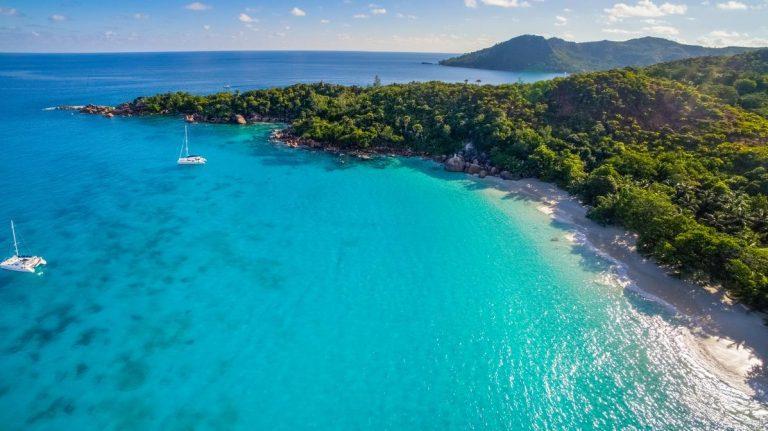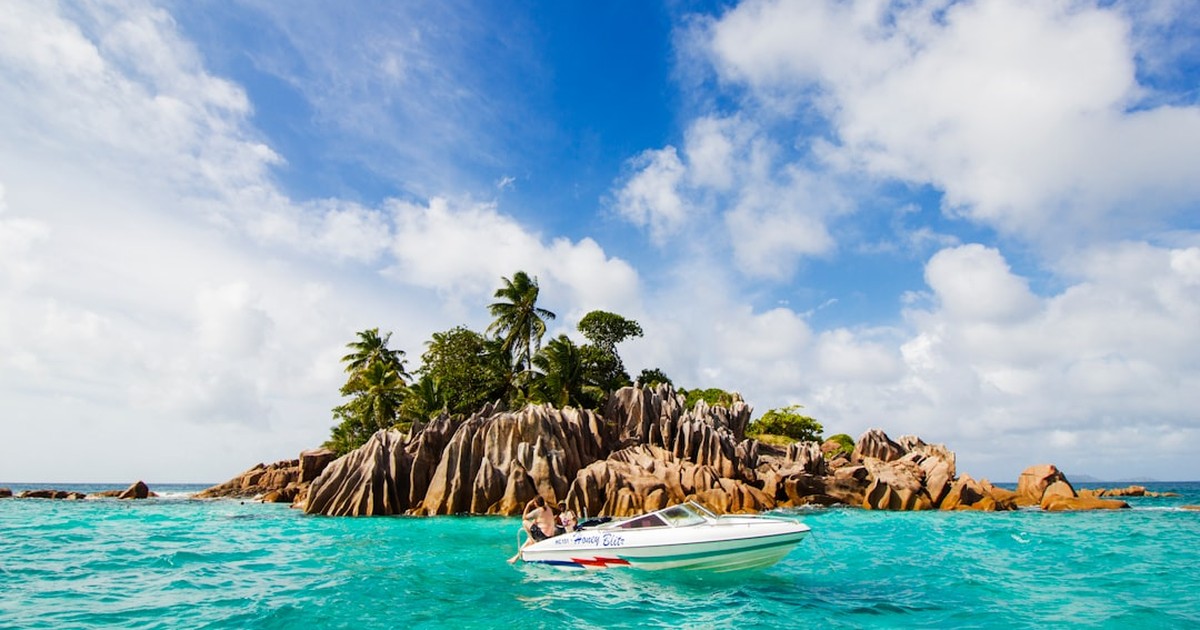
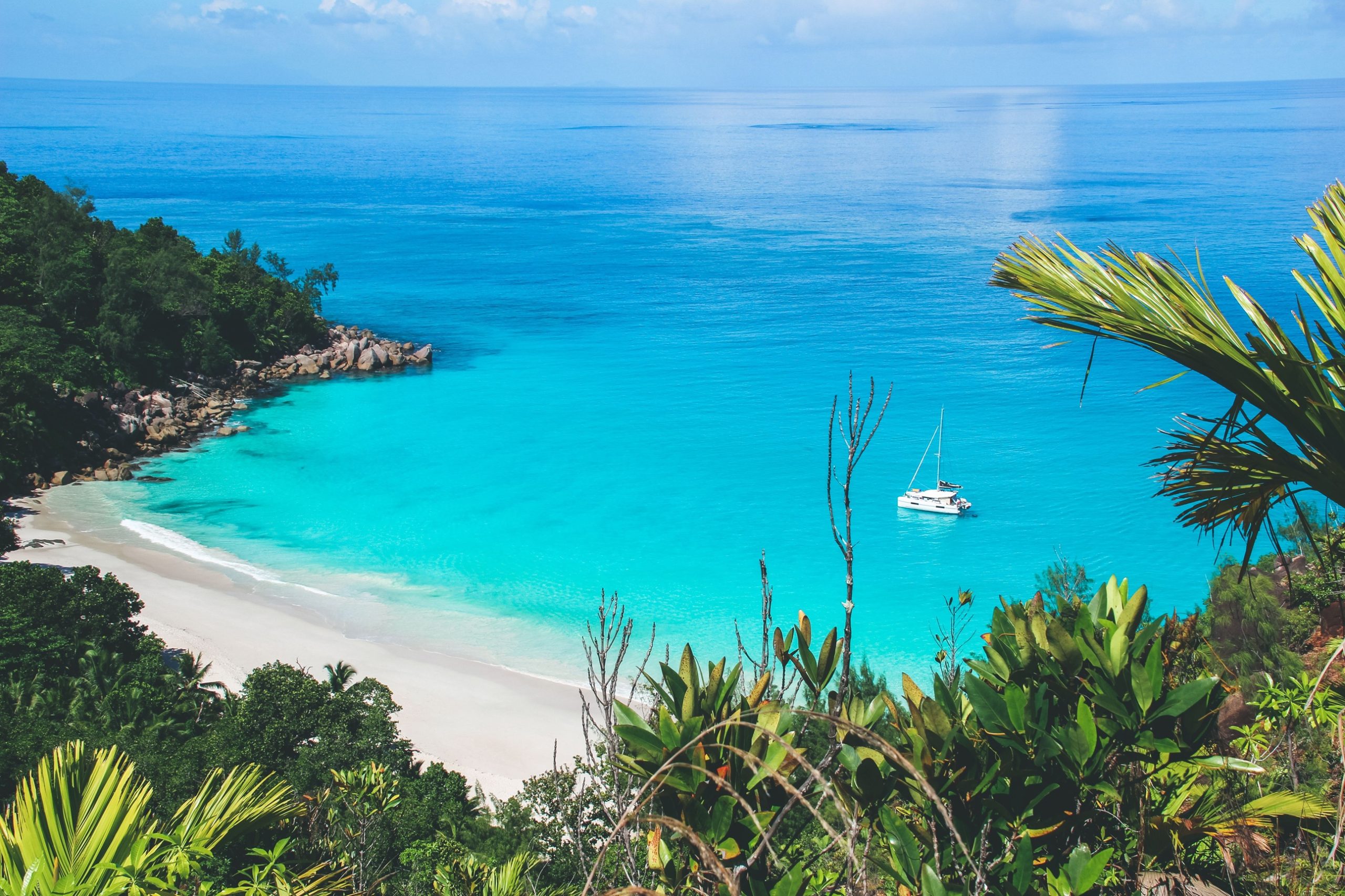
You drop anchor in a lagoon so clear you can count the parrotfish below the keel. Ashore, a beach of pink-white granite boulders backs into a forest of takamaka trees. There are no beach bars, no jet skis, no other boats. This is what a yacht charter Seychelles actually delivers, and it is unlike anything you will find in the Mediterranean or the Caribbean.
The Seychelles sit roughly 1,600 km east of the African coast in the Indian Ocean. The Inner Islands, clustered around Mahé and Praslin, pack a remarkable amount into a compact sailing area of around 80 nm. You can visit UNESCO World Heritage sites, snorkel over pristine coral reefs, watch giant tortoises roam freely, and eat fresh grilled fish on a terrace in the same week. The water temperature sits at 27 to 30°C year-round. Sailing conditions range from flat and gentle to brisk trade-wind passages depending on the season.
This guide covers everything you need to plan your trip: the best months to go, the routes worth doing, how much to budget, whether you need a skipper, and where to base yourself. If you are weighing up whether the Seychelles is right for your group, or just trying to figure out what it will cost, you will find specific answers here.
Why Seychelles is a dream sailing destination
The Seychelles is one of the few places in the world where ancient granite islands rise from a coral-fringed shallow shelf in the middle of the Indian Ocean. The Inner Islands sit on the Mascarene Plateau, which means the sea around Mahé, Praslin, and La Digue is relatively shallow and strikingly clear. Most sailing areas in the world offer either tropical reefs or dramatic topography. Here you get both.
Three things are genuinely only possible from a boat here. First, reaching the quieter outer beaches of Praslin and the Soeur islands without joining a day-trip crowd. Second, anchoring overnight at Ste Anne Marine Park, where you have the reef to yourself after the day boats leave. Third, accessing La Digue’s famous Anse Source d’Argent beach in the early morning before the ferry passengers arrive from Praslin.
The honest challenges: coral reefs demand careful chart work and ideally an experienced skipper who knows the local passages. Squalls can materialize quickly, particularly during the southeast trade wind season from May to September when winds run at 15 to 25 knots. The Seychelles is also a premium-priced destination. Charter costs run meaningfully higher than the Mediterranean, and marine park fees, provisioning, and fuel add up fast.
Compared to the Maldives, the Seychelles offers more variety. The Maldives is flatter, more resort-focused, and has fewer port towns to explore. The Seychelles has real culture, real food markets, and islands with distinct characters. Compared to Thailand or the Caribbean, the Seychelles is more remote and more expensive, but the reefs are in markedly better condition and the anchorages are far less crowded.

Best time to charter in Seychelles
The best months for a yacht charter in Seychelles are April to May and October to November. These transition months fall between the two main monsoon seasons, bringing lighter winds, calmer seas, and lower charter prices than the peak December and January period.
Here is a month-by-month breakdown of what to expect:
January to March (northwest monsoon, winding down)
Winds are light, typically 10 to 20 knots from the northwest. Seas are relatively calm. This is high season because of European winter holidays, so prices peak in December and January and stay elevated through February. Expect crowds at popular anchorages and the best charter boats to be booked well in advance.
April to May (transition, shoulder season)
The northwest monsoon fades and the southeast trades have not yet established. Winds ease to 10 to 15 knots, often variable. Sea conditions are at their most benign. This is the sweet spot: pleasant sailing, manageable prices, and far fewer boats at the best anchorages. April is slightly wetter in the Inner Islands but rarely disrupted by prolonged rain.
June to August (southeast trade winds)
The SE trades blow at 15 to 25 knots consistently. Passages between islands can be choppy, particularly on exposed routes toward the northeast. The wind is reliable and temperatures are slightly cooler, which some sailors prefer. Experienced bareboaters handle this fine, but it is not the right introduction for nervous crews. August can be rough on exposed passages and is worth treating with caution.
September (shoulder season)
The trades begin to ease. September is underrated. Prices drop, anchorages thin out, and conditions improve steadily through the month.
October to November (transition)
The second transition period mirrors April to May. Calm conditions, reasonable prices, and the best light for underwater photography because visibility peaks before any seasonal disruption. This is arguably the best month combination for first-timers.
December
Christmas and New Year push prices to their absolute peak. The northwest monsoon brings calmer conditions, which is why this period is so popular. Book at least six months ahead for December departures.
Best sailing routes in Seychelles
The most practical and rewarding route for most charter groups is the Inner Islands Classic, a 7-day loop from Mahé through Praslin to La Digue and back, covering roughly 80 nm. If you have 10 days and a confident skipper, the Outer Islands liveaboard route opens up some of the least-visited sailing in the Indian Ocean.
Route 1: Inner Islands Classic (Mahé to Praslin to La Digue), 7 days, ~80 nm
This is the route that works for almost every group and skill level. Distances between islands are short, the scenery changes constantly, and you tick off two UNESCO World Heritage sites along the way.
Day 1: Mahé (Victoria) to Ste Anne Marine Park
Provision in Victoria, which has well-stocked supermarkets and a lively market near the waterfront. The sail to Ste Anne Marine Park is barely 5 nm from Berth Eden Island Marina, so you arrive early and have the afternoon for snorkeling. Marine park fees apply at €10 to €15 per person per day. Pay at the park authority before anchoring.
Day 2: Cerf Island and Moyenne Island
Both islands sit within the marine park boundary. Moyenne is home to a private nature reserve with giant tortoises. Cerf has a handful of small guesthouses and excellent house-reef snorkeling on its east side.
Day 3: Praslin
The passage from the marine park to Praslin runs about 35 nm and takes 5 to 6 hours depending on wind. Arrive at Praslin Marina in the afternoon and spend the evening ashore. The Vallée de Mai UNESCO site is a short taxi ride from the marina and is genuinely worth half a day. This is where the Coco de Mer palm grows wild, producing the largest seed in the plant kingdom.
Day 4: Cousin Island and Cousine
Cousin Island is a strict nature reserve and bird sanctuary. Landing requires a guided tour, which must be pre-arranged. The birdlife is extraordinary: fairy terns, tropicbirds, and one of the densest concentrations of breeding seabirds in the region. Anchor off Cousine for lunch and snorkel the reef.
Day 5: La Digue, Anse Source d’Argent
La Digue is 5 nm east of Praslin. Anchor in the bay north of the main jetty and take the dinghy ashore. Anse Source d’Argent is a 20-minute bicycle ride across the island (bikes are the main form of transport on La Digue). The pink granite boulders and shallow turquoise water here are among the most recognizable beach images in the world. Arrive before 9am if you want it to yourself.
Day 6: Grande Soeur and Petite Soeur
The Soeur islands (Grande Soeur is about 4 nm northeast of La Digue) offer some of the best snorkeling on the whole route. The coral is healthy, the fish life is dense, and day-trip boats from Praslin rarely stay past mid-afternoon. Anchor off the northeast tip of Grande Soeur for the best reef access.
Day 7: Return to Mahé via Silhouette Island
Silhouette is a granite island about 20 nm northwest of Mahé, with a single resort and excellent hiking. If your checkout allows, anchor overnight and make the final 10 nm back to Mahé the following morning.
Route 2: Outer Islands Adventure (liveaboard only), 10+ days, ~300 nm
This route is for experienced offshore sailors only, with a qualified skipper and a fully provisioned liveaboard setup. The reward is sailing to Aldabra Atoll, a UNESCO World Heritage Site and one of the world’s largest raised coral atolls, with virtually no other boats and pristine reef ecosystems that have had almost no human impact. Farquhar Atoll is another option on this route.
The 300 nm from Mahé to the outer island group requires proper offshore preparation. Weather routing is serious, and the passages can involve overnight sails. This is not the right choice for first-timers, but for experienced crews it is among the most remote and rewarding sailing in the Indian Ocean.
Yacht charter costs in Seychelles: what to expect
A yacht charter Seychelles costs more than most comparable destinations. A monohull in the 40 to 45ft range runs from €2,500 per week in low season to €6,500 per week in high season. A catamaran in the 42 to 46ft range costs €4,500 to €7,000 per week in low season and €7,000 to €12,000 per week at peak times. These are base charter fees. Budget considerably more for running costs.
Price table: charter costs by yacht type and season
| Yacht type | Low season | High season | Best for |
|---|---|---|---|
| Monohull 40-45ft | €2,500-€4,000/week | €4,000-€6,500/week | 4-6 people |
| Catamaran 42-46ft | €4,500-€7,000/week | €7,000-€12,000/week | 6-10 people |
| Skipper add-on | €200-€250/day | €200-€250/day | Any group |
Low season corresponds broadly to the southeast trade wind period (May to September). High season peaks in December and January.
Catamaran vs. monohull for the Seychelles
The catamaran is the right choice for most groups sailing here. The reasons are practical, not just comfort-related. Catamarans have a shallower draft, which matters when you are nosing into coral lagoons or anchoring in the Ste Anne Marine Park where the bottom comes up fast. The wide deck space is genuinely useful in the heat, giving everyone room to spread out. Stability at anchor in a swell means better sleep and less seasickness for guests who are not regular sailors.
A monohull makes sense for experienced sailors who prefer the sailing performance, or for a couple or small group of four who do not need the extra living space.
What the charter price does not include
The base charter fee covers the boat, standard safety equipment, and basic domestic equipment. The following are almost always extra:
- APA (Advance Provisioning Allowance): typically 30 to 35% of the charter fee on top, covering fuel, marina fees, and provisioning
- Marine park fees: €10 to €15 per person per day in Ste Anne Marine Park
- Skipper: €200 to €250 per day if not already included
- Provisioning: plan €40 to €60 per person per day for groceries and eating ashore occasionally
- Fuel: motoring in light winds or through anchorages adds up quickly in hot weather when you run fans and watermakers
For a group of 6 on a catamaran in shoulder season, a realistic all-in budget is €12,000 to €15,000 for the week before flights.
Do you need a skipper for Seychelles?
Most people chartering in the Seychelles book a skippered yacht, and for good reason. Bareboat charter here requires an ICC (International Certificate of Competence) plus documented offshore experience, and many operators ask for proof of completed offshore passages before they will hand over the keys.
Why this is not a beginner bareboat destination
The Seychelles has coral reefs in most anchorages and on approaches to the islands. Charts are good but not perfect, and the consequences of a grounding in a remote location are serious. The trade wind season brings squalls that can build in under 30 minutes to 25 to 30 knots. Local knowledge about which side of an island to anchor on, and which passages to avoid in certain wind directions, makes a real difference to the quality and safety of the trip.
What a skipper adds
Beyond navigation, a good local skipper knows the best snorkeling spots that are not on any chart, the right time to leave an anchorage to arrive at the next one in daylight, and which beach restaurants are worth the dinghy trip. For a group of 6 to 8, splitting the skipper cost of €200 to €250 per day works out to €30 to €40 per person, which is reasonable given the value added.
Who can go bareboat
If your skipper holds a competence certificate equivalent to RYA Coastal Skipper or above, has offshore passage experience in tidal and open-water environments, and has handled boats in reef environments before, the charter companies will consider you. Go through the application process honestly and be prepared to provide logbook evidence.
Cabin charter option
Several operators offer cabin charters on crewed yachts, where you book one or two cabins rather than the whole boat. This works well for couples or solo travelers who want to experience sailing Seychelles without organizing a group.
Main charter bases in Seychelles
The two main islands for charter departures are Mahé and Praslin. Mahé handles the large majority of charter traffic because it has the main international airport and the most charter companies.
Mahé (Victoria)
Victoria is the capital and the practical hub for provisioning, flights, and charter briefings. Berth Eden Island Marina is the main modern marina facility, located on a reclaimed island just northeast of Victoria. It has secure berths, shore power, water, wi-fi, and a good range of restaurants and bars within walking distance. Most of the major charter companies are based here or have their boats berthed here. The supermarket access in Victoria is the best in the Seychelles, which matters when you are stocking up for a week at sea.
Praslin
Praslin Marina is a smaller facility on the island’s east coast. Praslin is the second largest island and has its own airport with regional connections. Starting a charter from Praslin puts you closer to La Digue and the Soeur islands from day one, which suits tighter itineraries. A handful of charter operators are based here, though the selection of boats is more limited than Mahé.
Getting to Seychelles for your charter
The main entry point for international flights is Seychelles International Airport (SEZ), located on Mahé just 8 km south of Victoria and Eden Island Marina. Transfer time from the airport to the marina is 15 to 20 minutes by taxi.
Direct flights operate from Paris (Air France and Air Seychelles), Frankfurt (Condor and Lufthansa seasonal), London Heathrow (British Airways), and Dubai (Emirates). Flight time from Europe is roughly 9 to 11 hours. From Asia, connections via Dubai or Singapore are common.
Practical tip: always arrive in Mahé the day before your charter start date. International flights frequently arrive late, and a missed charter briefing or late provisioning run creates problems that follow you through the whole trip. Most charter companies are happy to facilitate early storage of luggage on the boat if you arrive before the handover time.
If you are starting from Praslin, Seychelles Air operates short turboprop flights from SEZ that take around 15 minutes. The alternative is the inter-island ferry, which takes around one hour.
Find charter yachts in Seychelles
Searadar searches across the top charter platforms so you can compare real availability and prices for the Seychelles in one place, including both bareboat and skippered options, monohulls and catamarans.
Find Your Perfect Charter
Compare yachts, catamarans and prices from top charter companies in one search.
Powered by Searadar · No booking fees
Charter availability in the Seychelles during December and April fills up fast. For peak-season departures, booking 6 months ahead is realistic. Shoulder season gives you more flexibility, but the best boats still go early.
Frequently asked questions
How much does a yacht charter in Seychelles cost?
A monohull charter in the Seychelles costs €2,500 to €4,000 per week in low season and €4,000 to €6,500 in high season. A catamaran runs €4,500 to €7,000 per week in low season and €7,000 to €12,000 at peak times. Add a skipper at €200 to €250 per day, plus provisioning, fuel, and marine park fees. A realistic all-in budget for 6 people on a catamaran in shoulder season is €12,000 to €15,000 for the week.
Do I need sailing experience to charter in Seychelles?
You do not need sailing experience if you book a skippered charter, which most visitors do. Bareboat charter requires an ICC certificate and documented offshore experience, and operators typically ask for logbook proof before issuing a contract. The Seychelles has coral reefs, fast-forming squalls, and complex anchorage approaches that make it a poor choice for inexperienced bareboaters. First-timers are strongly advised to book skippered.
What is the best time of year for sailing Seychelles?
The best time is April to May and October to November. These transition months between the northwest monsoon and the southeast trades offer lighter winds of around 10 to 15 knots, calmer seas, and lower prices than the December to January peak. The southeast trade wind season from June to August brings consistent 15 to 25 knot winds that are manageable for experienced sailors but can make exposed passages uncomfortable for mixed-experience crews.
Should I book a catamaran or monohull for the Seychelles?
A catamaran is the better choice for most groups sailing Seychelles. The shallower draft suits the coral lagoon anchorages around the Inner Islands. The wider deck is genuinely useful in 30°C heat, particularly for groups of 6 or more. Stability at anchor reduces seasickness for guests who do not sail regularly. Monohulls cost less per week and are a good option for experienced sailors or smaller groups of 4 who prioritize sailing performance over space.
What is included in a Seychelles yacht charter?
The base charter fee includes the boat, safety equipment, dinghy and outboard, and standard domestic inventory. It does not include the skipper, fuel, marina fees, provisioning, or marine park entry fees. Charter companies typically require an APA of 30 to 35% of the charter fee on top of the base price to cover running costs. Marine park fees in Ste Anne Marine Park run €10 to €15 per person per day and must be paid at the park authority.
How far in advance should I book a Seychelles charter?
For December and January departures, book at least 6 months ahead. The best catamarans at reputable charter companies in these peak months book out by June for the following winter season. Shoulder season in April to May or October to November gives you more flexibility, but 3 to 4 months ahead is still advisable if you want a specific boat type or departure date. Last-minute availability exists but you are unlikely to find the vessel you want.