When choosing between a bareboat or skippered charter, you're deciding whether to captain the yacht yourself or hire a professional to handle the sailing. A bareboat charter puts you in command, requiring valid sailing certifications and practical experience to navigate independently. A skippered charter includes a qualified captain who manages all operations, navigation, and safety while you enjoy the voyage without needing sailing skills.
Bareboat appeals to experienced sailors seeking autonomy and the satisfaction of commanding their own vessel. Skippered charters suit beginners, families, or anyone who prefers local expertise and a stress-free experience.
Bareboat vs skippered charter: what's the difference?
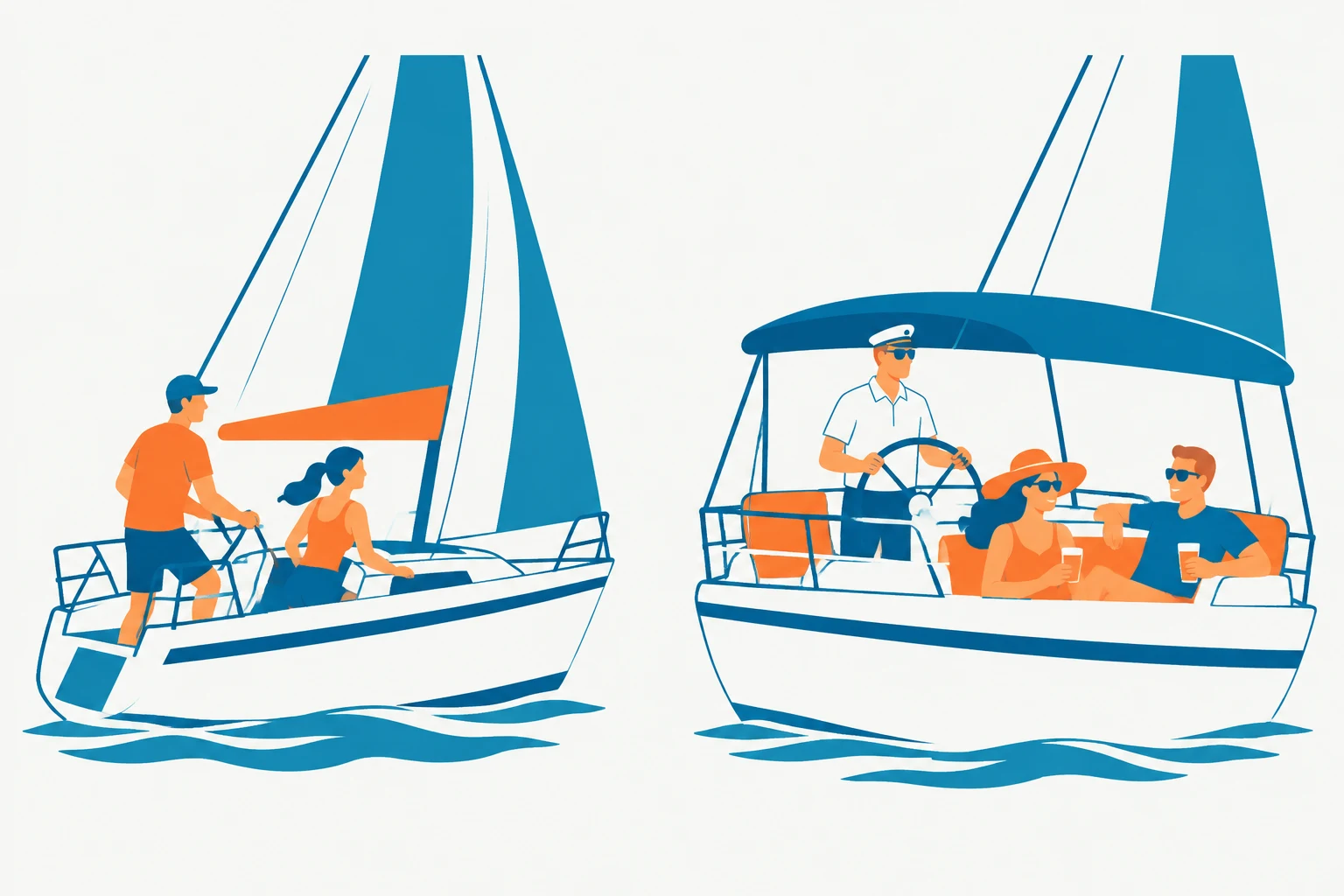
A bareboat charter means you rent the yacht without crew and captain it yourself. You take full responsibility for navigation, safety, and operating the vessel. A skippered charter includes a professional captain who handles all sailing duties while you relax as a passenger.
With a bareboat, you plan the route, manage the sails, dock the yacht, and make all decisions. A skippered charter removes these requirements. The hired captain navigates, operates the boat, and ensures safety. You need no sailing qualifications. The skipper typically knows the local waters and can suggest anchorages, restaurants, and hidden spots.
Comparing costs: is bareboat or skippered charter cheaper?
| Cost Category | Bareboat Charter | Skippered Charter |
|---|---|---|
| Yacht Rental Fee | Lower | Higher |
| Skipper Fee | Not applicable | Included |
| Crew (Cook, Host) | Optional, Extra | Often Included |
| Provisioning | Your responsibility | Can be arranged |
| Fuel | Your responsibility | Often extra |
| Mooring/Docking | Your responsibility | Often extra |
| Insurance | Included (basic) | Included (basic) |
| Security Deposit | Required | Varies by operator |
| End Cleaning | Often extra | Often included |
| Total Cost | Generally Lower | Generally Higher |
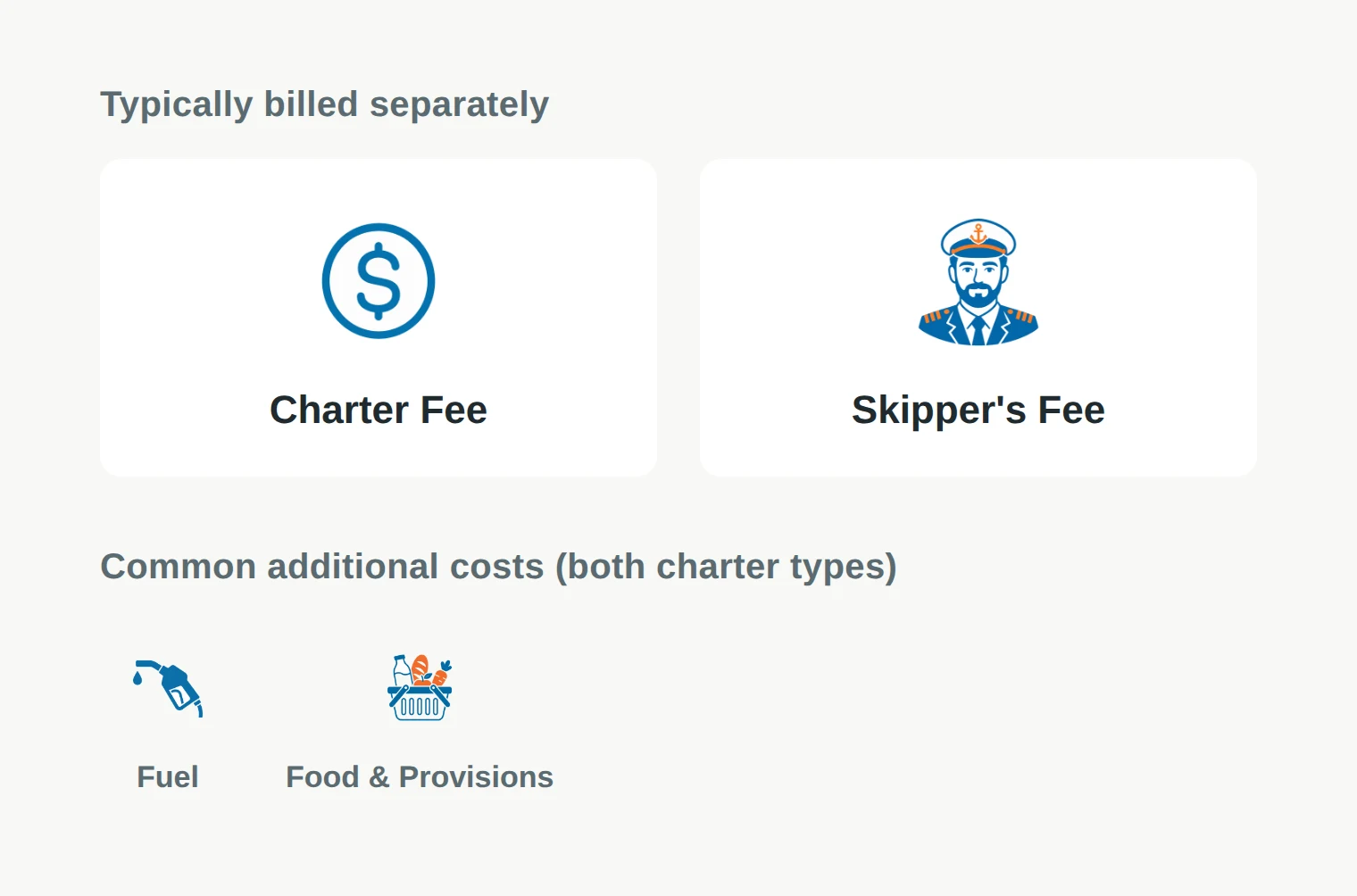
Bareboat charters typically cost less upfront, with weekly rates ranging from $2,000 to $8,000 depending on yacht size and season. Skippered charters add $150 to $250 per day for the captain's fee, plus 10-20% gratuity, increasing total costs by roughly $1,200 to $2,500 per week.
Bareboat charters require higher security deposits ($2,500 to $5,000) and often mandate damage waiver insurance, adding $200 to $500 weekly. Skippered charters reduce deposit requirements since the professional captain assumes responsibility, but you must provision meals for the skipper, typically adding $30 to $50 daily to your food budget. Marina fees, fuel, and mooring costs apply to both charter types equally.
The financial decision hinges on whether the skipper's fee justifies stress-free navigation, local knowledge, and reduced insurance liability. For groups splitting costs, the per-person difference often becomes negligible.
Sailing qualifications and legal requirements: do you need a license?
Bareboat charters require proof of sailing competency, though specific requirements vary by country and charter company. Most charter operators ask for a recognized sailing certification (RYA Day Skipper, ASA 104, IYT Bareboat Skipper, or equivalent) plus a sailing resume documenting your experience with similar-sized vessels. Greece and Croatia typically require ICC (International Certificate of Competence) or national equivalents.
The British Virgin Islands and many Caribbean destinations accept ASA or RYA certifications without additional licenses. Turkey and some Mediterranean countries may require radio operator licenses for VHF use.
Charter companies evaluate your sailing resume alongside certifications. They want to see documented miles, night sailing experience, and familiarity with boats similar in size and type to what you're chartering. A 40-foot catamaran requires more demonstrated experience than a 32-foot monohull. First-time bareboat charterers often face checkout sails where a company representative assesses your skills before handing over the boat.
Skippered charters eliminate all qualification requirements. The professional captain holds the necessary licenses and assumes legal responsibility for the vessel.
Pros and cons of bareboat and skippered charters
| Feature | Bareboat Charter (Pros) | Bareboat Charter (Cons) | Skippered Charter (Pros) | Skippered Charter (Cons) |
|---|---|---|---|---|
| Control | Complete freedom over itinerary and activities. | Full responsibility for navigation, safety, and vessel. | Relax and let the expert handle navigation and safety. | Less control over the exact itinerary and pace. |
| Cost | Generally more affordable as you're not paying for a skipper. | Potential for unexpected repair costs if damage occurs. | Higher upfront cost due to skipper's fee. | Can feel less "private" with an additional person onboard. |
| Experience | Develop sailing skills, sense of accomplishment. | Requires significant sailing experience and certifications. | Learn from an experienced local skipper, discover hidden gems. | May limit opportunities to practice your own sailing skills. |
| Privacy | Maximum privacy and intimacy with your group. | No local insights or recommendations from a professional. | Local knowledge and recommendations from the skipper. | Less privacy than a bareboat charter. |
| Relaxation | Can be stressful if unexpected issues arise. | Requires active participation in all aspects of the charter. | Fully relaxing, no responsibilities for sailing or maintenance. | May feel less adventurous or challenging. |
| Safety | Full responsibility for crew and vessel safety. | Higher risk if experience is insufficient or conditions are challenging. | Enhanced safety with an experienced professional at the helm. | Reliance on the skipper's judgment and expertise. |
| Flexibility | Can change plans on a whim (weather permitting). | Must be self-reliant for all decision-making. | Skipper can adapt to your preferences and conditions. | Still bound by the skipper's professional judgment. |
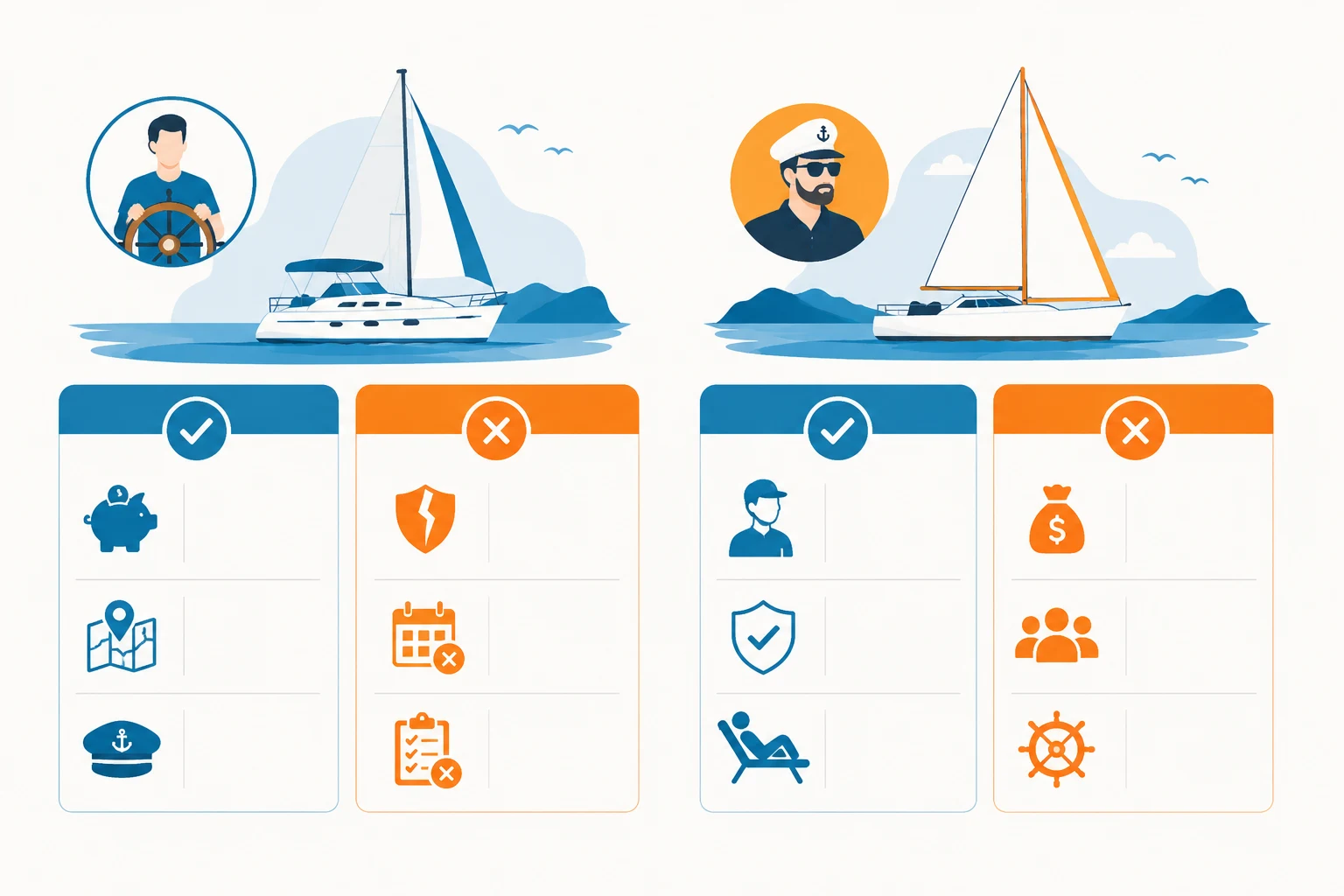
Bareboat charters offer complete freedom to set your own itinerary, anchor in secluded bays, and change plans without consulting anyone. You get total privacy on board and the satisfaction of captaining your own vessel. The downside is the responsibility: you handle navigation, weather decisions, mooring, and any mechanical issues.
Skippered charters eliminate sailing stress entirely. The captain handles all technical aspects, provides local knowledge about hidden anchorages and restaurants, and serves as a safety net for weather and navigation decisions. The tradeoff is reduced privacy, since the skipper lives aboard, and less flexibility in your schedule.
Bareboat suits confident sailors who value autonomy and have cruised similar boats in comparable conditions. Skippered charters fit first-time charterers, families with non-sailing members, groups exploring new cruising grounds, or anyone prioritizing relaxation over hands-on sailing.
What to expect onboard: responsibilities and experience
On a bareboat charter, you handle everything: setting and adjusting sails, navigating, monitoring weather, anchoring, docking, and troubleshooting mechanical issues. You're responsible for provisioning before departure, typically spending 2-3 hours at a local supermarket or arranging delivery through the charter company. You plan your itinerary based on weather forecasts, distance calculations, and marina availability.
Skippered charter guests focus on relaxing while the captain manages all sailing operations and safety considerations. You discuss preferred destinations with the skipper, who adjusts the itinerary based on conditions and local knowledge. Provisioning still falls to you, but the captain often accompanies you to suggest quantities and help transport supplies. Your main responsibilities are meal preparation (including for the skipper), keeping communal areas tidy, and respecting the captain's safety decisions.
Which charter is best for families and groups?
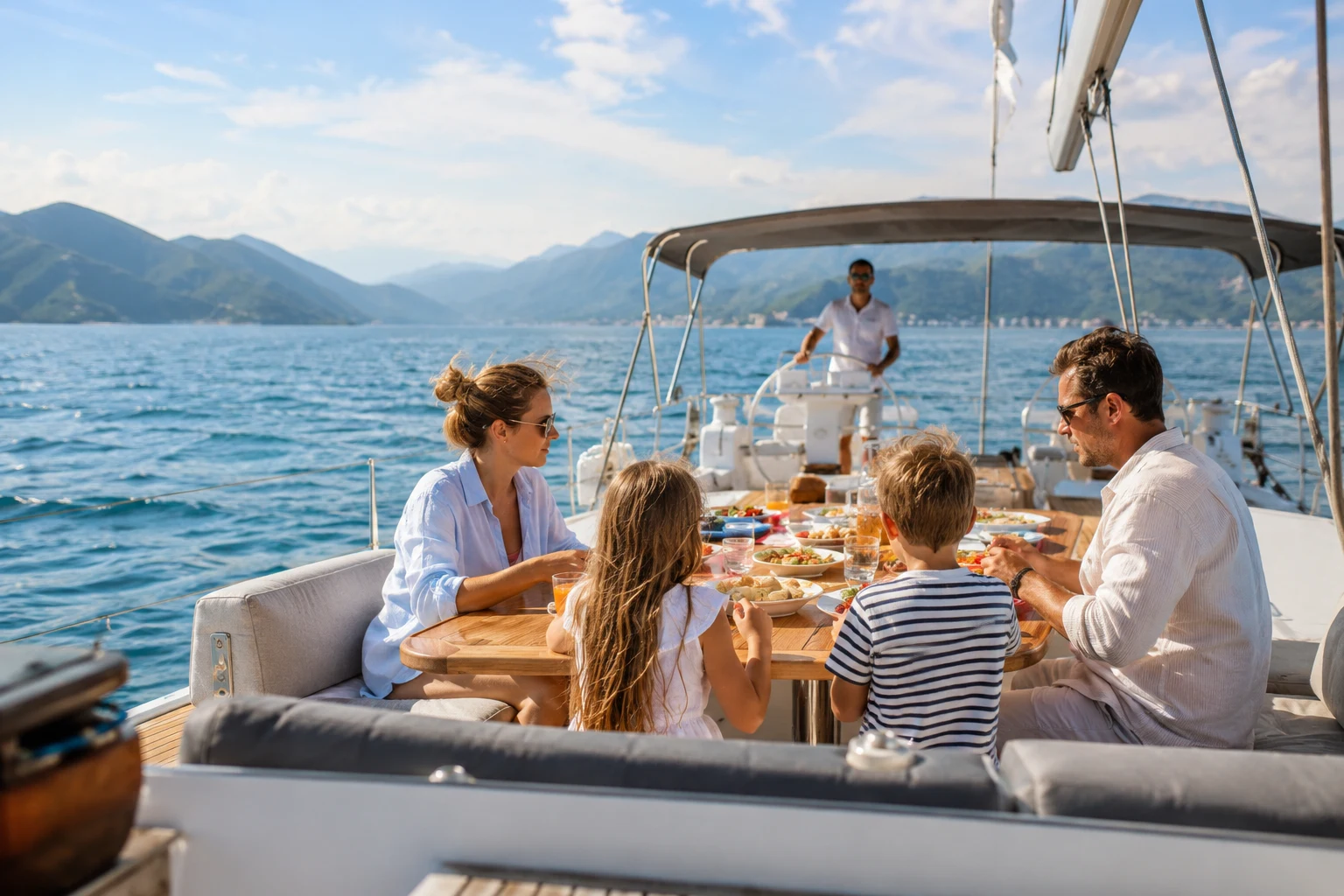
Skippered charters work better for most families with children or mixed-skill groups because the captain handles sailing while everyone focuses on enjoying the trip. The skipper can teach interested family members, suggest family-friendly anchorages, and manage safety without parents splitting attention between kids and navigation.
Group size directly affects which option makes sense. Yachts accommodating more than 12 people legally require a professional captain regardless of your qualifications. For groups of 8-12, splitting the cost across more people often makes the price difference minimal, while the skipper adds value by freeing everyone to socialize rather than rotating through sailing duties.
Popular destinations and when to choose each charter type
The British Virgin Islands and Greece's Saronic Gulf are classic bareboat destinations, offering protected waters, short passages between islands, and straightforward navigation. Skippered charters excel in challenging areas like Croatia's Adriatic coast, where local knowledge of mooring customs and hidden anchorages adds significant value. Turkey's strict maritime regulations and Thailand's monsoon patterns make skippers particularly useful.
Your trip style matters more than the location. Bareboat works for experienced crews prioritizing privacy and flexible schedules. Skippered fits learning-focused trips, family vacations where adults want to relax, or exploring unfamiliar yacht types like catamarans in new waters.
Tips for booking: insurance, partial skippers and more
Charter insurance is essential regardless of charter type. Most companies require a damage waiver ($200-$500 weekly for bareboat, often included in skippered rates) that covers minor damage but excludes major incidents like grounding or collision. Consider supplemental insurance through providers like Yacht Policy or Pantaenius for comprehensive coverage.
Review the charter agreement carefully before signing. Check cancellation policies, security deposit terms, included equipment, and your liability limits. Verify what the base rate covers and what costs extra.
Choose charter companies with strong online reviews on platforms like Trustpilot or sailing forums. Established operators like Sunsail, Moorings, or local specialists typically maintain better-serviced fleets and clearer contracts.
Frequently asked questions
Can you hire a skipper for part of a bareboat charter?
Some charter companies offer partial-skipper arrangements, particularly for challenging routes or the first few days of your trip. This gives you flexibility to learn the yacht and local waters before going solo. You must arrange this in advance, as it may affect insurance terms, deposit requirements, and overall charter cost.
What is not included in a bareboat charter?
Bareboat charters exclude crew, skipper, food, fuel, mooring fees, and often linens or water toys. You handle all provisioning, navigation, route planning, and safety procedures. The base charter fee covers only the yacht itself, plus basic equipment like life jackets and navigation tools.
What is a ship without a captain called?
A vessel without a captain is called a 'bareboat' in charter terminology. The charterer assumes full responsibility as skipper, handling navigation, safety, and all operational decisions.
What are the 4 types of charter?
The four main charter types are bareboat (self-skippered), skippered (captain provided), crewed (full crew including chef and deckhands), and cabin charter (booking individual cabins on shared yachts). Each option offers different levels of service, privacy, and independence.
If you hold recognized certifications, have logged recent offshore hours, and crave the autonomy of charting your own course, bareboat delivers unmatched freedom. If you lack qualifications, want to focus on swimming and meals rather than navigation, or plan to explore waters with challenging currents and regulations, a skippered charter removes operational stress entirely. Contact charter companies with your sailing resume and destination in mind to confirm whether your experience meets bareboat requirements or if they recommend a skipper.