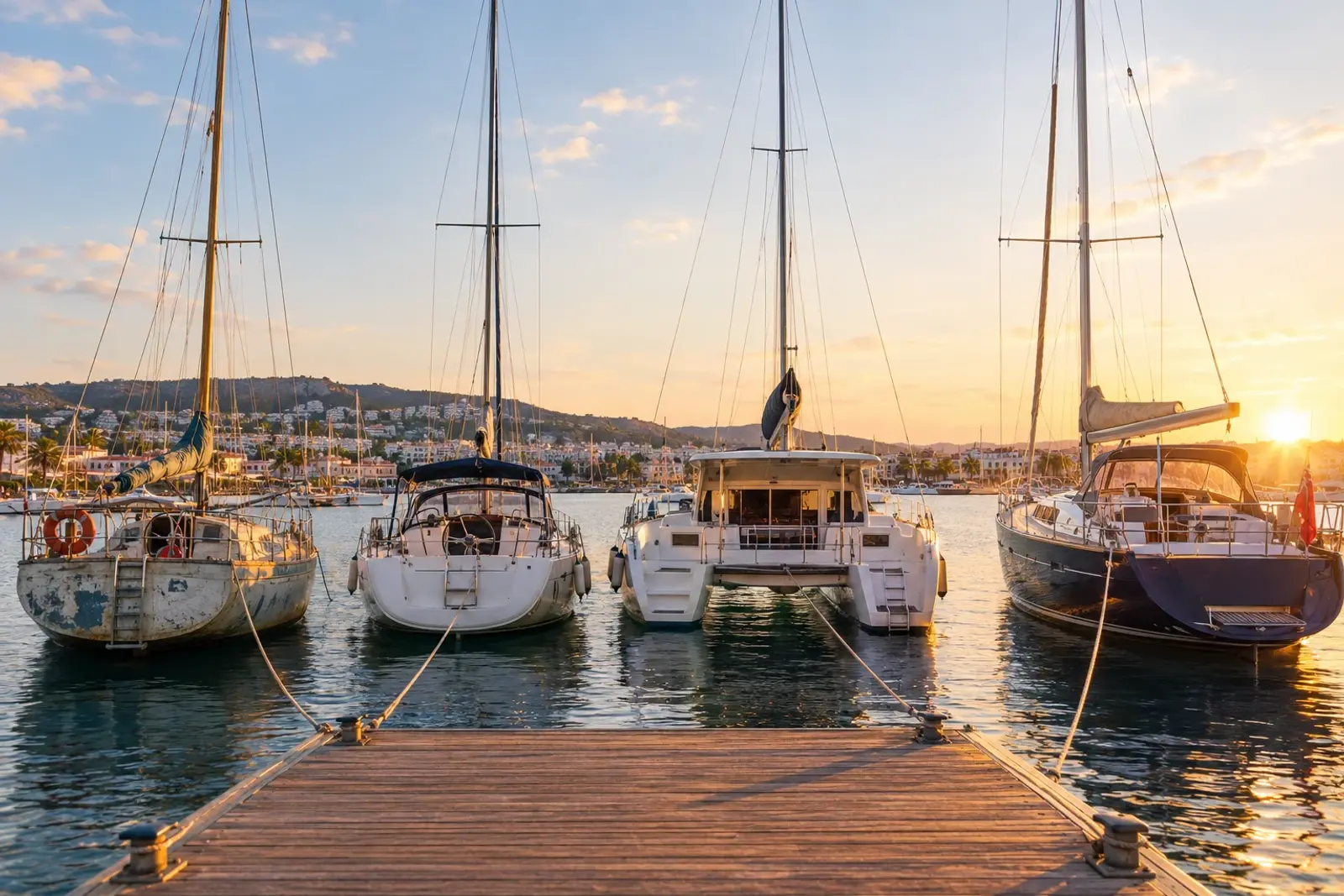
Yacht charter cost in Spain runs roughly 350 to 2,500 euros a week for a bareboat sailboat depending on season, 2,500 to 6,000 euros skippered, and 3,500 to 9,000 euros or more for a catamaran. How much it costs to charter a yacht in Spain depends on boat size, season, and whether VAT, APA, and crew gratuity are already folded into the quote or billed separately.
That range covers everything from an older bareboat sailboat off-season to a crewed catamaran in peak August. The sections below break down pricing by boat type, charter type, season, and region, along with what a quote actually includes before any extra fees show up.
How much does a yacht charter cost in Spain?
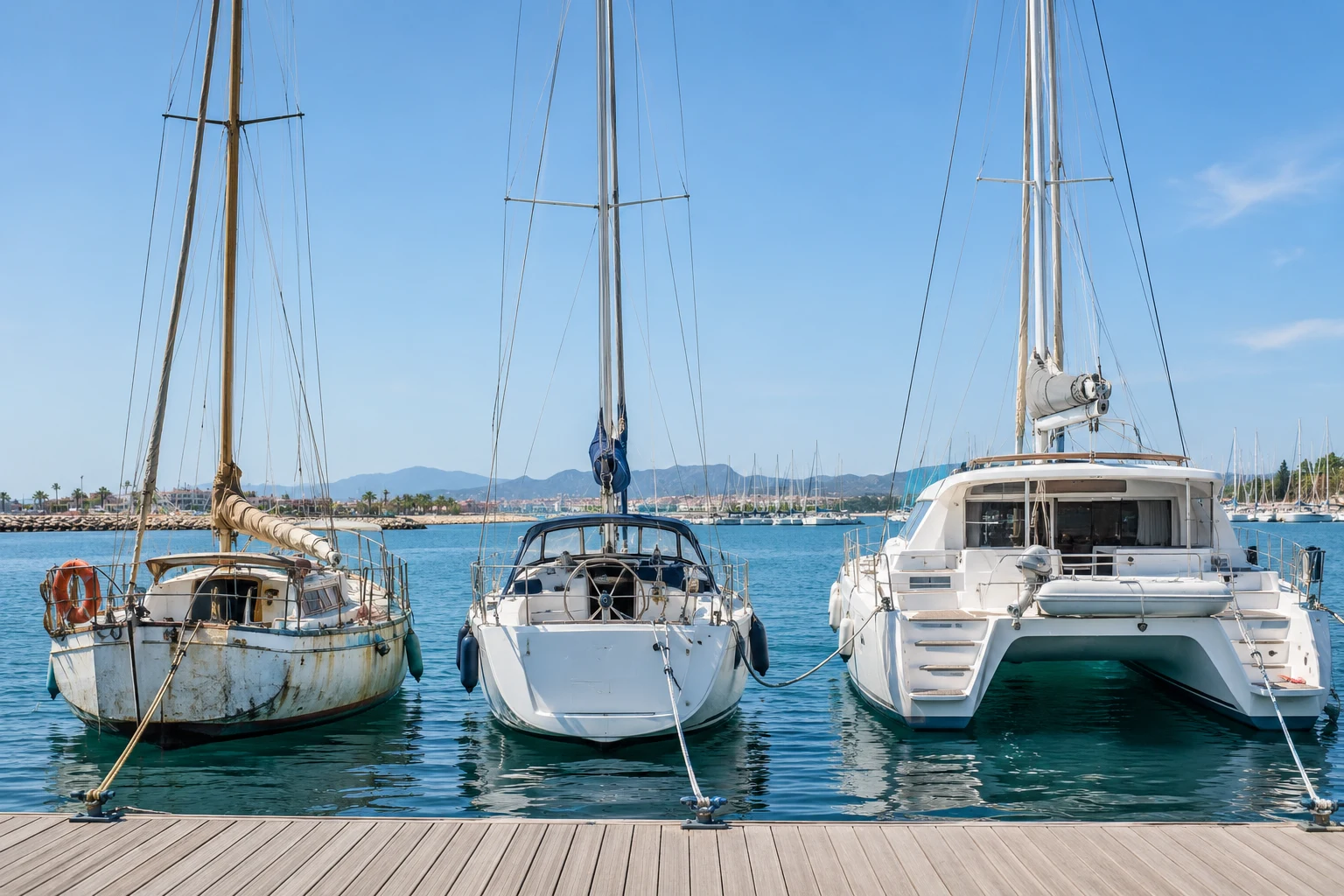
| Boat type | Typical weekly price (EUR) | Typical group size |
|---|---|---|
| Bareboat sailboat | 350 - 2,500 | 2-8 |
| Skippered sailboat | 2,500 - 6,000 | 2-8 |
| Catamaran | 3,500 - 9,000+ | 4-10 |
| Crewed sailing yacht | 6,000 - 20,000+ | 4-10 |
The table above sets the baseline; the figures below cover why the range is wide.
That low bareboat floor reflects smaller, older boats available outside the main season, not a typical liveaboard week. Most charterers booking a comfortable 38-40 foot sailboat in season should expect figures closer to the middle of these ranges.
Crewed charters on larger sailing yachts and catamarans scale well past these numbers, adding a chef, hostess, or extra deckhand depending on the boat. A 50-foot crewed catamaran in peak summer can run several times the bareboat rate for a comparable length.
Boat age moves the price almost as much as boat type. A newer catamaran commands a real premium over a decade-old boat of the same model and length.
What's included in the price — and what costs extra
Spain adds 21% VAT to the base charter fee, a cost that catches many first-time charterers off guard when comparing a headline rate between companies.
On top of that, an Advance Provisioning Allowance (APA) of 25 to 35 percent of the base fee is common on larger or crewed boats. It covers fuel, food, and drinks during the week, with any unused balance refunded at the end.
Marina fees and fuel sit outside the base fee on most bareboat and skippered charters, billed based on actual use rather than a flat rate. A refundable security deposit, typically held against damage, also applies regardless of charter type.
Crew gratuity, where a skipper or crew is involved, runs 10-15 percent of the base fee, paid directly to the crew in cash, separate from every other cost here.
Bareboat vs skippered vs crewed: how charter type changes the price
| Charter type | Required | Typical weekly price (EUR) | Who it suits |
|---|---|---|---|
| Bareboat | Sailing licence + VHF cert | 350 - 2,500 | Licensed, experienced sailors |
| Skippered | None | 2,500 - 6,000 | No licence, want to sail hands-on |
| Crewed | None | 6,000 - 20,000+ | Full service, no sailing involved |
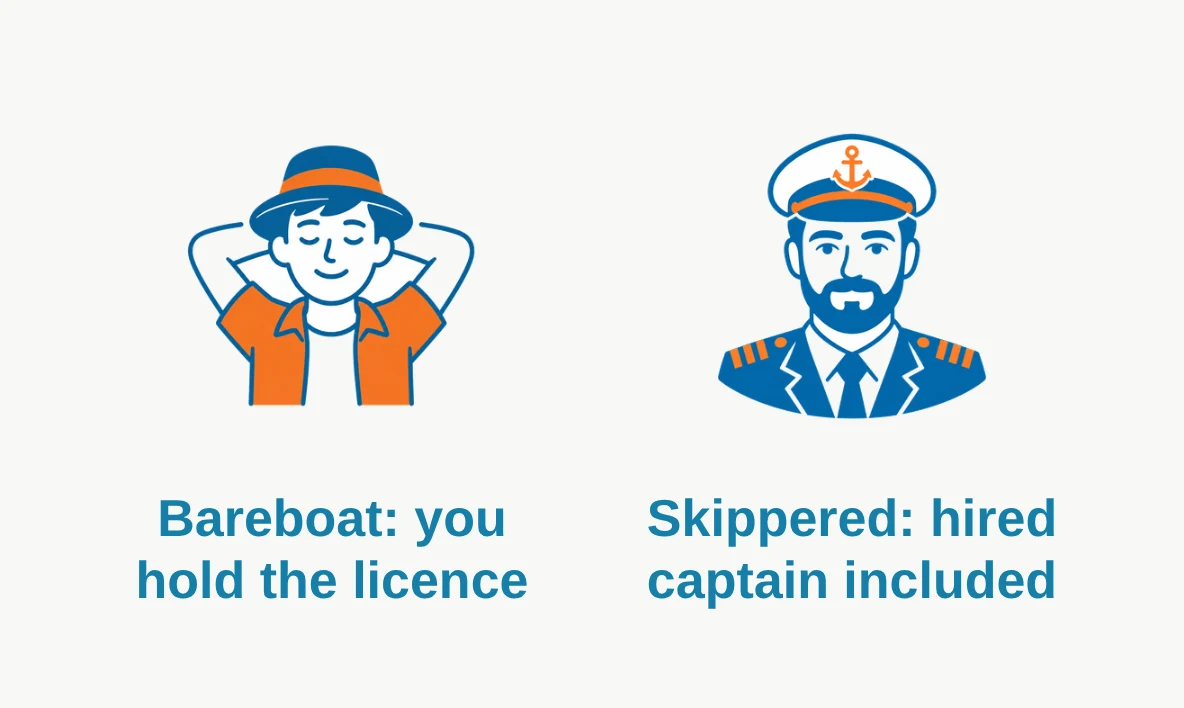
Bareboat needs a valid sailing licence, usually an International Certificate of Competence (ICC) or equivalent, plus a VHF radio operator's certificate, before a company hands over the keys.
Skippered drops the licence requirement: a professional skipper joins for a daily fee on top of the base rate, handling navigation and docking.
Crewed goes further, adding a chef, hostess, or extra deckhand depending on boat size. This is where price scales fastest: a small crewed sailboat might add 20-30 percent over bareboat, a large crewed catamaran several times the rate for the same length.
The right choice depends on experience and budget more than destination. Confident, licensed sailors save the most going bareboat, while anyone without a licence needs a skipper or crew regardless of how much they want to spend.
How much does a skipper cost in Spain?
A professional skipper typically adds a daily fee on top of the base charter rate, charged for every day of the charter rather than folded into a single weekly number.
Rates vary by boat size and season: a larger catamaran in peak summer costs more to skipper than a small sailboat in May or June.
Some charter companies quote the skipper fee as part of an all-in package, while others list it separately on top of the boat rate, so it's worth confirming which applies before comparing two quotes.
Does season affect the price?
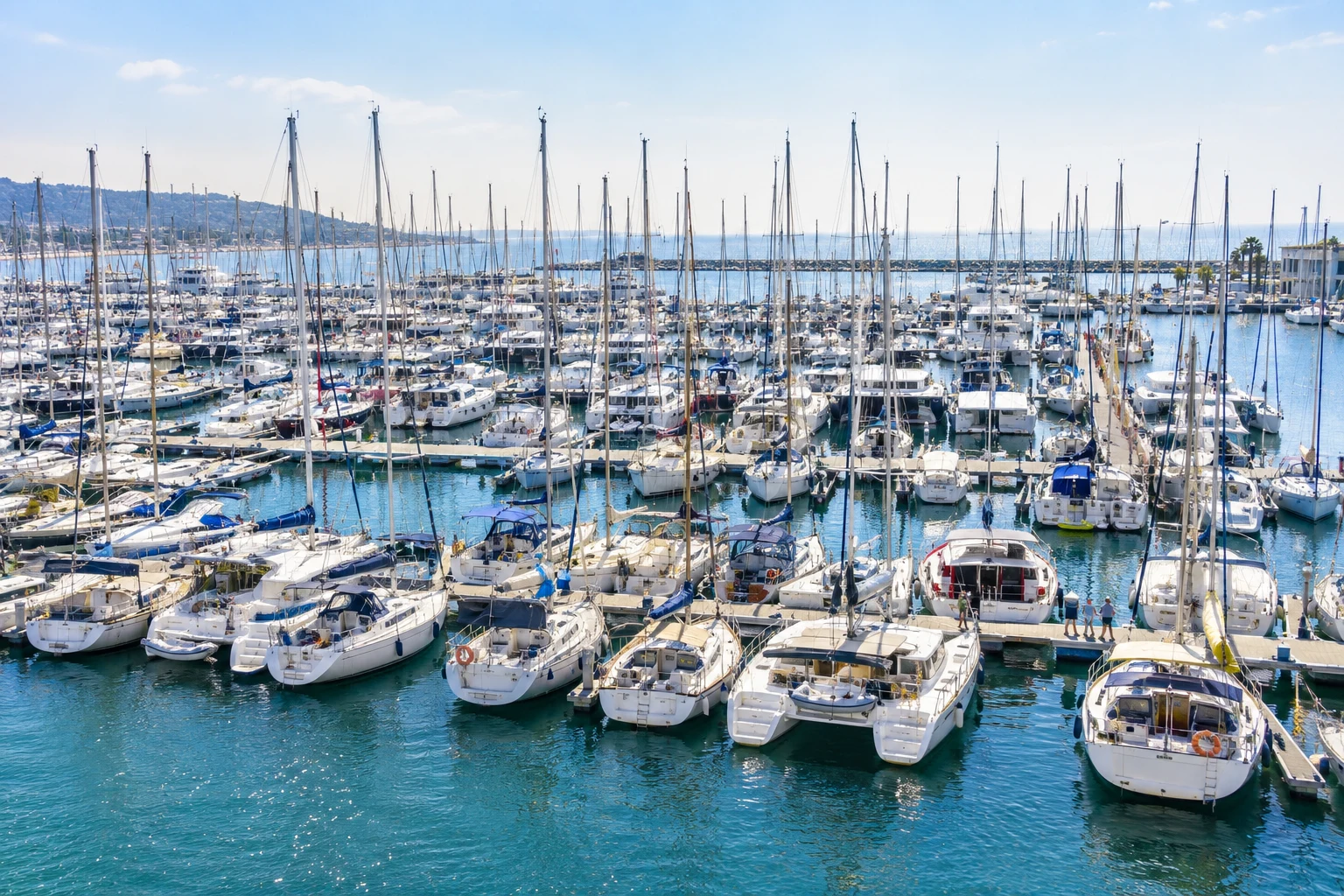
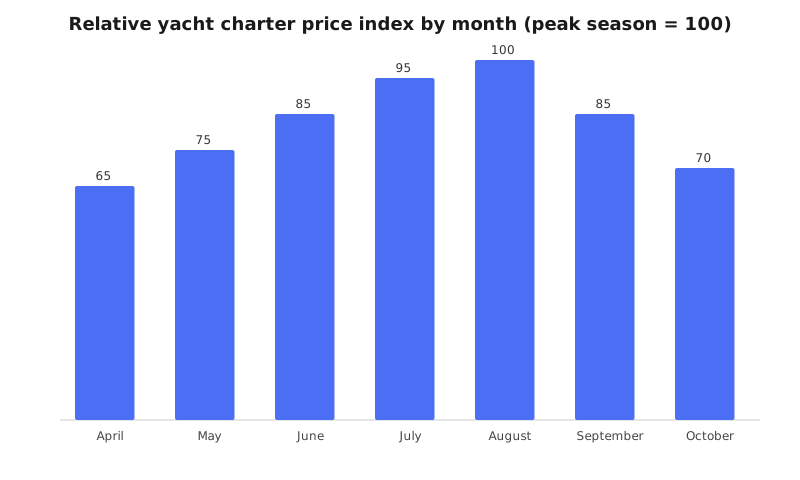
July and August carry the highest rates of the year in Spain, driven by school holidays and the most reliable summer sailing weather.
May, June, and September make up the shoulder season: good weather, far more availability, and rates well below the July-August peak.
Outside the main April-October season, rates can undercut shoulder-season pricing substantially, though far fewer operators run charters at all during these colder months on most of mainland Spain.
Booking early for peak summer still matters even with flexible dates: the best boats at any price point get reserved months ahead.
Does region change the price? Balearics vs mainland vs Canary Islands
The Balearic Islands carry the largest charter fleet in Spain, and that scale keeps per-boat pricing competitive despite being the most popular region in the country.
Mainland regions like Costa Brava and Costa del Sol run comparable to slightly lower than the Balearics, with lower marina fees offsetting longer coastal runs.
The Canary Islands work differently: the only region with a genuine winter charter market, where prices can carry a premium in colder months since demand doesn't drop off like elsewhere.
Region matters less than season for the final price on most routes, but it's worth checking both before assuming one destination is automatically cheaper than another.
How to keep your Spain yacht charter costs down
Moving the trip to shoulder season, May, June, or September, cuts the base rate noticeably compared with July and August without losing reliable sailing weather.
An all-inclusive quote costs more upfront but removes the risk of an APA running higher than expected or a surprise fuel bill after a windy week of motor-sailing.
A half-empty boat wastes the fixed costs of the charter. Filling every berth splits the same weekly fee, skipper cost, and APA across more people, lowering the price per person more than almost any other decision.
Bareboat and flotilla sailing, where a licensed sailor in the group takes the helm, skip the crewed-charter premium entirely. For a group that already holds a sailing licence, this is the single biggest lever on the final bill.
Frequently asked questions
Is yacht charter cheaper in Spain than in Greece or elsewhere in the Mediterranean?
Spain is broadly comparable to Greece and Croatia for similar boats, with pricing driven more by boat age and season than by country. Spain's 21 percent VAT runs higher than some neighboring countries, which can offset otherwise similar base rates. The Balearics specifically compete closely with Greece's most popular islands on price.
How much is a short 3-day yacht charter in Spain?
Daily rates for short charters run higher per day than a full week works out to. A 3-day charter typically costs 40 to 55 percent of the full weekly rate rather than a simple fraction of it. Many operators set a minimum charter length of 3 to 4 days outside peak season, a full week in July and August.
What is the 12-guest rule on a charter yacht?
Commercially licensed charter yachts in Spain and most of the Mediterranean carry a maximum of 12 paying guests. A larger group needs two boats or a bigger, commercially-coded vessel. The limit is a safety and certification rule, not a pricing tier that changes with what you pay.
Is it really cheaper to charter in low season?
Yes, outside the April-October main season, rates drop well below even shoulder-season pricing where sailing remains practical. Far fewer boats and operators run charters at all in deep winter on most of mainland Spain. The Canary Islands are the main exception, with a genuine winter charter market.
Do I need to tip the crew on top of everything else?
Crew gratuity of 10 to 15 percent of the base charter fee is customary on skippered and crewed charters. It's paid directly to the crew in cash, separate from the charter fee, APA, and security deposit. Gratuity isn't legally required but is a strongly followed convention in the charter industry.
Settle on a charter type before comparing prices. A licensed sailor in the group saves the most going bareboat, while anyone without a licence should budget for a skippered or crewed rate and stop comparing those quotes against bareboat numbers.
Once you have a shortlist, ask each operator the same two questions: is this all-inclusive or plus expenses, and what's the APA percentage. Those two answers let you compare quotes on equal terms instead of being misled by a lower headline price.
If the dates are flexible, move the trip into May, June, or September first. That single change saves more than any other decision on this page, short of switching from a crewed boat to a bareboat one.
Explore next
Destination guide
Spain
Sail the Balearic Sea and the Spanish Mediterranean, where calm coves, lively ports, and steady breezes shape every leg of the journey.