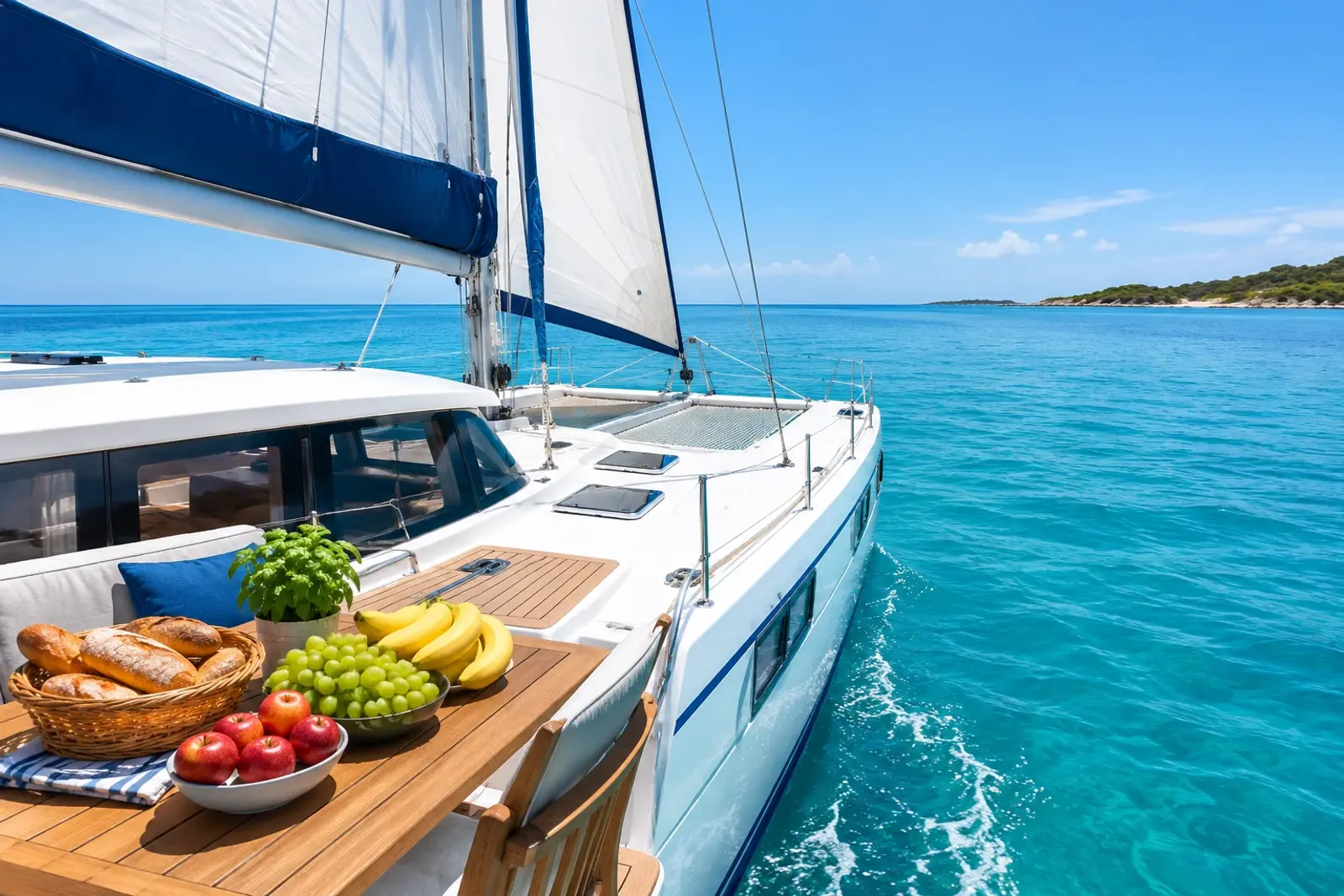
A yacht charter provisioning guide details how to plan, source, and store food and essentials for your sailing trip, including meal planning, shopping lists, galley storage tips, and advice for different charter types and destinations. Done right, provisioning for yacht charter turns a potential logistical headache into a smooth, self-sufficient week on the water.
The goal is simple: have the right food and supplies onboard without overbuying, wasting money, or running out of fresh provisions mid-week. Offshore restocking is rarely an option, so your planning determines how much time you spend sailing versus scrambling.
This guide walks through the full provisioning process, from gathering crew preferences and building a meal plan to estimating quantities, organizing the galley, and avoiding the most common mistakes.
What Is Yacht Charter Provisioning and Why Does It Matter?
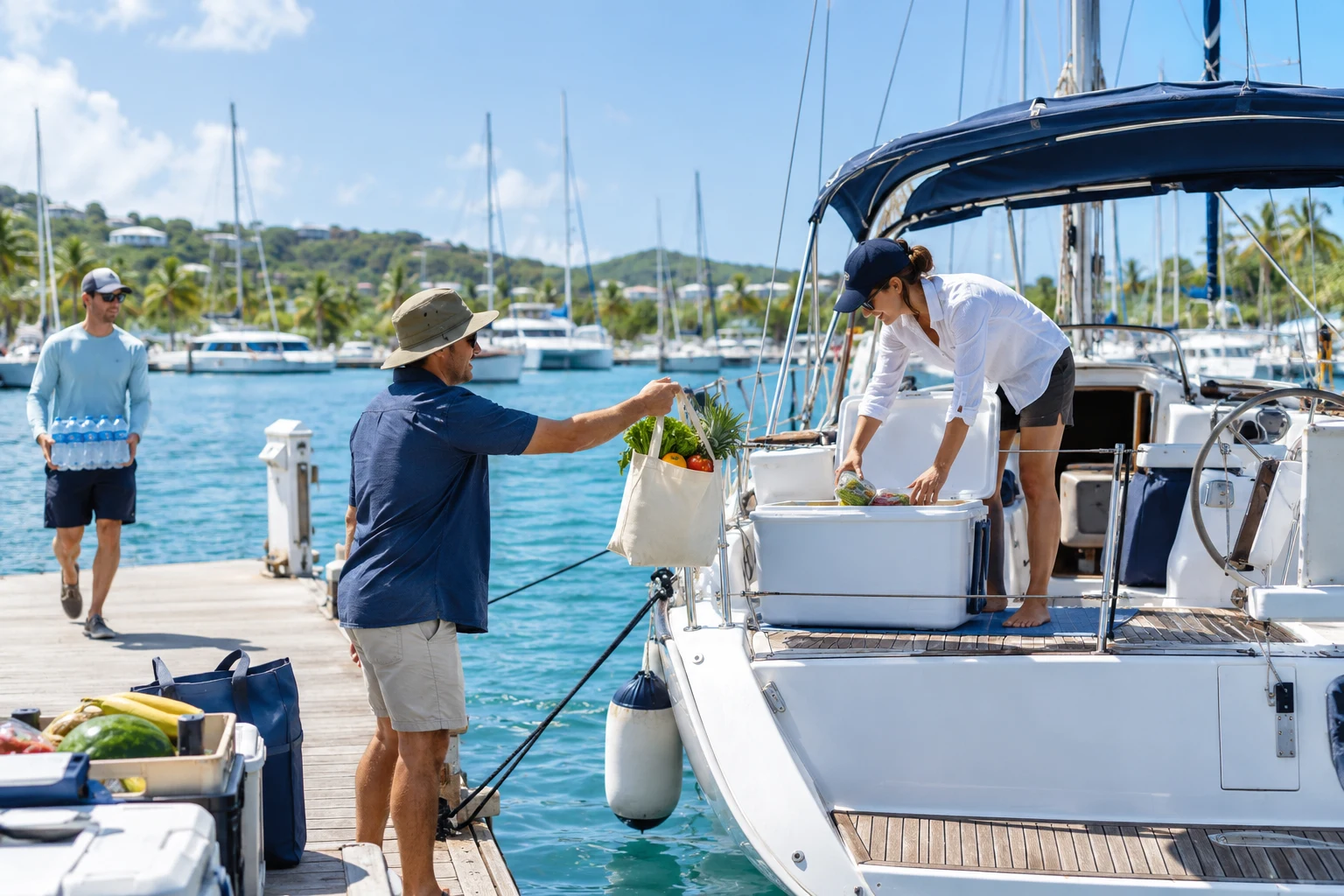
Provisioning for a yacht charter is the process of planning, buying, and loading all food, drinks, and supplies you will need for the trip before you leave the dock. It covers everything from meals and snacks to drinking water, cooking fuel, and paper goods.
Getting provisioning right is critical for safety, not just comfort. A sailing yacht has limited storage and no easy restocking options once you are offshore. Running out of water or food on a remote passage is a genuine problem, and seasickness can make a poorly stocked galley worse.
How you provision depends on your charter type:
- Bareboat: You handle everything, including shopping, loading, and cooking.
- Skippered: A professional captain sails the boat, but you still manage your own food and supplies.
- Crewed: The crew handles all provisioning, usually based on a preference sheet you fill out before arrival.
Your destination, trip length, and group size drive the actual shopping list. A good rule of thumb is to plan for one extra day of food and water beyond your scheduled duration, in case weather or mechanical issues delay you.
Step-by-Step: How to Provision a Charter Yacht
| Step | Responsible Party | Timing |
|---|---|---|
| Collect crew preferences & dietary restrictions | Charterer | Weeks pre-arrival |
| Build meal plan | Charterer | Weeks pre-arrival |
| Estimate quantities | Charterer | Weeks pre-arrival |
| Coordinate with charter company (onboard items) | Charterer | Weeks pre-arrival |
| Schedule shopping | Charterer | Weeks pre-arrival |
| Shopping | Charterer | Pre-arrival / Arrival |
| Loading | Charterer | Arrival |
| Inventory management | Charterer | During trip |
Provisioning a charter yacht follows a repeatable process that starts weeks before you step aboard.
Start by collecting crew preferences and dietary restrictions. Send a shared form asking about allergies, intolerances, aversions, and must-have items.
Build a meal plan around the number of meals you will actually cook onboard. Count every breakfast, lunch, dinner, and snack for the full crew for every day of the trip, then add one extra day of food and water as a safety buffer. Plan for easy no-cook lunches on sailing days when the galley is hard to use at a heel.
Estimate quantities per person per meal rather than per trip. A typical adult eats roughly 0.5 to 0.75 pounds of protein per meal, one to two cups of grains or starches, and fresh produce that will last the first few days before you switch to canned or frozen options.
Coordinate with the charter company on what is already onboard. Most bases stock basic spices, oil, and cleaning supplies, but confirm in writing so you do not double-buy.
Schedule shopping for the morning of embarkation or the afternoon before, depending on the base's check-in time. Perishables go in last, and you load dry goods first so they sit at the bottom of lockers.
Bareboat vs. Skippered: Who Handles Provisioning?
The split of provisioning duties depends entirely on your charter type. On a bareboat yacht provisioning plan, you are responsible for everything: meal planning, shopping, loading, and cooking.
On a skippered charter, the captain handles navigation and boat operations, but provisioning remains your job. You must shop, load, and prepare all food and drinks.
Crewed charters are the exception. Here, the crew manages all provisioning based on your preferences form, and you only bring personal items.
The Ultimate Yacht Provisioning Checklist
| Food Category | Quantity per Person (Daily) | Storage Notes |
|---|---|---|
| Protein | 0.5 - 0.75 lbs | Fresh for first 3 days, then frozen |
| Grains/Starches | 1 - 2 cups | Non-perishable |
| Fruits/Vegetables | 5 - 7 servings | Fresh for first 3 days, then canned |
| Water (Drinking/Cooking) | ~1.1 gallons | Extra for rinsing |
| Backup Food/Water | 1 day's worth | Shelf-stable |
A week-long charter for four people typically needs roughly 40 to 50 pounds of food and about 30 gallons of water for drinking and cooking. Build your yacht provisioning checklist around a per-person daily estimate: 0.5 to 0.75 pounds of protein, 1 to 2 cups of grains or starches, and 5 to 7 servings of fruits and vegetables. Plan one backup day of shelf-stable food and water on top of that.
Your yacht vacation grocery list should split into three categories: fresh, frozen, and non-perishable. Buy fresh produce and dairy for the first three days, then rely on canned vegetables, frozen meats, and pantry staples for the rest of the trip.
Galley essentials for yacht
The galley essentials for yacht cooking go beyond food. Pack aluminum foil, plastic wrap, zip-top bags in multiple sizes, paper towels, dish soap, sponges, and a basic cleaning spray. Bring salt, pepper, cooking oil, and a small spice kit, but confirm with the charter base first, since many boats stock these basics already.
Special considerations
Check every crew member's allergies and dietary needs before you shop. Label common allergens like nuts, shellfish, and dairy, and separate them in storage to avoid cross-contamination. For kids, pack familiar snacks, juice boxes, and easy one-hand foods that survive a moving boat.
Pack drinks by volume, not by container count. Plan one gallon of water per person per day for drinking and cooking, then add juice, soda, coffee, and beer or wine at roughly two to three drinks per adult per day.
Smart Meal Planning for Sailing Trips
Meal planning for a sailing trip is the difference between stress-free lunches at anchor and a disorganized galley at sea. The goal is simple: easy, nutritious meals that require minimal prep, tolerate a moving boat, and use up fresh ingredients before they spoil.
A solid daily rhythm on a charter looks like a hearty breakfast, a no-cook lunch, and a one-pot dinner. Breakfasts should be simple and filling: oatmeal with dried fruit, yogurt with granola, or eggs with pre-cooked sausage and toast. For lunches, think wraps, hummus with pita, cold cuts, or tuna salad with crackers, since firing up a stove while heeling over is unpleasant and unsafe. Dinners are where you can get creative with one-pan dishes like pasta with jarred sauce, stir-fry with pre-chopped veggies, or foil-packet fish with rice.
Charter boat food ideas that work well are make-ahead and pre-prepped at home or the dock. Marinate proteins in zip-top bags before boarding, pre-cook grains, and chop vegetables into labeled containers.
Balance your plan by dining ashore a few nights, especially if the marina or town has good local spots. This lightens your provisioning load, saves your fresh ingredients, and gives the crew a break from galley duty. Aim for two or three restaurant meals on a week-long charter.
A sample day might look like scrambled eggs with toast for breakfast, a build-your-own wrap bar with cold cuts and veggies for lunch, and a one-pot pasta with jarred sauce and pre-cooked sausage for dinner. Keep the plan flexible, and rotate meals so you use the most perishable items first.
Shopping for Your Yacht Charter: Where and How?
| Provisioning Option | Pros | Cons | Cost (Relative) | Best For |
|---|---|---|---|---|
| Onboard Delivery / Advance Ordering | Saves time, convenient, guarantees availability | Higher cost | Higher | Large groups, long charters, tight schedules |
| Local Markets | Fresh fish, fruit, vegetables; local specialties | Varies by location, limited selection | Typical | Fresh produce, day's catch |
| Supermarkets | Cheaper, better stocked, wide selection | May require travel, can be crowded | Lower | Produce, dairy, local brands |
| Marina Minimarts | Last-minute items, convenient | Premium prices, limited selection | Higher | Sunscreen, forgotten essentials |
| Duty-Free | Savings on alcohol & tobacco | Rarely applies to food, customs rules | Lower (alcohol/tobacco) | Alcohol, tobacco (Caribbean/Europe) |
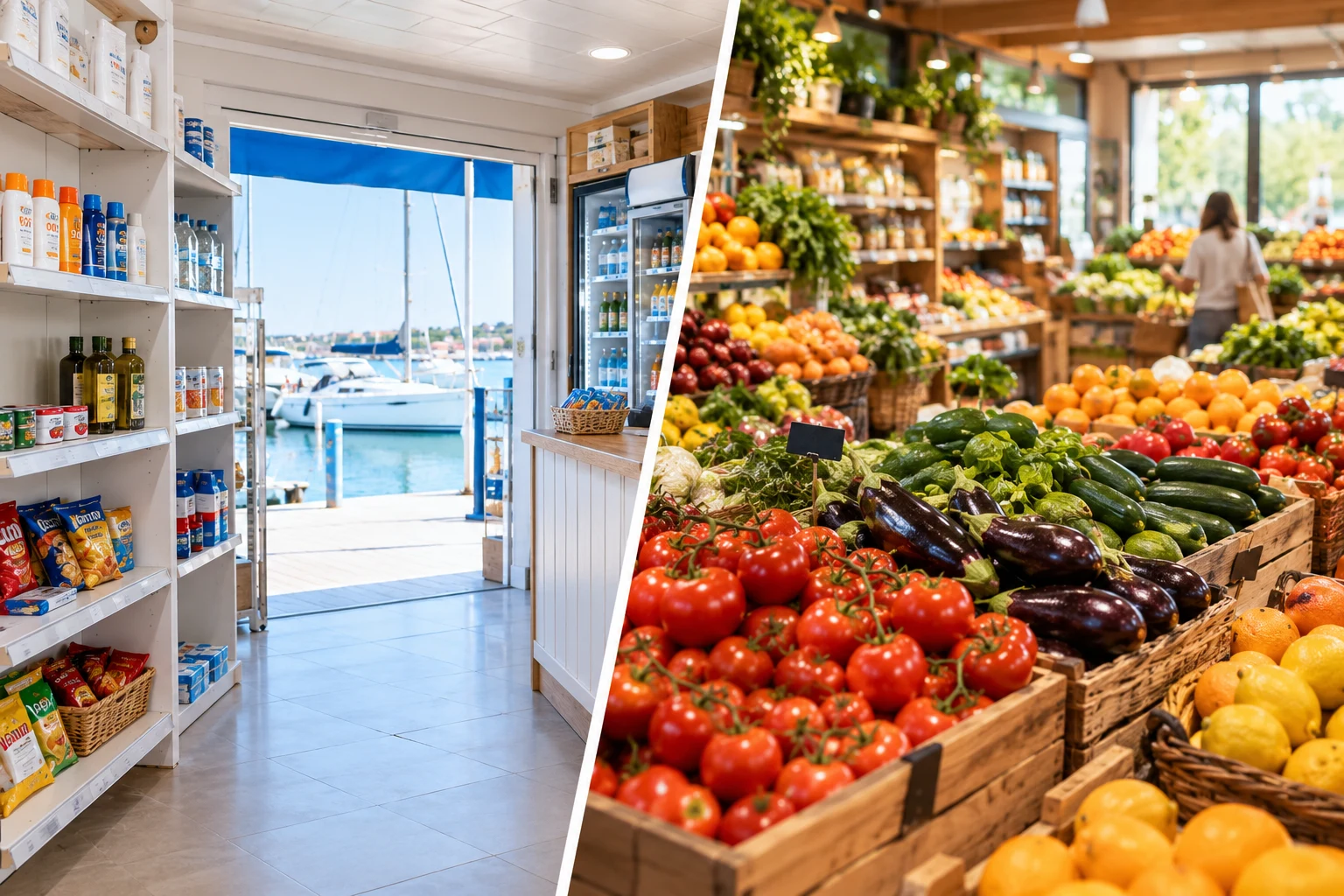
Marina stores and local supermarkets are your two main options, and most charter bases sit within walking distance of both. Marina minimarts carry the basics but at a premium, so use them only for last-minute items. The local supermarket is almost always cheaper and better stocked.
Local markets are the best source for fresh fish, fruit, and vegetables in most yacht charter destinations. In the Mediterranean, shop the morning markets in Greece, Croatia, and Italy for the day's catch and seasonal produce.
Duty-free provisioning is worth considering for alcohol and tobacco in the Caribbean and parts of Europe, but the savings rarely apply to food.
Advance ordering and provisioning services make sense for large groups, long charters, or tight embarkation schedules. Many charter companies and local suppliers offer pre-order packages where you submit a list and the groceries are waiting on the boat when you arrive.
Budgeting for food and drinks on a sailing yacht charter runs roughly $15 to $25 per person per day for full provisioning in the Mediterranean and Caribbean, depending on how much seafood, alcohol, and specialty items you buy.
Storing and Organizing Provisions on a Sailing Yacht
Galley storage on a sailing yacht is about working with limited, angled spaces. Use collapsible containers, hanging mesh bags, and stackable bins to make the most of every locker. Keep heavy items low and near the keel line to maintain stability.
Marine refrigeration runs on 12V or 24V systems that work harder in warm climates. Set the fridge to 3-5°C (37-41°F) and open it briefly to preserve cold air. Pre-chill drinks before loading them, and use a portable cooler for drinks so the fridge stays dedicated to food.
To keep food fresh longer, remove produce from plastic bags and wrap it in paper towels to absorb moisture. Store eggs and dairy in the coolest part of the fridge, and keep potatoes, onions, and garlic in a dry, ventilated locker rather than the fridge.
Pack with pre-prep in mind: portion proteins into meal-sized freezer bags, pre-chopped vegetables into labeled containers, and create meal kits per day.
A solid yacht charter packing list includes zip-top bags, foil, paper towels, and a permanent marker for labeling.
Sustainable and Allergy-Safe Yacht Provisioning
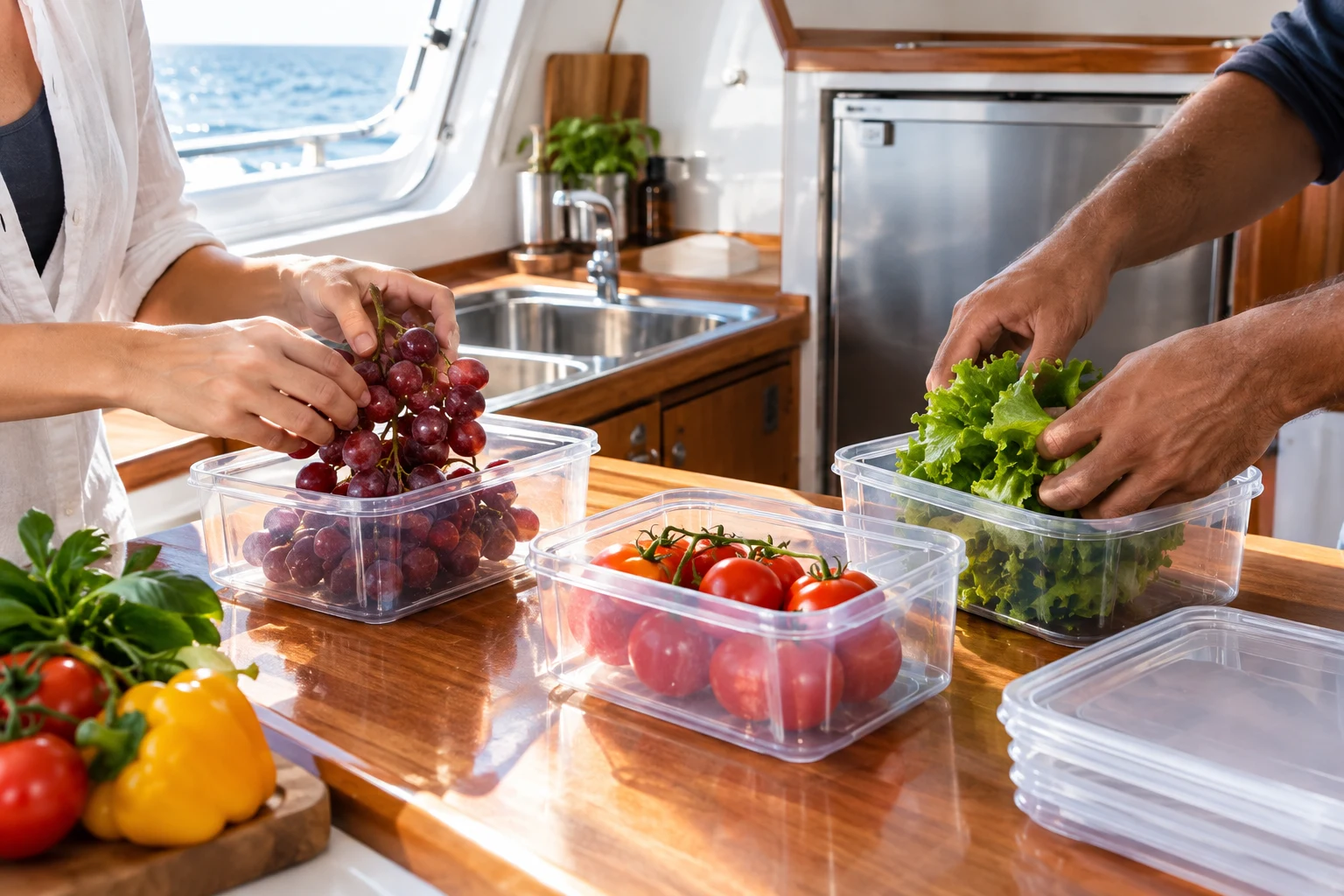
Sustainable yacht provisioning means buying local, cutting packaging before you board, and planning meals to avoid waste. Shop at port-town markets for fresh fish and seasonal produce, then decant dry goods into reusable containers so paper and plastic never reach the boat.
Allergies on a yacht charter demand a stricter system than preferences. Collect every allergy, intolerance, and dietary restriction on the crew form, then build the meal plan around the most severe case. Cross-contamination is the real risk in a small galley, so keep allergenic foods on a dedicated shelf and use color-coded cutting boards and utensils.
Safe food handling matters more offshore because help is far away. Keep raw meat sealed on the lowest refrigerator shelf, cook proteins to safe internal temperatures, and never leave prepared food out in the heat.
Avoiding Common Provisioning Mistakes on Yacht Charters
Overbuying is the single most frequent error new charterers make. Enthusiasm at the supermarket leads to overflowing lockers. Poor menu planning compounds the problem when meals require ingredients you forgot, forcing expensive marina-store runs. Always write a detailed meal plan before you shop, then stick to it.
Forgetting essentials like a bottle opener, matches, or dish soap creates unnecessary friction onboard. Keep a laminated galley checklist to verify every item before checkout.
Managing food waste means planning meals with overlapping ingredients. Assign one "use-it-up" night before restocking. Pre-portion perishables into meal kits, freeze what you will not eat in the first three days, and keep a running inventory list taped inside a cabinet.
Yacht Charter Provisioning: Expert Tips and Final Checklist
Experienced sailors keep provisioning simple: plan every meal, buy local, and pack a flexible buffer. Stick to your inventory list in the store and resist impulse buys, since galley space is finite.
Before departure, run a final checklist. Confirm all crew allergies are covered, verify the water tank is full, and check that the first-aid kit includes seasickness remedies. Load dry goods first, then frozen items, and fresh produce last so it stays cool longest.
Yacht charter tips from seasoned cruisers all circle back to the same idea: a good provisioning job runs quietly in the background. When meals are planned, stored, and labeled, you spend your days sailing instead of solving logistics.
Frequently Asked Questions
How do I provision a yacht for a week?
Start by estimating meals and snacks per person per day, then build a detailed provisioning checklist around that number. Count every breakfast, lunch, dinner, and snack for the full crew, and add one extra day of food and water as a safety buffer. Shop locally or pre-order for delivery to your marina.
What food should I bring on a yacht charter?
Bring non-perishable staples, fresh produce for the first three days, proteins, snacks, and beverages. Favor easy, one-pan meals that tolerate a moving boat, and buy local specialties at port-town markets. Canned vegetables, frozen meats, and pantry staples carry you through the rest of the trip.
Can you hire a chef for a yacht charter?
Yes, many skippered or crewed charters offer chef or cook services as part of the package. The crew handles all provisioning based on your preferences form. Bareboat charters may allow freelance yacht chefs in some destinations, but confirm with the charter company first.
How much food do I need for a sailing trip?
Plan for three meals and snacks per person per day, then add 20 percent for the extra safety day. A good rule of thumb is one pound of total food per person per day. Account for eating ashore a few nights and possible weather or mechanical delays that extend the trip.
What are the best tips for yacht provisioning?
Plan simple meals, buy local, and avoid overbuying. Pack smart for limited galley space using clear, stackable bins and labeled containers. Stick to your inventory list in the store and resist impulse buys, since overbuying is the most common mistake charterers make.
What is the 12 person rule on a yacht?
Most charter yachts are licensed for a maximum of 12 guests, regardless of the boat's size. This limit exists for safety and regulatory reasons, covering life raft capacity, safety equipment, and insurance. A yacht carrying more than 12 passengers is legally classified as a small passenger vessel with stricter requirements.
What is the 24m rule for yachts?
Yachts over 24 meters (about 79 feet) fall under stricter regulations and may require professional crew with specific certifications. Most charter sailing yachts are under 24 meters to allow for more flexible use, including bareboat operation. The 24-meter threshold triggers additional safety, construction, and manning requirements under international maritime rules.
How much should I tip the crew on a yacht charter?
Typical gratuity ranges from 10% to 20% of the charter fee for crewed charters. Tipping is discretionary and reflects service quality, so adjust based on how the crew performed. Cash is standard, and it is usually distributed among the crew at the end of the charter.
A well-provisioned yacht is a stress-free yacht, and the difference is made before you leave the dock. Start your plan by collecting every crew member's dietary needs and building a meal-by-meal menu that includes one extra day of food and water. Then, use a master checklist to coordinate with your charter company, schedule your shopping close to embarkation, and load dry goods before perishables.
When you step aboard, your provisioning work pays off in more sailing time and fewer logistical headaches. Keep your plan flexible with no-cook backups and shelf-stable staples, and track what you actually use so your next trip is even easier.