Yacht capacity refers to the maximum number of people legally and safely allowed on board a sailing yacht, determined by international safety regulations, yacht design, and charter type. This includes separate limits for overnight guests and daytime passengers, with crew counted separately from guest capacity.
Understanding what is yacht capacity matters before you book any sailing charter. The number on a yacht's certification plate is not a suggestion; it is a legal ceiling that affects your safety, your insurance coverage, and whether the voyage is legal at all. This guide explains yacht capacity explained in practical terms for anyone planning a sailing holiday.
What Is Yacht Capacity? Key Terms and How It's Calculated
| Yacht Type (Example) | Overnight Capacity | Day Capacity | Crew (Overnight) | Crew (Day) |
|---|---|---|---|---|
| 40ft Monohull | 4-6 | 8-10 | 1-2 (often incl.) | 1-2 (often incl.) |
| 50ft Monohull | 6-8 | 10-12 | 2-3 (often incl.) | 2-3 (often incl.) |
| 40ft Catamaran | 6-8 | 10-12 | 1-2 (often incl.) | 1-2 (often incl.) |
| 50ft Catamaran | 8-10 | 12-18 | 2-3 (often incl.) | 2-3 (often incl.) |
| 60ft Catamaran | 10-12 | 18-25 | 3-4 (often excl.) | 3-4 (often excl.) |
| Superyacht (80ft+) | 8-12 | 12-36 | 4-10+ (excl.) | 4-10+ (excl.) |
Yacht capacity is the maximum number of people permitted on a sailing yacht at any given time, including guests and sometimes crew. For charter purposes, the number is split into two figures: overnight capacity and daytime cruising capacity.
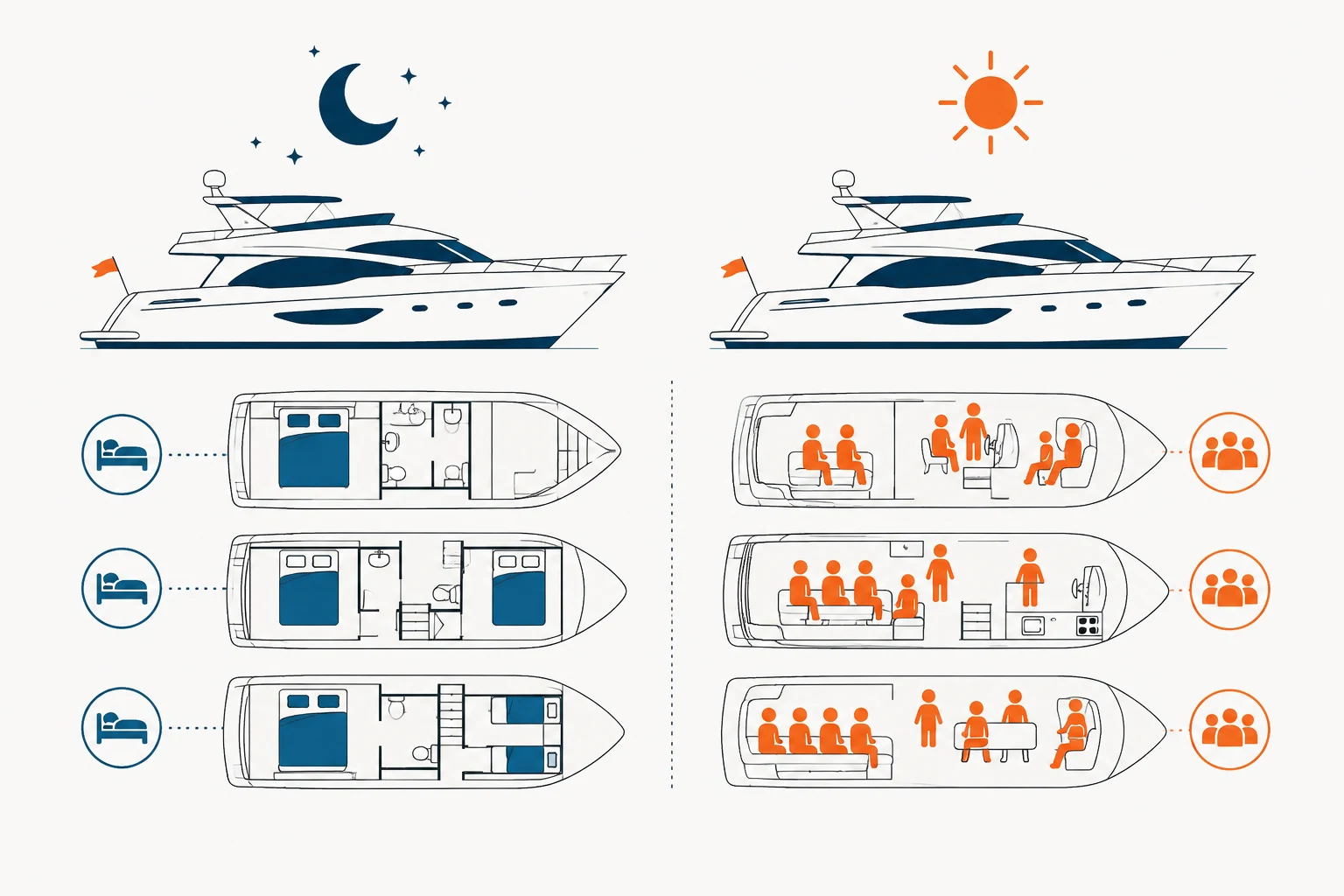
Overnight capacity is the number of guests the yacht can sleep in designated berths. Daytime capacity is usually higher, because guests can sit in the cockpit and on deck during a day sail without needing a bunk.
Naval architects calculate these numbers during the design phase. The hull's stability curve, freeboard, and reserve buoyancy determine how many people the vessel can carry without compromising its ability to right itself after heeling. Classification societies review the design and issue a certified passenger number.
Several factors feed into the final certified number:
- Hull stability under load and at extreme angles of heel
- Number of berths and seating positions with proper safety equipment
- Lifesaving capacity: life rafts, life jackets, and man-overboard gear
- Escape routes and access to safety equipment from every berth
- Crew size and whether crew berths are separate from guest berths
The certified yacht passenger limit is stamped on the yacht's documentation and displayed on a capacity plate in many jurisdictions. Charter companies must respect that number even if the yacht appears to have room for more.
Guest vs. Crew: Who Counts Toward Yacht Capacity?
Guests and crew are counted separately for regulatory purposes. A professional skipper and mate are not part of the guest count, which is why a 45 ft catamaran can advertise "sleeps 8 guests plus 2 crew."
The crew to guest ratio on a skippered charter affects both service quality and safety. Most charter regulations set a maximum number of maximum yacht guests per crew member to ensure someone is always available to manage the vessel.
Who Sets Yacht Capacity? Laws, Regulations, and Classification
Yacht capacity is governed by international maritime regulations, flag state requirements, and yacht classification societies. No single authority sets a universal number; the rules layer depending on where the yacht is registered and where it operates.
The International Convention for the Safety of Life at Sea (SOLAS) is the primary international framework. SOLAS sets the baseline for passenger vessel safety, but its full requirements only apply above a certain passenger threshold. Below that threshold, flag states apply their own national rules.
Flag state requirements vary significantly. A yacht registered in the UK, the United States, or Malta will follow different national regulations for passenger certification. The flag state issues the vessel's registration documents and enforces its rules.
Yacht classification societies, such as Lloyd's Register or Bureau Veritas, assess the vessel's design and construction. They issue class certificates that confirm the yacht meets specific safety and structural standards. While classification is technically voluntary, most charter companies require it for insurance and commercial licensing.
Boat capacity regulations also distinguish between commercial and private vessels. A privately owned yacht used only by its owners and their invited guests faces fewer restrictions. The same yacht used for paid charters must meet commercial standards, carry proper certification, and often undergo periodic inspections.
Why Do Most Yachts Allow Only 12 Passengers?
The yacht passenger limit of 12 is one of the most important numbers in charter sailing. Under SOLAS and most national maritime laws, a vessel carrying more than 12 passengers is legally classified as a passenger ship, not a yacht.
That reclassification triggers a much heavier regulatory burden. Passenger ships must meet stricter construction standards, carry more lifesaving equipment, employ higher-qualified crew, and follow more rigorous inspection schedules. The cost of compliance is substantial, which is why almost all charter yachts are designed and certified for no more than 12 guests.
This legal threshold balances the practical needs of the charter industry with the safety of everyone on board.
What Factors Influence How Many People Can Be On a Yacht?
Yacht size, design, and the number of guest cabins directly affect how many people can be accommodated. A 60 ft monohull with four double cabins sleeps eight guests, while a 45 ft catamaran with four cabins might sleep the same number with more communal space.
Guest cabins are the primary constraint for overnight capacity. Each berth needs a mattress, ventilation, and a safe escape route. Designers can add extra bunks, but every berth competes with storage, headroom, and the yacht's weight budget.
Geography and destination also play a role. Some cruising areas impose local limits on vessel occupancy, especially in marine parks or protected waters. Seasonal weather patterns can reduce safe capacity: a yacht certified for twelve guests in the Mediterranean summer may be unsafe with that number in a North Atlantic winter gale.
Weight and stability are the critical engineering factors. Every guest, bag, and provision adds weight above the waterline, which raises the center of gravity and reduces the yacht's ability to self-right after a knockdown. Safety gear must also scale with passenger count: life rafts, life jackets, and EPIRBs have finite capacity.
Charter type changes the equation. On a bareboat charter, the guests are also the crew, so the certified capacity must account for the fact that everyone on board may need to handle sailing operations. On a skippered charter, professional crew handle the vessel, which can allow a higher guest count relative to the yacht's size.
Does Yacht Size Always Equal More Guests?
Larger yachts often have more cabins, but legal limits cap how many guests can be carried regardless of physical space. A 100 ft sailing yacht with eight guest cabins is still limited to 12 passengers under the SOLAS threshold, even though it could physically sleep sixteen.
A 50 ft yacht may be limited by legal or safety rules rather than available bunks. The certified capacity considers stability, lifesaving equipment, and crew requirements, not just mattress count.
Comfort and safety are prioritized over maximizing headcount. A yacht certified for twelve guests might be miserable with that many people on board for a week, because there is only one head and limited refrigeration. The legal capacity is the ceiling, not the target.
What Happens If You Exceed Yacht Capacity? Risks and Consequences
Exceeding yacht capacity is illegal and voids marine insurance. If a vessel capsizes or a guest is injured while the yacht is over its certified limit, the insurer will likely deny the claim, leaving the charter company and the captain personally liable for damages.
Overloading endangers safety in three ways: reduced stability, compromised evacuation, and insufficient lifesaving equipment. A yacht certified for ten guests carries life rafts and life jackets for ten people. With twelve on board, two people have no survival equipment in an emergency.
Charter companies, captains, and guests may face severe penalties. Fines, voyage cancellation, and legal action are all possible outcomes. In serious incidents, a captain can lose their license, and a charter company can lose its commercial operating permit.
Maritime safety regulations exist because the ocean does not forgive overconfidence. The certified capacity is the maximum number of people the yacht can safely carry under the worst conditions the voyage might encounter.
Frequently Asked Questions
Is yacht capacity different for private versus commercial use?
Yes, commercial charter yachts face stricter capacity and safety requirements than private yachts. Commercial yachts often have lower passenger limits due to international regulations and insurance requirements, because carrying paying guests triggers additional liability and certification obligations.
Can a yacht ever exceed its stated capacity?
No, exceeding capacity is illegal and dangerous, even for short trips or dockside events. Insurance becomes invalid and legal penalties may apply, regardless of the reason or duration of the overload.
Who enforces yacht capacity limits?
Flag state authorities, port state control, and charter companies all play roles in enforcement. Maritime safety inspectors may check capacity compliance during routine inspections, and charter companies enforce limits through their booking and boarding procedures.
What is the '10 rule' for yachts?
The '10 rule' is an informal guideline suggesting that a yacht's safe day capacity is 10% of its length in feet. A 50 ft yacht would allow five people under this rule. However, legal limits and safety rules always override this rule of thumb.
How many people can a 50 ft sailing yacht hold?
A typical 50 ft sailing yacht sleeps 8 to 10 guests in cabins, plus 1 to 2 crew. Daytime guest capacity may reach 12 under international charter rules, but always check the yacht's certified capacity before booking.
Plan Around Certified Capacity, Not Wishful Thinking
When you book a sailing charter, ask for the yacht's certified passenger number before you sign anything. Confirm that the number covers everyone in your group, including children, and check whether it applies to overnight stays or daytime sailing only.
The safest approach is to book a yacht with capacity to spare. A group of eight will enjoy a 50 ft yacht far more than a group of twelve, because there will be more storage, more personal space, and less strain on the systems. The certified limit is the legal maximum; the comfortable number is usually lower.