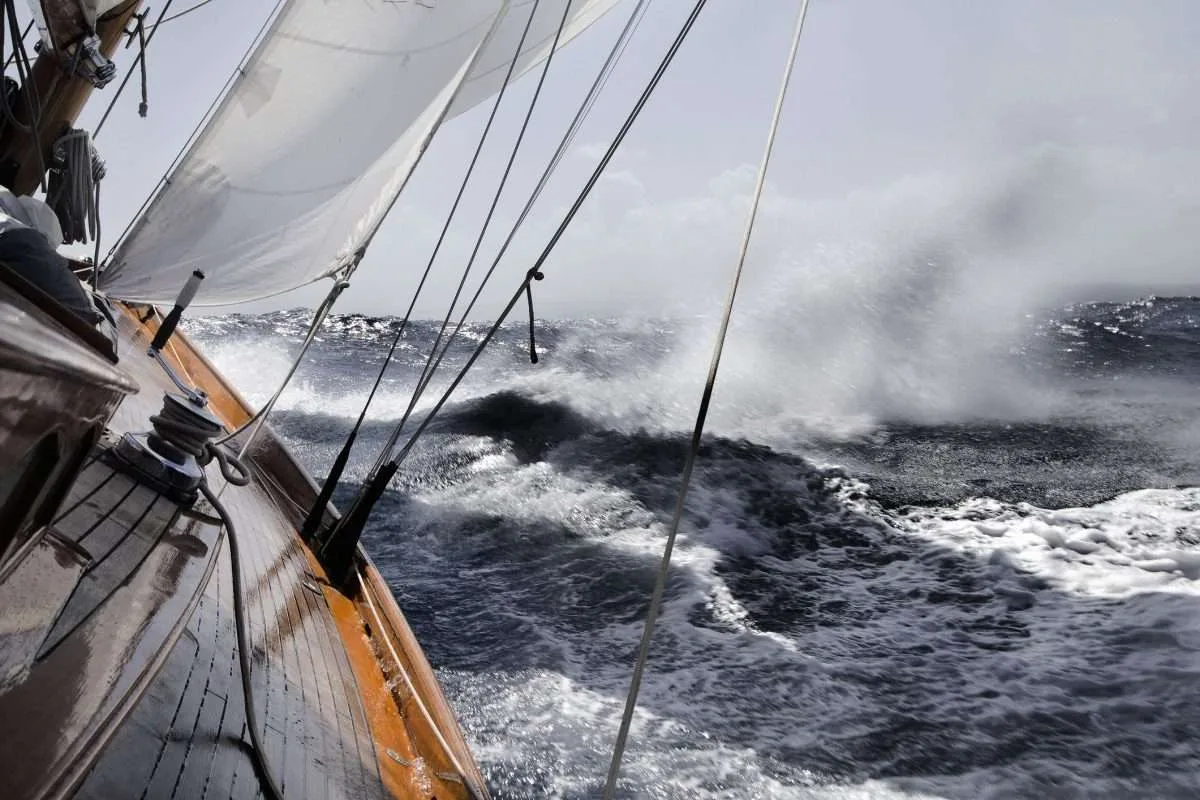
A sailing knockdown is a sudden, extreme heel in which a boat is forced far onto its side, sometimes bringing the mast close to or into the water. It is usually caused by a strong gust, a breaking wave, excessive sail area, or a combination of these factors.
Knockdown, capsize and broach: the difference
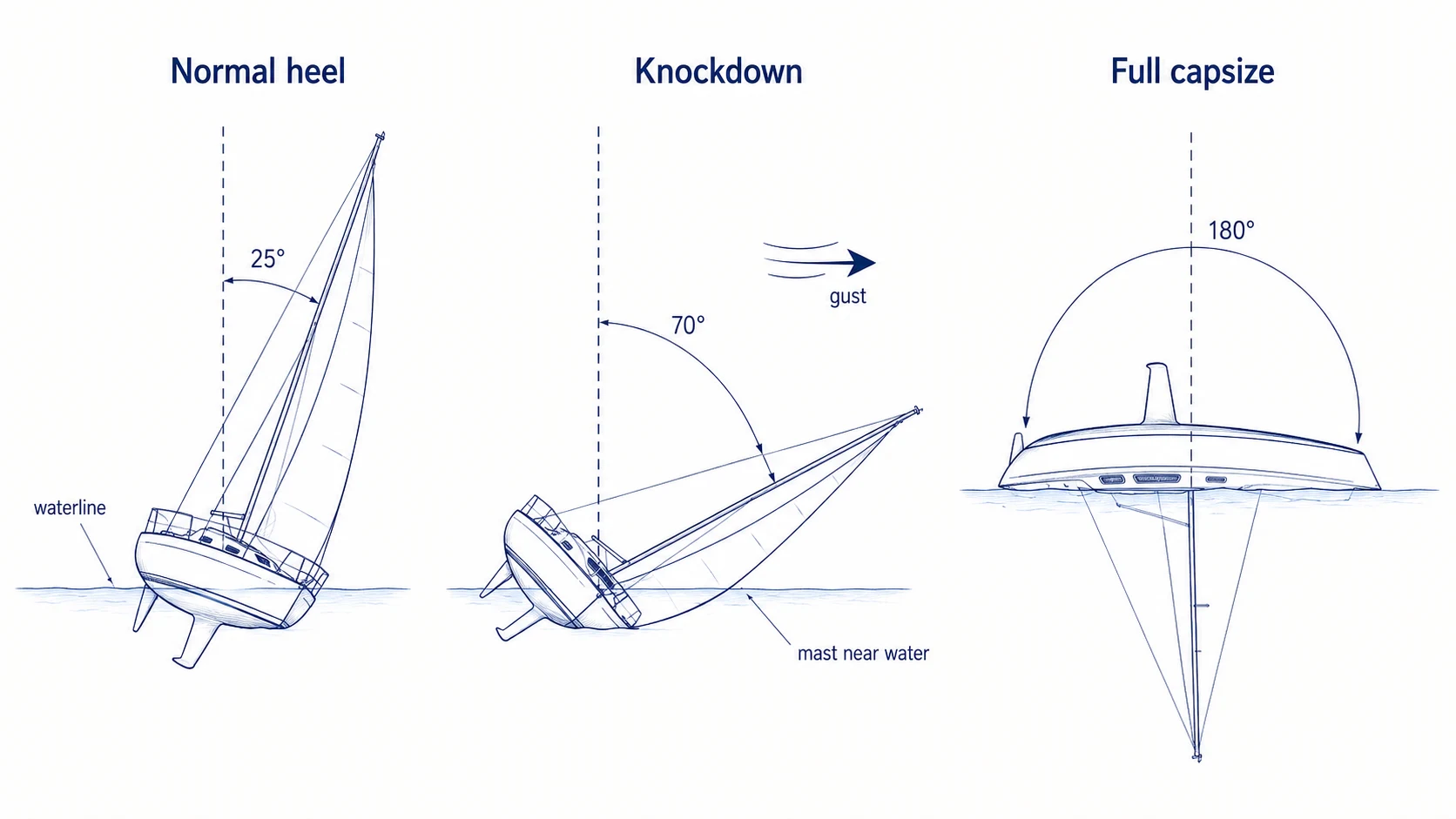
A knockdown occurs when a boat heels beyond its normal sailing angle, often to 90 degrees or more, but the keel remains weighted enough to bring the boat back upright. The mast may touch the water, but the vessel does not invert. Crew members can remain on board, and the boat typically rights itself once the heeling force passes or sails are released.
A capsize is more severe. The boat rolls past the point of recovery and inverts completely, with the mast pointing downward and the hull or deck facing skyward. Capsizes are more common in dinghies and multihulls, which lack the deep ballasted keels that help monohulls self-right. A capsized boat may require outside assistance or specialized righting techniques.
A broach is a loss of steering control in which the boat suddenly rounds up into the wind, usually while sailing downwind at speed. The bow swings toward the wind despite helm input, and the boat heels sharply as the sails fill from a new angle. A broach can lead to a knockdown if the heel becomes extreme, but the two events are distinct. Broaching stems from rudder stall or wave action overpowering the helm, while a knockdown results from an overwhelming heeling force.
Sailors often confuse these terms because all three involve sudden, uncontrolled heeling. The key difference lies in the degree of heel and whether the boat can recover on its own. A knockdown is dramatic but temporary. A capsize is a full inversion. A broach is a steering failure that may or may not result in extreme heel.
What causes a sailing knockdown
Gusts and squalls
Wind does not blow at a constant speed. Gusts are short bursts of increased wind, while squalls are longer, more organized systems that can double or triple wind speed in seconds. Both can generate heeling forces far beyond what the boat was trimmed for. A gust that arrives when sails are set for 15 knots can produce the same heeling moment as steady 30-knot winds, and the crew may have no time to ease sheets or reduce sail.
Squalls often appear as dark bands on the horizon, sometimes with visible rain or a sharp cloud edge. The wind shift and increase can be abrupt. Boats caught with full sail in a squall are at high risk of knockdown, especially if the crew is unprepared or the helm is unattended.
Breaking seas
Waves that break against the side of a hull can push a boat over with tremendous force. This is most common in steep, confused seas or when a boat is beam-on to large swells. A breaking wave can strike the topsides and deck, creating a lateral force that the keel cannot immediately counteract. The result is a rapid, violent heel.
Boats running downwind in heavy weather are particularly vulnerable. A wave breaking from astern can lift the stern, reduce rudder authority, and roll the boat onto its side. This scenario is more dangerous than a gust because the wave's energy is concentrated and directional.
Sail balance and excessive canvas
Carrying too much sail for the conditions is a common cause of knockdowns. Sailors sometimes delay reefing because the boat feels manageable in the lulls, but the gusts reveal the mismatch. An over-canvassed boat heels excessively, loses helm balance, and becomes difficult to control.
Sail balance matters as well. A large headsail combined with a small or reefed mainsail can create weather helm and increase the risk of rounding up into a knockdown. Conversely, too much mainsail relative to the headsail can make the boat difficult to steer and prone to sudden heeling if the main is not eased quickly.
What to do during and immediately after a knockdown
Protect crew
The first priority is to keep everyone on board and prevent injury. Crew members should clip into jacklines or tethers in rough conditions, and they should brace themselves when a knockdown begins. Loose gear, winch handles, and blocks can become projectiles. Anyone below should hold on and stay clear of the companionway, where water may pour in.
If someone goes overboard during a knockdown, the situation becomes far more serious. The boat may be disabled, and the crew must initiate man-overboard procedures immediately.
Depower and regain control
The boat will begin to right itself as soon as the heeling force decreases. The helmsman should release the mainsheet or ease the traveler to spill wind from the mainsail. If the boat has a furling headsail, the crew should furl it partially or completely. On boats with hanked-on sails, easing the jib sheet will reduce heeling force.
Once the boat is upright, the crew should assess whether to continue sailing or heave to. If conditions remain severe, reducing sail further or changing course may be necessary. The goal is to regain control and prevent a second knockdown.
Check people, rig and flooding
After the boat is upright and under control, the crew should check for injuries and account for everyone on board. Next, inspect the rig for damage. Look for bent stanchions, torn sails, loose shrouds, or a cracked mast. A knockdown can stress rigging components beyond their design limits.
Check the bilge for water. If the boat was heeled far enough, water may have entered through hatches, vents, or the companionway. Pump or bail as needed. If the boat took on significant water, determine the source and whether it can be stopped.
How to reduce the risk
Reef early
The most effective way to prevent a knockdown is to reduce sail before conditions become severe. Many sailors wait too long, hoping the wind will moderate or that they can manage with full sail. Reefing early is safer and often faster, as a balanced, controllable boat sails more efficiently than one that is overpowered.
A common guideline is to reef when you first think about it. If the crew is discussing whether to shorten sail, the answer is usually yes. Reefing in moderate conditions is easier and safer than doing so in a gust or squall.
Watch weather and sea state
Pay attention to forecasts, but also observe the conditions around you. Look for signs of increasing wind: whitecaps, spray, or a change in wave shape. Watch the horizon for squalls. If you see a dark line or a sudden change in water color, prepare to reduce sail or alter course.
Sea state can change independently of wind. Waves may build after a storm has passed, or tidal currents can create steep, breaking seas in certain areas. Adjust sail and course to match both wind and wave conditions.
Practice crew communication
A well-coordinated crew can respond to a sudden gust or wave more effectively than individuals acting alone. Establish clear roles: who trims the main, who handles the headsail, who steers. Practice reefing and sail changes in calm conditions so the crew knows the sequence and can execute it quickly when needed.
Use simple, direct commands. In a knockdown, there is no time for discussion. The helmsman should call for action, and the crew should respond immediately. After the event, debrief to identify what worked and what can be improved.
Frequently asked questions
What is a knockdown in sailing?
A sailing knockdown is a sudden, extreme heel that forces a boat far onto its side, sometimes with the mast close to or in the water. A ballasted monohull will usually right itself once the heeling force passes or the sails are eased.
What causes a knockdown in sailing?
Strong gusts, squalls, breaking seas, carrying too much sail, and poor sail balance can create more heeling force than the boat can resist.
How can I avoid a knockdown in sailing?
Reef early, watch the weather and sea state, keep the boat balanced, and make sure the crew knows their roles for easing sails and steering.
How do I recover from a knockdown?
Protect the crew, ease or furl sails to depower the boat, then regain control. Once upright, check everyone on board, inspect the rig, and check for flooding before deciding whether to continue.
Can a knockdown be dangerous?
Yes. A knockdown can injure crew, sweep someone overboard, damage the rig, or let water enter through hatches, vents, or the companionway.