Points of sail describe a sailboat's course relative to the true wind. The main points are close-hauled, close reach, beam reach, broad reach and run, with a no-go zone directly upwind where a conventional sailboat cannot sail efficiently.
The Points of Sail at a Glance
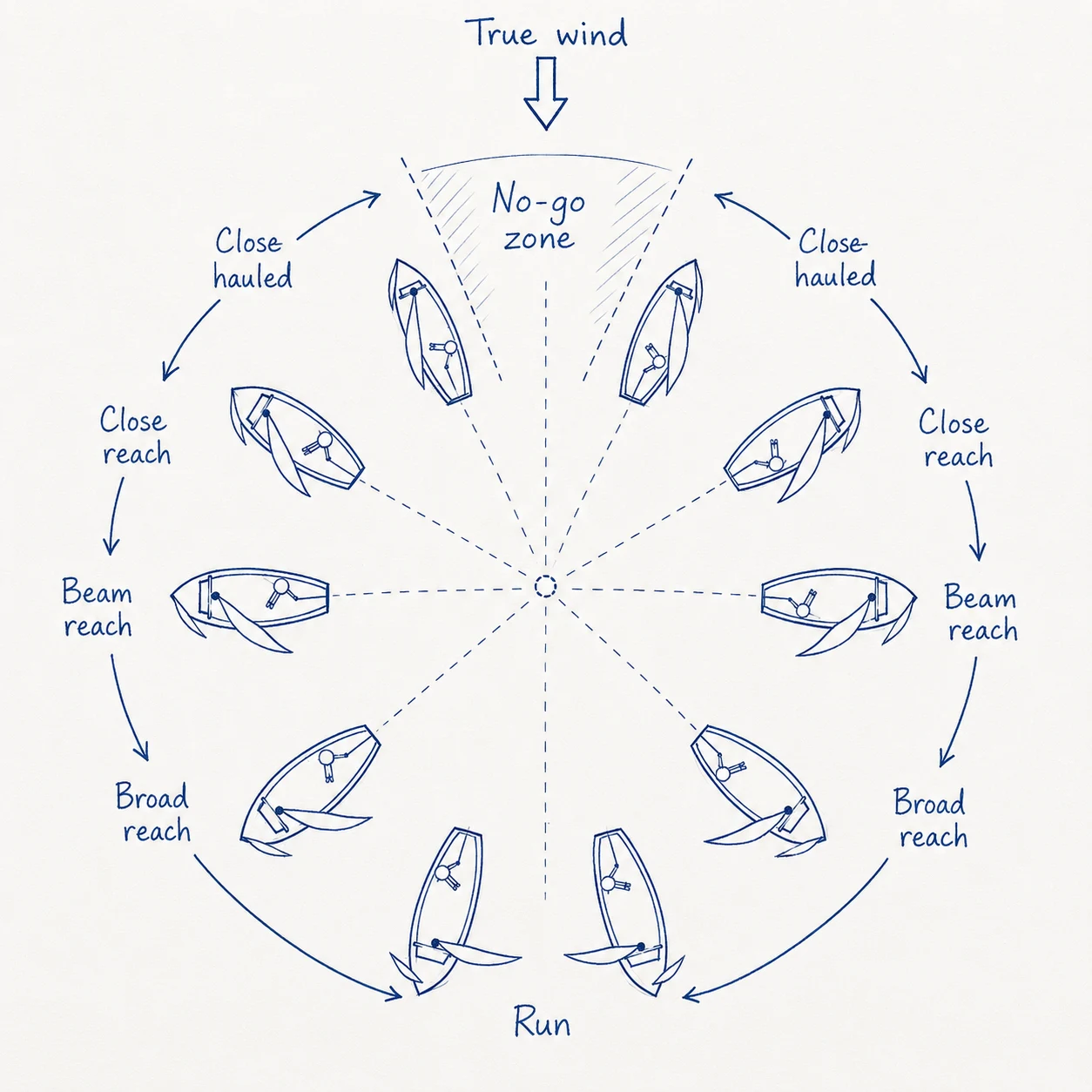
The traditional diagram divides the circle around a sailboat into sectors defined by wind angle. True wind, the actual wind you would feel standing still, serves as the reference. The no-go zone occupies roughly 45 degrees on either side of dead upwind, a total arc of about 90 degrees where sails cannot generate forward thrust.
Close-hauled sailing occurs at approximately 45 degrees off the wind, the closest angle most boats can maintain while making progress to windward. A close reach falls between 60 and 80 degrees off the wind. A beam reach sits at roughly 90 degrees, with the wind perpendicular to the boat's centerline. A broad reach spans from about 120 to 160 degrees off the wind. A run places the wind directly astern or nearly so, from 160 to 180 degrees.
These numbers vary by boat type. A modern racing yacht might point as high as 30 degrees off the wind when close-hauled. A traditional gaff-rigged vessel may need 60 degrees. The boundaries between points blur in practice, but the sequence remains consistent across all sailboats.
How Each Point of Sail Feels and Performs
Close-hauled sailing produces maximum heel. The boat leans away from the wind, sometimes steeply on a breezy day. Speed is moderate, and the motion tends to be choppy as the bow meets waves at an angle. The sails are sheeted in tight, and the boat requires constant attention to maintain the optimal angle. Stray too close to the wind and the sails luff; fall off too far and you sacrifice the upwind progress that defines this point of sail.
A close reach reduces heel slightly and increases speed. The boat feels more balanced, and the motion smooths out. This point often delivers the best combination of speed and comfort for cruising sailors.
A beam reach typically offers the highest speeds for most cruising boats. Heel remains moderate, and the boat surges forward with each gust. The apparent wind, the wind you feel on deck, shifts forward as boat speed increases. This shift matters because it determines how the sails behave and how the boat handles.
Apparent wind combines true wind with the wind created by the boat's own motion. On a beam reach at 6 knots in a 12-knot true wind, the apparent wind angle moves forward and the apparent wind speed increases. This phenomenon becomes more pronounced as boat speed rises.
A broad reach reduces heel further. The boat stands more upright, and the ride becomes gentler. Speed may drop slightly compared to a beam reach, depending on hull shape and sail plan. The apparent wind continues to shift aft as the true wind angle opens.
Running dead downwind eliminates heel almost entirely. The boat rolls instead, rocking from side to side as waves pass under the hull. Speed often drops because the sails block each other. The mainsail shadows the headsail, reducing total sail area exposed to the wind. Many sailors deploy a spinnaker or whisker pole to present more sail area and improve performance on a run.
Sail Trim by Point of Sail
Sail trim adjusts to match the wind angle. Close-hauled requires sheets pulled in until the sails form a narrow slot between jib and mainsail. Telltales, short ribbons attached to the sail, stream aft on both sides when trim is correct. The leading edge of the sail should be just on the verge of luffing. Overtrimming stalls the sail and kills boat speed.
Reaching allows the sheets to ease progressively as the wind angle opens. On a close reach, the sails still maintain a fairly flat shape. On a beam reach, the sails develop more curve, or draft. The telltales continue to guide trim, but the goal shifts from pointing ability to raw speed. Ease the sheets until the leading edge begins to luff, then trim back slightly.
A broad reach and run require sheets eased well out. The sails take on a full, rounded shape. Telltales become less reliable as the wind flows more directly across the sail rather than along it. Watch for the leading edge to curl forward, a sign the sail is stalled and needs to be eased further or the boat's course adjusted.
Oversimplified rules such as "set the sail at half the wind angle" ignore the complexity of sail aerodynamics. Sail shape, mast bend, sheet tension, traveler position, and outhaul all interact. A flat sail generates less power but points higher. A full sail produces more drive but requires a lower angle. Conditions change these relationships further. In light air, sails need more draft to capture every bit of energy. In heavy air, flatter sails reduce heeling force and maintain control.
Using Points of Sail to Plan a Course
Sailing directly toward a destination requires understanding which points of sail the course will require. A mark dead upwind cannot be reached on a single tack. The boat must zigzag, sailing close-hauled on alternating tacks. Each tack involves turning the bow through the wind, switching the sails from one side to the other. The total distance sailed exceeds the straight-line distance, sometimes by a factor of two or more if the destination lies deep in the no-go zone.
Tacking strategy depends on wind shifts, current, and obstacles. Sail on the tack that points closest to your destination. Watch for headers, wind shifts that force the bow away from the target, and tack when they occur. Lifts, shifts that let you point closer to the target, are gifts to be sailed as long as they last.
Sailing downwind to a destination also requires planning. A dead run is often slower and less stable than broad reaching on alternating gybes. A gybe turns the stern through the wind, switching the mainsail from one side to the other. The maneuver requires care because the boom swings across with considerable force.
Current and sea state modify the ideal point of sail. A foul current, flowing against your direction of travel, may make a slower but more direct course preferable to a faster but longer route. Large waves can slow a boat dramatically when sailing upwind, while a broad reach or run in the same conditions might be surprisingly comfortable and fast.
Coastal sailing adds wind shadows from land, thermal effects that shift wind direction through the day, and shallow water that steepens waves. Open ocean passages face long swells, persistent trade winds, and the need to balance speed against crew fatigue and boat stress over days or weeks.
FAQ
What is the fastest point of sail?
A beam reach is the fastest point of sail for most cruising sailboats. The combination of wind angle and apparent wind speed maximizes drive without excessive heeling. High-performance boats, particularly those capable of planing or foiling, may reach top speeds on a broad reach where they can accelerate enough to generate very high apparent wind speeds. The fastest point varies with hull type, sail plan, and wind strength.
Can a sailboat sail directly into the wind?
A conventional sailboat cannot sail directly into the wind. The no-go zone extends roughly 45 degrees on either side of the true wind direction. Sails generate forward thrust by creating lift, similar to an airplane wing, but this mechanism fails when the wind approaches from dead ahead. To reach an upwind destination, sailors tack back and forth at the closest angle the boat can maintain, typically 45 degrees off the wind for modern designs. Each tack makes progress toward the goal, though the total distance sailed exceeds the straight-line distance.