To book a sailing yacht charter, you need to provide your personal details, group size, desired yacht type, charter dates, destination, sailing experience or captain's license (for bareboat), passport information, payment method, and any special requests or dietary needs. The exact information varies by operator and whether you want bareboat or skippered, but the list below covers what you need in nearly every case. Getting these details together before you start makes the process faster and reduces errors on your crew list or charter agreement.
What Information Is Needed to Book a Yacht Charter?
| Information Needed | Bareboat Charter | Skippered Charter | Crewed Charter |
|---|---|---|---|
| Preferred Dates | Required | Required | Required |
| Number of Guests | Required | Required | Required |
| Vessel Type | Required | Required | Required |
| Destination | Required | Required | Required |
| Lead Charterer ID | Required | Required | Required |
| Sailing Resume/Logbook | Required | Not Required | Not Required |
| Proof of Experience | Required | Not Required | Not Required |
| Minimum Logged Nautical Miles | 200+ | N/A | N/A |
| Overnight Passages | Several | N/A | N/A |
| Sailing Experience Level | High | Moderate | Low |
| Draft Limitations | Recommended | Recommended | Recommended |
| Number of Children | Recommended | Recommended | Recommended |
Charter companies need the same core details for any booking: preferred dates, number of guests, vessel type (monohull or catamaran), and destination. Beyond that, you provide personal identification for the lead charterer, a sailing resume or logbook, and proof of experience for bareboat. Skippered charters require less, since the captain handles navigation and boat handling.
The most load-bearing piece for a sailing yacht charter is your sailing experience level. Bareboat companies typically require documented evidence of at least 200 logged nautical miles and several overnight passages before they release the boat. This matters more for sailboats than motor yachts, because handling a rig, anchoring, and managing heeling under sail demands proven competence rather than just a license.
Accurate information ensures the right boat is assigned and that safety equipment matches your crew's abilities. Providing a false resume or underestimating your guest count can void the charter contract and leave you without insurance coverage at sea.
Personal Details and Guest Information
The booking process requires full legal names, dates of birth, and contact details for every guest who will step aboard. The lead charterer also needs to provide their address, phone number, and email as the primary contact for the contract and pre-departure briefings.
Passport information is mandatory for any international charter, even when crossing a nearby border. The charter company needs the passport number, country of issuance, and expiry date for each guest to complete the crew list required by local authorities and port officials.
For the crew list, accuracy is not a formality. This document is a legal requirement in most charter destinations, and it must match the number of people physically onboard. An inaccurate crew list can delay your departure at the marina, result in fines, or void your insurance coverage if an incident occurs at sea.
Visa requirements vary by nationality and destination, so confirm these well before your charter start date. It is your responsibility, not the charter company's, to ensure every guest has the correct entry documentation.
What Information Does the Charter Company Need About My Guests?
The charter company needs the full legal name, date of birth, and contact details for every guest, not just the lead charterer. For international routes, passport numbers, countries of issuance, and expiry dates are mandatory for the legally required crew list. An inaccurate crew list can delay your departure or void your insurance.
Flag any children onboard, as this affects life jacket sizes and safety briefings. Note dietary restrictions and medical conditions in advance so the provisioner can stock the right food and the skipper can plan for any onboard care needs.
Charter Type, Yacht Type, and Experience Requirements
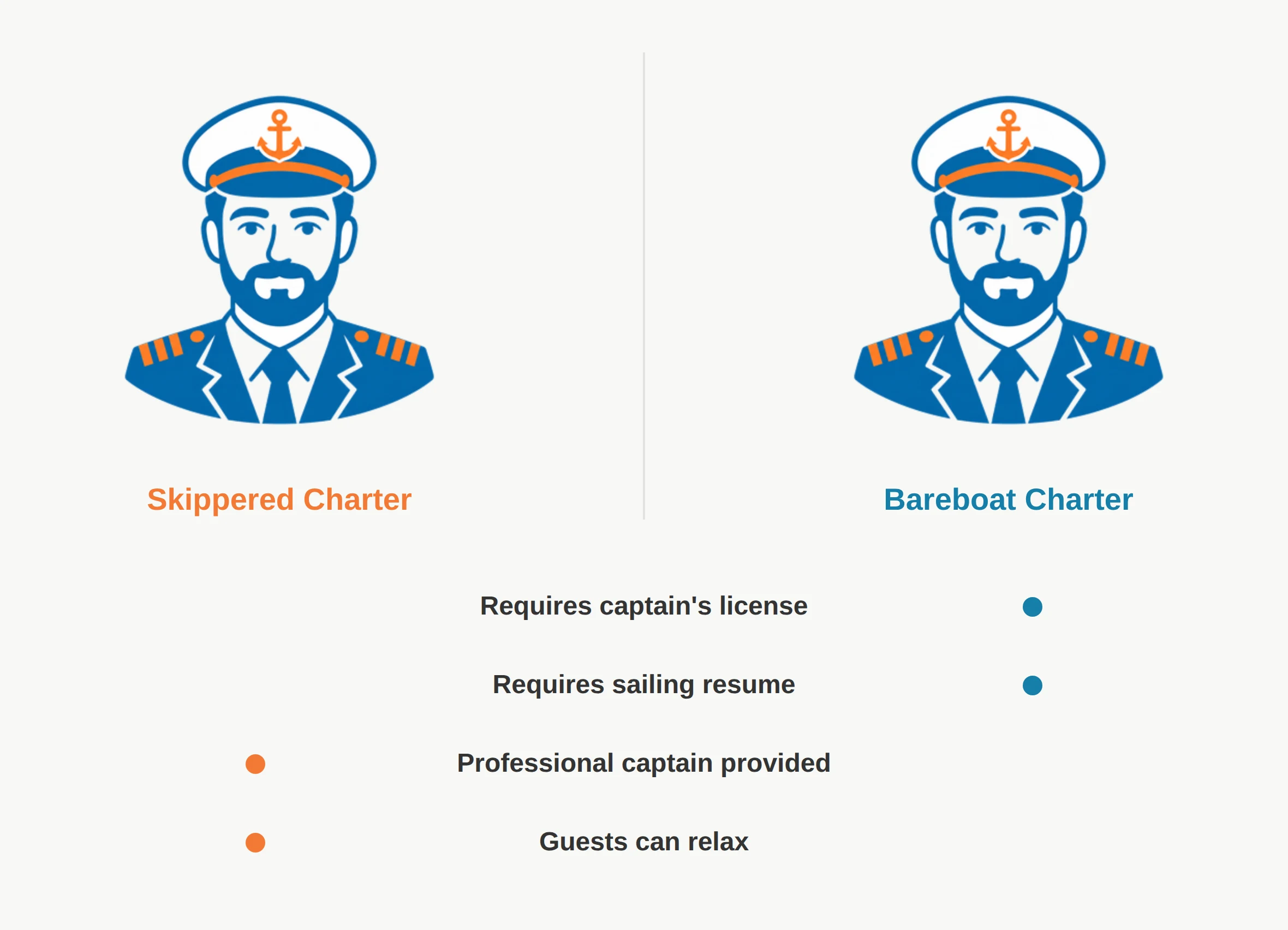
The first decision is whether you want a bareboat charter, where you act as skipper, or a skippered charter with a professional captain. This choice determines everything downstream: the yacht type, the paperwork, and the cost.
For a bareboat charter, the lead charterer must prove they can handle the boat. Most companies require a recognized captain's license (such as an RYA Day Skipper or equivalent) plus a sailing resume showing at least 200 logged nautical miles and several overnight passages. If you cannot provide this documentation, a skippered charter is the safer route.
Yacht type comes next. Catamarans offer more living space, stability, and shallow draft, making them popular for families and groups. Monohulls provide a more traditional sailing feel, better upwind performance, and generally lower charter rates. Size matters: a 40-foot monohull suits four to six guests, while a 45-foot catamaran comfortably handles eight.
Be clear about your group's skill level when discussing options with the charter broker. If some guests have no sailing background, a skippered charter lets everyone relax while still covering the miles.
Do I Need a Captain's License to Book a Yacht?
No, you do not need a captain's license to book a yacht. Booking is simply the reservation process. However, whether you need a licensed captain to operate the yacht depends entirely on the type of charter you choose and your own sailing credentials.
For a Bareboat Charter (No Captain Provided): You are the skipper. While you don't need a formal captain's license in most jurisdictions, you must prove your sailing competence. Charter companies typically require a sailing resume detailing your experience (number of years, types of boats, and approximate miles sailed), relevant certifications (e.g., RYA Day Skipper, ASA 104), references from previous charter companies or marina managers, and a minimum age requirement (usually 25 or 30).
For a Crewed Charter (Captain Included): You book the yacht, and a professional captain (who holds the necessary licenses) handles all navigation and operation. You aren't required to hold any qualifications. This is the safest choice if you lack formal sailing credentials or have limited open-water experience.
Be honest about your skill level. If you overstate your experience for a bareboat charter, the company may void your contract or deny you the vessel upon arrival.
Charter Dates, Duration, and Destination
Your travel dates and charter duration are the first fixed points of any booking. Most bareboat charters run in weekly increments, typically Saturday to Saturday, though many bases now offer flexible midweek starts or shorter three-to-four-day mini charters.
The destination shapes everything that follows: the port of embarkation, the boat you need, and the season you sail in. The Mediterranean (Greece, Croatia, Turkey) peaks from May to October, while the Caribbean (BVI, St. Martin) is busiest from December to April. Hurricane season in the Caribbean, roughly June through November, brings lower rates but higher weather risk.
To get optimal availability and price, book six to twelve months ahead for peak-season weeks in popular bases. Booking three to four months out still works for shoulder season, but your choice of yacht and port narrows considerably.
How Far in Advance Should I Book a Yacht?
For peak season in the Mediterranean or Caribbean, booking 6 to 12 months ahead is the safest window to secure your preferred yacht and marina. For shoulder-season dates, a 3 to 4-month lead time typically offers more flexibility and better availability. Last-minute bookings within weeks can yield savings, but they carry real risks: fewer boat choices and limited time for proper planning.
This lead-time decision affects everything from airfare to provisioning, so weigh your priorities before signing.
Documents Required for Yacht Charter
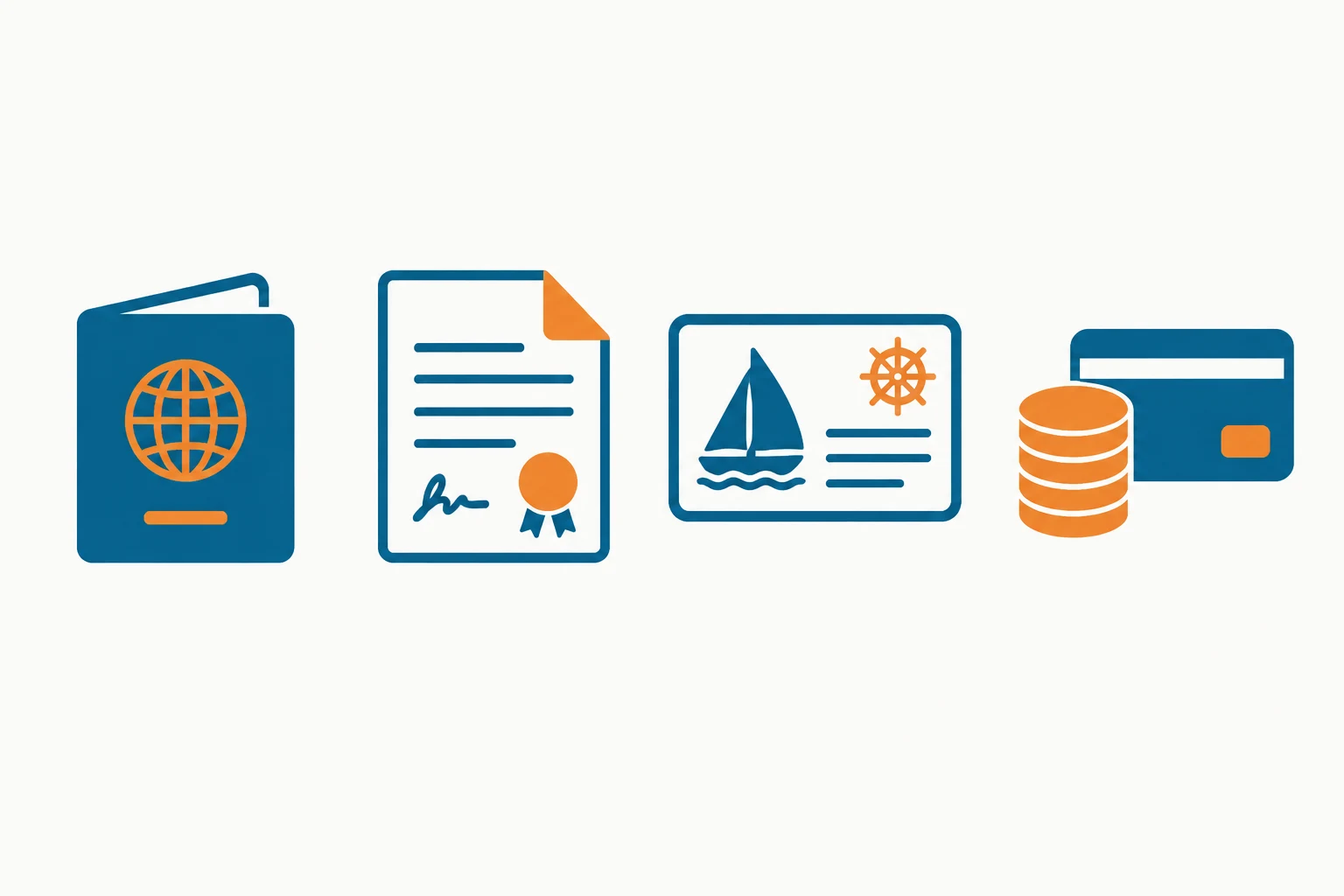
The documents required for yacht charter fall into four categories: identification, the charter agreement, proof of qualifications, and financial security. Gathering these before you start prevents delays and last-minute surprises at the dock.
Identification and crew list
Every guest needs a valid passport with at least six months of validity remaining. For international charters, the charter company needs passport numbers, countries of issuance, and expiry dates for each person to file the official crew list with port authorities. This is a legal document, not a formality; inaccuracies can result in fines or denied departure.
Guests are responsible for their own visa requirements. The charter company cannot secure visas on your behalf, so confirm entry rules for your destination well in advance.
Yacht charter agreement
The yacht charter agreement is the binding contract between you and the charter company. It covers the charter period, the vessel assigned, the total cost, cancellation terms, and the responsibilities of each party. Read it carefully before signing, particularly the clauses on damage liability and weather-related cancellations. The lead charterer signs this document, making them legally responsible for the vessel and crew.
Proof of qualifications for bareboat charters
For bareboat charters, you must submit a sailing resume or logbook and proof of a recognized qualification, such as an RYA Day Skipper certificate. Most charter companies require 200 logged nautical miles and several overnight passages before approving a bareboat booking. If you cannot provide verifiable documentation, the company may require a checkout sail with one of their skippers before releasing the boat.
Skippered charters skip this requirement entirely. The professional captain holds the qualifications, so your personal sailing history is not part of the booking paperwork.
Insurance and security deposit
The security deposit is typically the largest single sum you pay after the base charter fee. It is refundable, provided the boat returns in the same condition it left. Standard deposits range from EUR 1,500 to EUR 5,000 depending on vessel size and value.
Most charter companies include basic hull insurance in the charter fee, but this rarely covers your personal liability. Separate travel insurance with sailing coverage is strongly recommended, and some companies require proof of it before boarding.
Payment Information and Security Deposits
| Charter Type | Booking Deposit | Balance Due | Security Deposit |
|---|---|---|---|
| All Charters | 30-50% | 4-6 weeks prior | EUR 1,500 - 5,000 |
Payment methods for yacht charters are typically bank transfer, credit card, or wire transfer. Most operators require a deposit of 30-50% at booking to confirm the yacht, with the balance due 4-6 weeks before the charter start date. Cancellation terms are tiered: the closer to departure, the larger the penalty, and peak-season bookings usually carry the strictest conditions.
The security deposit ranges from EUR 1,500 to 5,000, depending on vessel size and value. This refundable amount covers damage beyond normal wear and tear. It is returned after the final inspection, usually within a few weeks of the charter ending.
Basic hull insurance is included in most charter rates, but it rarely covers personal liability, crew injuries, or your belongings. A deposit waiver, typically 1-2% of the yacht's value, reduces your liability for damage to a capped amount, but it is not comprehensive insurance.
Read the charter agreement carefully before paying. It specifies exactly what the deposit covers, how damage claims are assessed, and the timeline for refunds.
What Payment Information Is Needed for a Yacht Rental?
Payment methods for a yacht charter are usually bank transfer, credit card, or wire transfer. You will need your card details or bank account information (IBAN/SWIFT) to pay the initial deposit, which is typically 30-50% of the total charter fee at the time of booking.
The balance is due 4-6 weeks before your charter start date. Review the cancellation policy before paying, as refund terms are tiered and depend on how far in advance you cancel.
Provisioning Preferences, Dietary Restrictions, and Special Requests

Provisioning preferences cover everything from food and drinks to household supplies you want onboard before you arrive. Most charter companies offer a provisioning service where you submit a shopping list, and they stock the galley before your boarding day. Specify quantities, preferred brands, and whether you want premium or budget options.
Dietary restrictions require advance notice. Allergies, intolerances, and medical dietary needs should be communicated to the charter company or your skipper before departure, not on the first morning. This gives them time to source appropriate alternatives, especially in remote anchorages where shops are limited.
Special requests can include water toys like paddleboards and kayaks, celebration arrangements for birthdays or anniversaries, and accessibility needs for guests with limited mobility. Water toys are often available for an additional fee, and accessibility requirements may influence which yacht or marina you book.
Understanding Key Charter Terms, Rules, and Safety Regulations
The yacht charter agreement is the binding contract you'll sign as lead charterer, covering the charter period, vessel, cost, and cancellation terms. Before signing, understand the 12 person rule on a yacht: most charter vessels legally carry a maximum of 12 guests plus crew, a safety regulation that also affects insurance and licensing. The security deposit (EUR 1,500–5,000) is refundable and basic hull insurance is included, but personal liability and belongings aren't automatically covered. Review what's included (fuel, water, final cleaning) versus extras like port fees. Consider separate travel insurance with sailing coverage, as yacht insurance provided by the company protects the boat, not your personal gear or medical needs.
Booking a Private Yacht: Complete Checklist
| Category | Item | Details / Requirements | Notes |
|---|---|---|---|
| Trip Planning | Dates | Preferred week | Be flexible on start day |
| Destination | Confirmed location | ||
| Charter Type | Bareboat or Skippered | Decide beforehand | |
| Budget | Total cap | Includes deposit, port fees, extras | |
| Guest Information | Full Legal Names | For every guest | |
| Dates of Birth | For every guest | ||
| Passport Numbers | For every guest | ||
| Passport Expiry Dates | For every guest | 6 months validity minimum | |
| Sailing Experience | Sailing Resume | Required for bareboat | |
| (Bareboat Only) | Logbook | Required for bareboat | |
| Captain's License | Required for bareboat | ||
| Special Requests | Dietary Needs | List all | |
| Medical Conditions | List all | ||
| Children's Ages | For life jacket sizing | ||
| Financial & Legal | Booking Deposit | 30-50% of total | Due at contract signing |
| Balance Payment | Full remaining amount | Due 4-6 weeks before departure | |
| Charter Agreement | Signed contract | Verify inclusions, deposit, cancellation | |
| Travel Insurance | Covers sailing activities | Arrange before departure | |
| Pre-Departure | Crew List Cross-Check | Names/passports match actual documents | Prevents delays/voids insurance |
| Check-in Time | Confirmed | ||
| Base Location | Confirmed |
Use this checklist to gather everything before you contact a charter broker or base. Having documents ready speeds up the process and prevents last-minute delays.
- Dates and destination: Confirm your preferred week and be flexible on start day if possible.
- Group details: Full legal names, dates of birth, passport numbers, and expiry dates for every guest. Passports need at least 6 months of validity.
- Charter type: Decide between bareboat and skippered before you inquire.
- Experience proof (bareboat only): Prepare your sailing resume, logbook, and captain's license.
- Special requests: List dietary needs, medical conditions, and ages of any children for life jacket sizing.
- Budget: Know your total cap, including the security deposit and extras like port fees.
Before confirming, double-check the charter agreement line by line. Verify the included items, the deposit amount, and the cancellation terms. Confirm the exact check-in time and base location, then send the signed contract and pay the 30-50% booking deposit.
The final step is settling the balance, due 4-6 weeks before departure, and arranging travel insurance that covers sailing activities.
Frequently Asked Questions
What documents are required to charter a sailing yacht?
Every guest needs a valid passport with at least six months of validity remaining. For bareboat charters, the lead charterer must provide proof of sailing competence, such as an RYA Day Skipper certificate and a sailing resume showing logged miles. You will also sign the charter agreement and submit the crew list.
Can I book a sailing yacht without a crew?
Yes, if you meet the bareboat requirements. Charter companies require documented sailing experience, typically a recognized qualification and at least 200 logged nautical miles, before releasing the boat to you. If you cannot provide this proof, the charter company can arrange a skipper or full crew for you instead.
What are the typical terms and conditions for sailing yacht bookings?
Standard terms include a 30-50% deposit at booking, with the balance due 4-6 weeks before departure. Cancellation penalties are tiered and grow as the start date approaches. The charter agreement specifies the security deposit amount, insurance coverage, and exactly what is included in the charter fee.
What is the 12 person rule on a yacht?
Most charter vessels legally carry a maximum of 12 guests plus crew. This limit is a safety regulation that also affects insurance and licensing requirements. Groups larger than 12 need special permission and higher safety standards, so confirm capacity with the charter company before booking.
What is the '10 rule' for yachts?
The '10 rule' is not a universal standard across the charter industry. It may refer to a local guest limit or a vessel-specific capacity based on design and safety equipment. Always confirm the exact guest limitation with your charter provider, as it varies by destination and boat.
Do guests pay on Below Deck?
On the TV show Below Deck, guests pay a discounted charter fee and are responsible for gratuities to the crew. This arrangement is specific to the production and does not reflect standard yacht charter pricing. Real charters are priced by the charter company and include or exclude gratuities according to the contract.
What are the requirements to be considered a yacht?
A yacht is generally a recreational vessel over 10 meters (33 feet) in length. For charter booking purposes, the distinction matters less than the vessel's certification, passenger capacity, and safety equipment. Charter companies apply their own definitions based on local maritime regulations and insurance requirements.
Booking a sailing charter comes down to preparation. Gather your crew's passports, decide between bareboat and skippered, and confirm your dates before you contact a charter base. Have your sailing logbook ready if you plan to captain the vessel yourself, and clarify your security deposit options early so there are no surprises at the dock.
Your next step is simple: choose a destination and a week, then send an inquiry with your crew list and requirements. A complete, accurate booking request gets you a faster confirmation and locks in better rates. Compare two or three bases for the same dates, and remember the final balance is due 4-6 weeks before departure.