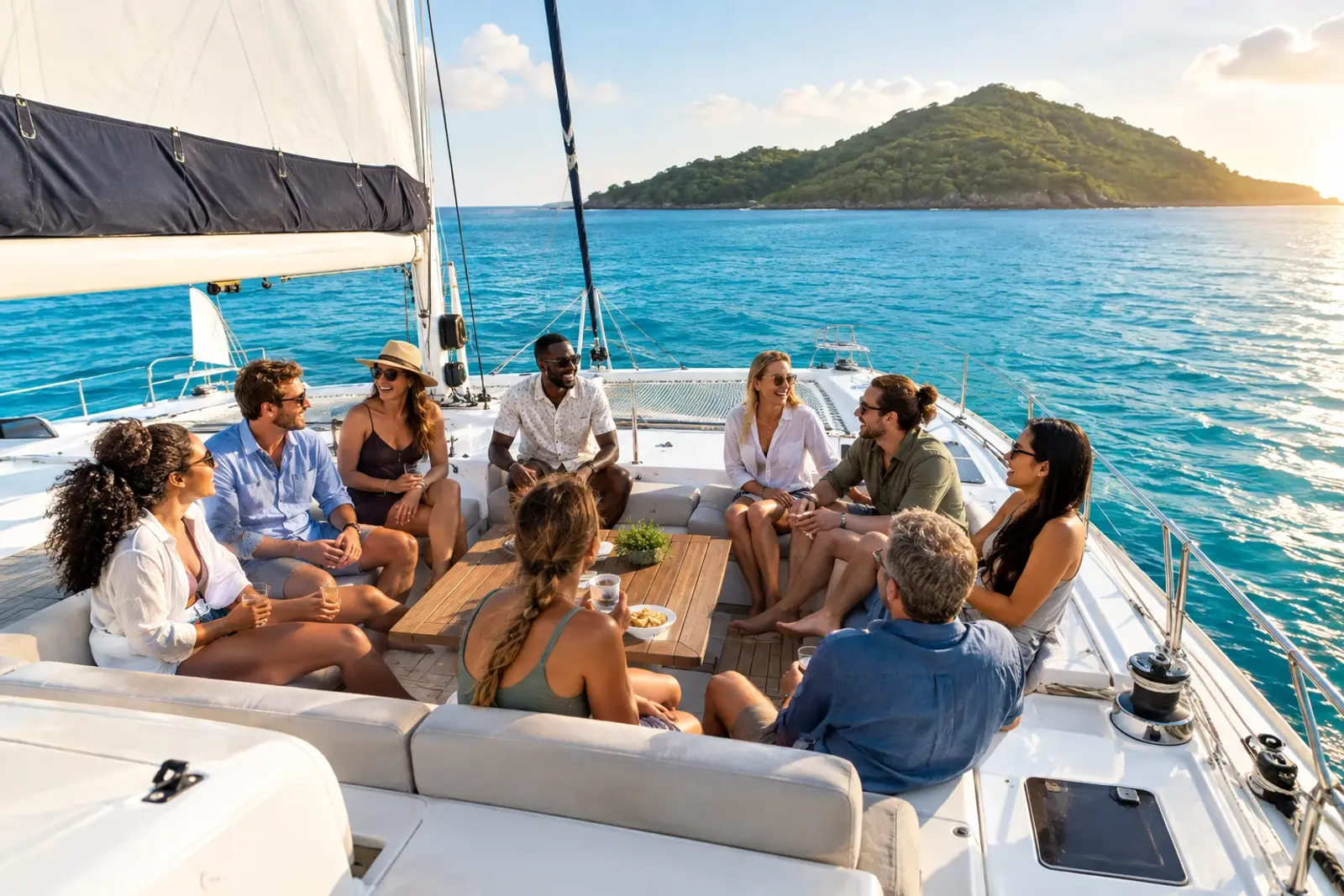
The best yacht for group charter is typically a large sailing catamaran or monohull, offering spacious cabins, ample social areas, and stability for up to 12 guests under international regulations. For groups over 12, certified commercial sailing yachts or traditional gulets are needed to comply with safety laws. This makes the best yacht for group charter a balance of legal capacity, comfort, and the kind of holiday your group actually wants.
Choosing a commercial yacht for groups requires more than picking the prettiest boat. Group size, charter type, destination, and budget all shape the decision. A 44-50 foot catamaran suits 8-12 guests with 4-6 cabins, while a monohull prioritizes sailing performance over living space. Gulets offer a relaxed, fully crewed alternative, and motor yachts deliver speed at a higher cost.
Which Yacht Types Are Best for Group Charters?
| Feature | Catamaran | Monohull | Gulet |
|---|---|---|---|
| Capacity | 6-10 (40-50 ft typical) | Varies by size | Varies by size |
| Cabins | Private, each in own hull | Varies, often shared heads | Varies, often en-suite |
| Stability | High (eliminates rolling) | Lower (prone to rolling) | High |
| Amenities | Excellent space-per-person, open saloon | Varies, can be more basic | Large sun decks, open saloons, crewed |
| Price Range | Typical for sailing charters | Lower charter costs | Higher (all-inclusive, crewed) |
| Sailing Perf. | Slower to windward, needs room to tack | Faster, points higher, direct feedback | Limited (motor-sailer) |
| Best For | Comfort, social space, stability | Sailing experience, budget, crowded harbors | Relaxed, crewed, all-inclusive holiday |
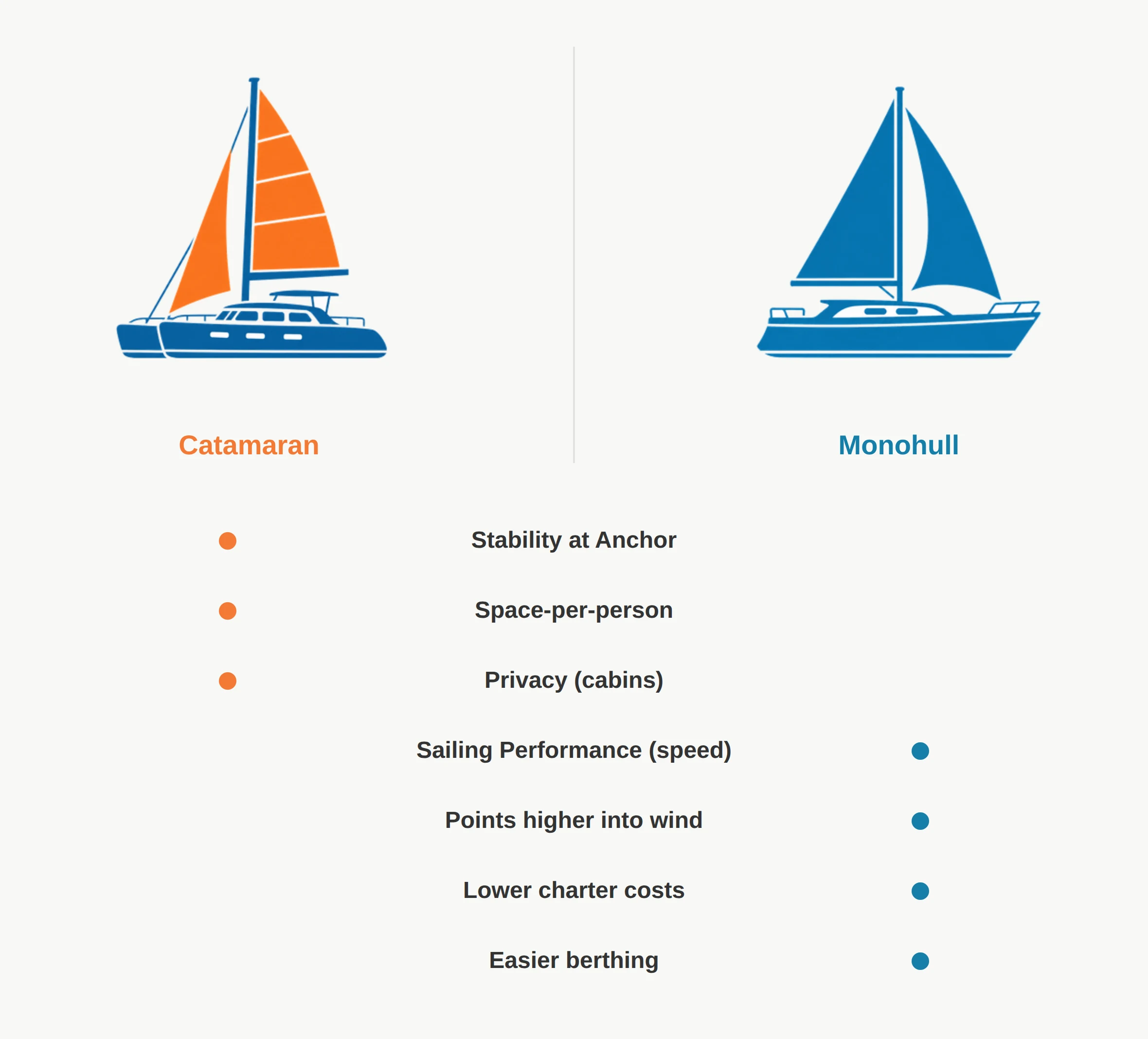
For most group charters, a catamaran is the best yacht type. Its two hulls create a wide, stable platform that eliminates most rolling motion when anchored or under sail. That stability matters when your group includes children, older guests, or anyone prone to seasickness.
Catamarans also offer the best space-per-person ratio. The saloon and cockpit sit at the same level, so the whole group can socialize in one open area. Each cabin gets its own hull, which gives couples or families real privacy at night.
The trade-off is sailing performance. Catamarans are slower to windward than a well-trimmed monohull, and they need more room to tack.
Monohulls are the choice when the sailing itself is the point. They point higher into the wind, accelerate faster, and give the helmsman direct feedback through the wheel. Their narrower beam also means lower charter costs and easier berthing in crowded Mediterranean harbors.
Traditional gulets suit groups that want a crewed, all-inclusive holiday rather than hands-on sailing. These wooden motor-sailers are built for lounging, with large sun decks and open saloons, and they carry a professional crew to handle navigation and cooking.
Motor yachts deliver the most speed and onboard luxury, but they cost significantly more per week and burn fuel at rates that dwarf a sailing charter.
The deciding factors are your group's priorities. If comfort and social space lead, choose a catamaran. If the sailing itself drives the trip, pick a monohull. If you want a fully crewed, relaxed holiday, a gulet delivers that better than either.
Key Factors to Consider When Choosing a Group Yacht
Your group size is the first constraint. Most charter companies cap sailing yachts at 12 guests, and that number includes children. Beyond 12, you move into motor yacht territory or split the group across two boats. For 8 to 12 guests, a 44 to 50 foot catamaran with four to six cabins keeps everyone in separate berths.
Charter type shapes the experience as much as the hull does. A bareboat charter means at least one person in the group holds a sailing qualification and takes full responsibility for navigation, anchoring, and safety. A skippered charter keeps the sailing in professional hands but leaves the group to handle meals, cleaning, and daily planning. A fully crewed charter adds a cook and often a host, which suits groups who want a holiday rather than a sailing job roster.
The group's preferred experience narrows the options further. For corporate events and team building, a catamaran's wide, stable deck and open saloon make it easy to run meetings or group activities without seasickness derailing the agenda. For a charter yacht for corporate events, a fully crewed catamaran lets guests focus on networking while the crew handles logistics. Groups chasing an active sailing holiday should pick a monohull and a bareboat or skippered charter. Relaxation-focused groups, including families with mixed ages, get the most from a gulet or crewed catamaran where nobody has to cook.
Season, destination, and trip duration all feed into the final choice. Trade-wind destinations like the BVI or the Seychelles favor catamarans because the steady breeze suits their reaching and running performance. Light-air regions like parts of the Ionian favor monohulls, which move in less wind. A one-week charter can absorb an extra day of motoring, but a two-week itinerary across longer distances rewards a faster hull. Budget also shifts with the charter type: bareboat monohulls are the cheapest per person, while fully crewed gulets and motor yachts sit at the top of the price range.
Matching Yacht Amenities to Group Needs
Amenities decide whether a group spends its time together or splits apart. The most valuable features for a group charter are lounge areas, dining spaces, water toys, and equal cabins rather than a single impressive master suite.
A catamaran's saloon and cockpit sit on the same level, which keeps the whole group in one social space during meals and evenings. A monohull's cockpit is typically smaller, so a group of 8 or more will feel crowded at dinner. Gulets and motor yachts excel here with large open saloons and expansive sun decks.
Water toys matter more for mixed-age groups. A swim platform, paddleboards, and a towable tube turn anchor time into the highlight of the day, and they are standard on most charter catamarans.
Equal cabins are a quiet dealbreaker. If the group has couples, a catamaran with four identical double cabins avoids the awkward negotiation over who gets the owner's suite. For a luxury yacht for group holidays, look for air conditioning in every cabin, not just the main one.
Entertainment and connectivity round out the list. A Bluetooth speaker, an outdoor TV, and reliable Wi-Fi keep a group engaged on long passages and at anchor. For corporate groups, check that the saloon has a table large enough for laptops and that the onboard generator can handle the power draw.
Understanding Capacity and Legal Requirements for Group Yacht Charters
| Yacht Type/Region | Guest Capacity (Max) | Legal Requirements (Key) | Crew Requirements (Typical) |
|---|---|---|---|
| Private Pleasure Craft | 12 | International 12-person rule | Varies (Bareboat: None; Crewed: Skipper, sometimes Host/Cook) |
| Commercial Passenger Vessel | 13+ | SOLAS standards, Commercial certification, Formal inspection | Licensed Master, often 2nd crew member |
| Mediterranean | 12 (Typical) | International 12-person rule, Local registration/safety (e.g., France, Croatia) | Varies by operator |
| Caribbean (BVI) | Varies by license | BVI commercial licensing scheme | Varies by operator |
| Caribbean (USVI) | Varies by license | USVI commercial licensing scheme | Varies by operator |

The most significant legal limit for group charters is the international 12-person rule. Under most maritime conventions, a vessel carrying more than 12 passengers is no longer a private pleasure craft; it becomes a small passenger ship, subject to a far stricter set of safety, construction, and crewing regulations. The 12-passenger figure excludes the crew, so a yacht can carry 12 guests plus a skipper and crew without triggering commercial passenger vessel certification.
Once a yacht carries 13 or more passengers, it must be certified as a commercial passenger vessel. This certification requires compliance with SOLAS (Safety of Life at Sea) standards, including higher fire-resistance ratings, additional life rafts, emergency lighting, and more rigorous stability testing.
Regulations vary by geography, and the charter company must hold the correct local license. In the Mediterranean, most countries follow the international 12-guest rule, but some, like France and Croatia, have additional local requirements for vessel registration and safety equipment. In the Caribbean, the British Virgin Islands and the U.S. Virgin Islands each have their own commercial licensing schemes, and a yacht licensed in one territory is not automatically legal in the other.
The crew requirements scale with the vessel's passenger count. A standard bareboat charter needs no professional crew, but a certified commercial vessel for 13 or more passengers typically requires a licensed master and often a second crew member. For groups of 8 to 12, most commercial catamarans operate with one skipper and sometimes a host or cook.
For groups planning corporate events or large celebrations, the distinction between 12 and 13 guests is the single most important number in the entire charter contract. Exceeding it can void the insurance, ground the trip, or result in fines.
Catamaran vs. Monohull: Which Is Better for Group Charters?
| Feature | Catamaran | Monohull |
|---|---|---|
| Primary Benefit | Comfort, Space, Stability | Sailing Experience, Budget |
| Deck Space | Roughly double (same length) | Less (same length) |
| Layout | Single-level saloon/cockpit | Saloon below deck |
| Private Cabins | Each hull, separate quarters | Typically shared living space |
| Stability | High, no heel, beam 25+ ft | Heels, active sailing |
| Seasickness | Better for prone passengers | More motion |
| Sailing Performance | Slower to windward, less weatherly | Faster to windward, points higher |
| Cost to Charter | Higher premium | Less |
| Cost to Berth | Higher | Less |
| Best For | Socializing, entertaining, swimming | Active sailing, "more boat for money" |
| Availability | Dominates Caribbean, South Pacific | More common Mediterranean, Northern Europe |
| Group Size | 6 to 12 people (mentioned) | Varies by operator |
The choice between a catamaran and a monohull for a group charter comes down to one question: does your group want a floating social venue or a sailing yacht? Catamarans win for comfort, space, and stability. Monohulls win for the sailing experience itself and for budget.
For groups of 6 to 12 people, a catamaran charter offers roughly double the deck space of a monohull of the same length. The saloon and cockpit sit on one level, which means no one is isolated below while others socialize on deck. That single-level layout makes the catamaran the best yacht for family reunion charter groups. Each hull contains private cabins, so couples and families get separate quarters without sacrificing the shared living space.
Stability is the other major catamaran advantage. With a beam of 25 feet or more, a catamaran does not heel over when sailing. Glasses stay on the table, children move around safely, and passengers prone to seasickness handle the motion far better. The trade-off is sailing performance: catamarans are heavier and less weatherly, so they make slower progress to windward.
Monohulls deliver that connection. A monohull heels, accelerates through tacks, and rewards an active crew with genuine sailing feedback. Their deeper keels let them point higher into the wind, which matters in light-air regions like the Mediterranean in summer. They also cost less to charter and berth than catamarans of comparable accommodation.
Availability shifts the decision too. Catamarans dominate the Caribbean and South Pacific charter fleets. Monohulls are more common in the Mediterranean and Northern Europe. If your dates are fixed, book early, because popular catamaran sizes in peak season go quickly.
Choosing the Right Yacht for Corporate Events and Team Building
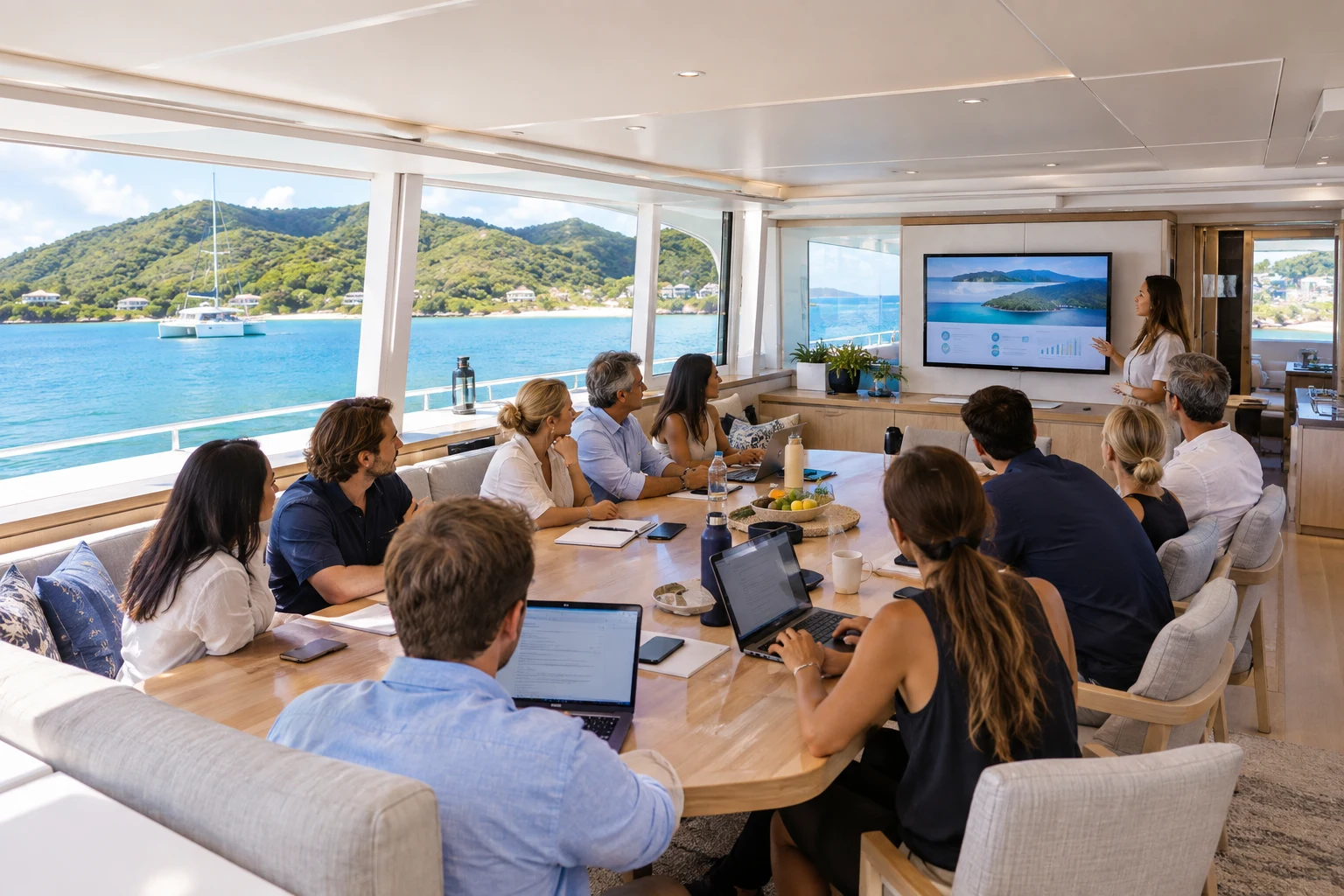
A corporate charter needs more than passenger capacity. The right yacht turns a boat ride into a working venue, with the space to hold a meeting, the audio-visual setup to present, and the crew to handle logistics while your team relaxes.
Catamarans are the default choice for corporate events because their wide, stable decks and single-level saloons double as meeting spaces. A 50-foot catamaran can seat 10 to 12 people around a saloon table, and the same space converts to a presentation area with a laptop plugged into the onboard TV. The lack of heeling keeps laptops, coffee cups, and nervous non-sailors comfortable. Monohulls work better for active team-building days focused on sailing itself, where the group is split between helm, winches, and trim.
For branding and client entertainment, look for a yacht with a large cockpit canopy, outdoor speakers, and space for a banner or logo placement. Fully crewed charters add a professional edge: a skipper handles navigation, a cook manages catering, and a host keeps the schedule moving.
A sample corporate itinerary might run three days in the British Virgin Islands: day one sails from Tortola to Jost Van Dyke with a morning meeting in the saloon and an afternoon swim stop; day two is a team-building sail around Norman Island with a beach barbecue; day three ends with a client lunch at Leverick Bay before returning. The Mediterranean suits a similar format, with a meeting in the morning, lunch ashore in a port like Portofino or St. Tropez, and an evening sail back to the anchorage.
For groups over 12, the legal classification shifts to a small passenger ship, which changes crewing and safety requirements. If you need more than 12 guests, charter two yachts that sail in company rather than pushing one boat past its limit.
Cost Breakdown: What Does a Group Yacht Charter Really Cost?
| Yacht Type | Size (feet) | Charter Type | Destination | Sample Weekly Cost (USD) | Notes |
|---|---|---|---|---|---|
| Monohull | Varies | Bareboat | Mediterranean | $2,000 - $4,000 | High Season |
| Catamaran | 44-50 | Bareboat | Mediterranean | $6,000 - $12,000 | High Season |
| Gulet | Varies | Fully Crewed | Varies | $15,000+ | Meals/Beverages often included |
| Motor Yacht | Varies | Fully Crewed | Varies | $15,000 - $30,000+ | Premium vessels higher |
A bareboat monohull charter in the Mediterranean starts around $2,000 to $4,000 per week in high season. A comparable 44 to 50 foot catamaran runs $6,000 to $12,000, while a fully crewed gulet or motor yacht typically starts at $15,000 and climbs well past $30,000 for premium vessels. These are base prices; the final figure depends on season, destination, and how the yacht is equipped.
What you pay for depends heavily on the charter type. Bareboat rates cover the vessel, basic safety gear, and dinghy, but nothing else. Skippered charters add a professional skipper, usually at $150 to $250 per day plus their food and drink allowance. Fully crewed charters include the skipper, cook, and often a host or stewardess, with meals and beverages typically built into the package.
Fuel is a major variable. Sailing yachts under engine use modest amounts, but motor yachts burn through hundreds of gallons daily. Port fees and mooring costs add another $50 to $150 per night in popular anchorages.
Split across a group of 10, a week on a crewed catamaran at $15,000 works out to $1,500 per person, or roughly $215 per night. That covers accommodation, sailing, and often most meals. A comparable land-based holiday with hotel rooms, restaurant dinners, and day-boat excursions in the same destination frequently runs higher, with less flexibility and no private onboard experience.
Best Global Destinations for Group Sailing Yacht Charters

The best yacht charter destinations for groups are the Mediterranean, Caribbean, South Pacific, and Indian Ocean. Each region offers a different flavor of group travel yacht experience, from party-focused circuits to remote anchorages.
The Mediterranean is the most popular summer destination, running from April to October. The Greek Ionian and Cyclades islands offer calm seas, short hops between islands, and reliable meltemi winds. Marina facilities are excellent, with tavernas and beach clubs within walking distance of the dock. The Amalfi Coast and Balearics are busier and pricier, while Croatia's Dalmatian coast delivers similar scenery at a lower cost.
The Caribbean runs on trade winds from December to May, with the British Virgin Islands as the classic first-time charter ground. The BVI's protected waters and consistent 15-20 knot breezes make it forgiving for a skippered catamaran. The Leeward Islands, like St. Martin and Antigua, offer longer passages and more open-water sailing. Hurricane season closes most Caribbean bases from June to November.
The South Pacific and Indian Ocean are expedition-style destinations. French Polynesia, including Tahiti and the Tuamotus, rewards groups with turquoise lagoons and uncrowded anchorages, but distances between islands are long and provisions are expensive. The Seychelles and Mauritius offer shorter hops, calm waters, and granite boulders and reefs that make for spectacular snorkeling. Both regions are best in the dry season: May to October in the South Pacific, and April to October in the Indian Ocean.
A sample seven-day BVI itinerary runs from Tortola to Jost Van Dyke, Anegada, and back through the Virgin Gorda baths. In Greece, a common week starts in Athens, heads to Hydra and Poros, then loops through the Saronic Gulf. Both routes keep daily sails under four hours, leaving afternoons for swimming, paddleboarding, and dinner ashore.
For groups that want a mix of sailing and shore days, pick a destination with short hops and rich marina life. For groups that want to disconnect, the South Pacific and Indian Ocean deliver more solitude but demand more careful provisioning and longer passage planning.
How to Book the Best Yacht for Your Group: Step-by-Step Guide
Start with the hard numbers: guest count, budget per person, and preferred dates. These three figures will eliminate most of the market before you ever contact a broker.
Lock in the season and destination next. The Mediterranean books out months ahead for July and August, while Caribbean charters peak from December to May. If your dates are flexible, you can often secure a better yacht for less money by shifting a week or two.
Working with a charter company or broker
A good broker does more than find a boat. They know which yachts in a given fleet have genuinely equal cabins, which skippers handle groups well, and what the real additional costs will be.
Bareboat charters require at least one experienced sailor with the proper certification. If your group lacks that, ask the charter company about their yacht crew services options, ranging from a solo skipper to a full crew including a cook.
Key questions to ask before booking
Ask about the passenger certificate and maximum guest count first. The international 12-person limit is a legal line, not a suggestion, and exceeding it voids insurance and violates regulations.
Then confirm what the quoted price includes. Ask specifically about skipper fees, fuel, water, port fees, and provisioning.
Finally, ask about the yacht's condition and age, the cancellation policy, and what happens if the weather turns bad mid-charter. Get answers in writing before you put down a deposit.
Expert Tips for a Smooth Group Yacht Charter Experience
A successful group charter starts with the right group dynamics. Choose a boat where the sleeping arrangements are settled before boarding. Equal cabins, or at least cabins of similar size, prevent the most common disputes.
Pack soft-sided duffel bags rather than hard suitcases. They store far more easily in the cabins and under bunks. Bring a layer for wind and spray even in summer, reef-safe sunscreen, and seasickness medication for anyone who is uncertain.
Onboard etiquette keeps the trip civil. The skipper's safety instructions are not suggestions, so listen closely during the briefing. Everyone should know where the life jackets and fire extinguishers are located before the anchor comes up. Yacht safety features are only useful if the whole group knows how to use them.
Communication starts with realistic expectations. Skippered and crewed charters come with rules of their own: the crew needs space to work, and the cook needs to know dietary restrictions in advance. On bareboat trips, the nominated skipper should have the final say in docking and anchoring decisions. Assign a rotating role for dinghy duty and provisioning runs so no one person carries the work.
Frequently Asked Questions
What type of yacht is best for a large group charter?
A large sailing catamaran is usually best for groups up to 12, offering the space and stability that keeps everyone comfortable. Its wide beam eliminates most heeling, and the single-level saloon and cockpit keep the whole group socializing together. For groups over 12, consider a certified commercial sailing yacht or traditional gulet instead.
How do I choose a commercial yacht for a corporate event?
Look for yachts with large saloons, A/V equipment, and flexible layouts that convert from meeting space to dining area. A 50-foot catamaran can seat 10 to 12 people around a saloon table with a laptop plugged into the onboard TV. Prioritize professional crew and amenities tailored for group activities and networking.
What are the best yacht amenities for group entertainment?
Spacious lounges, multiple dining areas, water toys, onboard Wi-Fi, and equal-sized cabins enhance group enjoyment more than a single impressive master suite. A swim platform, paddleboards, and a towable tube turn anchor time into the highlight of the day. Outdoor decks and entertainment systems are also important for socializing.
What is the maximum capacity for a group yacht charter?
Most private sailing yachts accommodate up to 12 guests due to the international 12-person rule. Under most maritime conventions, a vessel carrying more than 12 passengers becomes a small passenger ship subject to far stricter safety and crewing regulations. Larger groups require a yacht certified for commercial passenger service.
How much does it cost to charter a yacht for a group?
Costs range widely by yacht type, group size, and destination. Expect from $2,000 to $4,000 per week for a bareboat monohull, $6,000 to $12,000 for a 44 to 50 foot catamaran, and $15,000 to $30,000+ for a fully crewed gulet or motor yacht. Extras like food, fuel, and crew gratuities may be additional.
The pattern is clear once you lay the options side by side. Catamarans win for most groups because stability, space, and privacy matter more than sailing performance. Monohulls win when the sailing itself is the point. Gulets and motor yachts win when comfort and service outweigh everything else.
Start your decision with the 12-guest rule, then match the boat to the charter type and the group's temperament. If this is your first group charter, book a skippered 44 to 50 foot catamaran. Confirm the passenger certificate covers your exact headcount, get every cost in writing before you sign, and settle cabin assignments and meal plans before anyone steps aboard.