To plan a sailing trip in Turkey, choose your sailing region, select the right yacht and charter type, check license requirements, set your dates for optimal weather, plan your route, budget for costs, and prepare essential documents and packing. Early booking is recommended for the best selection. This step-by-step approach turns the Turkish coast from a beautiful map into a workable itinerary, whether you are an experienced skipper or a complete beginner.
The Turkish coastline works for every skill level. Crystal-clear water, pine-fringed bays, and ancient ruins sit within easy reach of modern, well-equipped marinas. The culture blends Ottoman and Greek influences, and the steady northerly winds make route planning straightforward. The Göcek-Fethiye area is the classic starting point for first-timers, offering protected waters and short hops between anchorages.
Why Sail in Turkey? Unique Advantages of the Turkish Coast
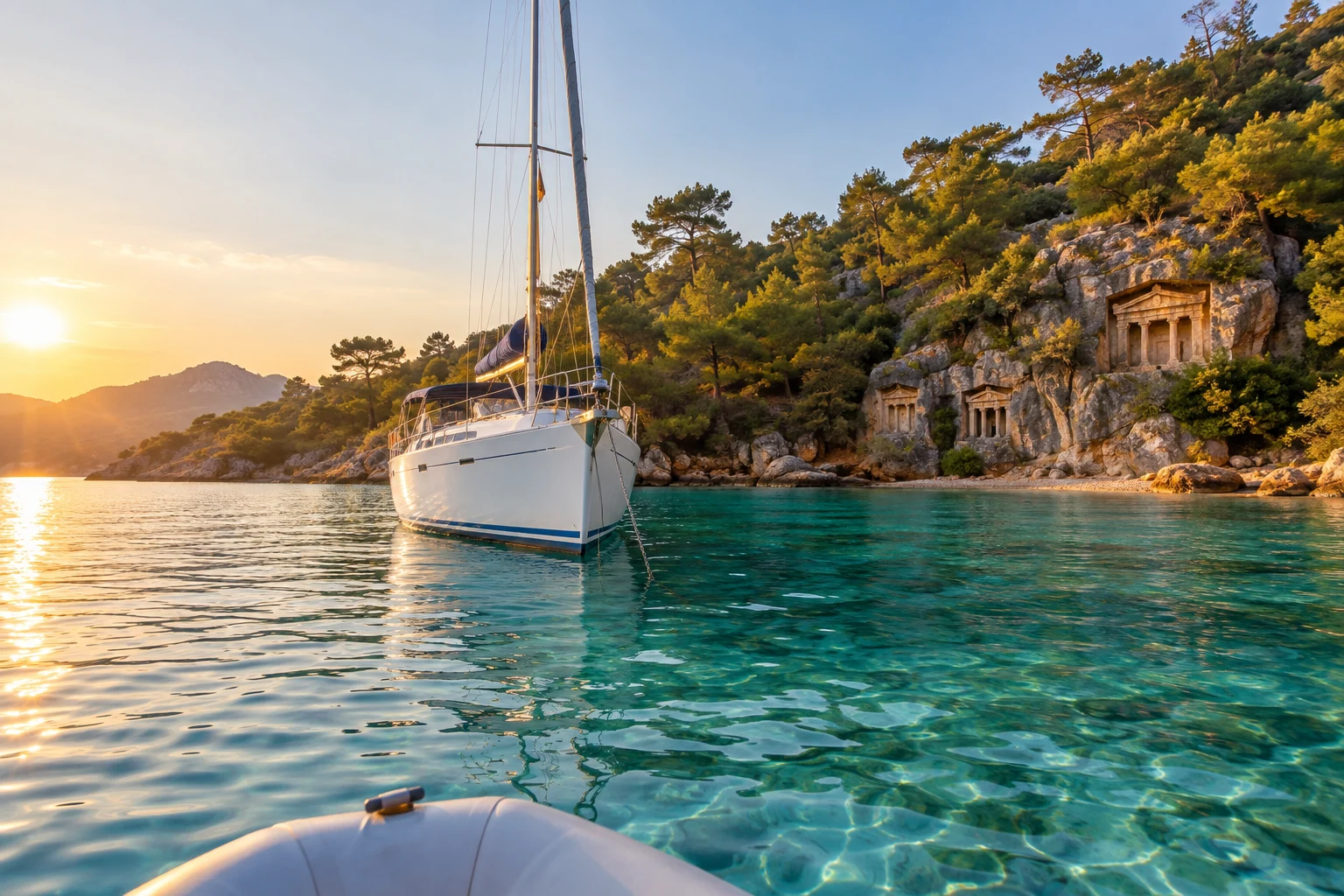
Turkish coast sailing stands apart from the rest of the Mediterranean for one simple reason: the water. The coastline between the Aegean and the Mediterranean is lined with pine-fringed bays and anchorages where the sea holds a clarity that rivals the Caribbean. Most cruising grounds put you within a short sail of ancient ruins that come right down to the waterline, so you can anchor for lunch and swim to a Lycian rock tomb.
The culture is a second draw. Mediterranean sailing Turkey offers a mix of Ottoman and Greek influences that you will not find in Greece or Italy, from waterfront tea gardens to village markets. Marina quality is consistently high, with modern facilities and reliable services at most major ports.
The coast suits every experience level. Bareboat charters work for confident crews, while skippered charters and flotillas give less experienced sailors the same access. The stretch between Göcek and Fethiye is the classic starting point, protected waters with steady winds and short hops between anchorages.
Step 1: Choose Your Ideal Sailing Region and Base
| Base | Location | Airport Proximity | Marina Size | Best For |
|---|---|---|---|---|
| Bodrum | Gulf of Gökova (western end) | Varies | Varies | Families, Nightlife, Long Passages, Culture |
| Marmaris | Datça Peninsula (gateway) | Dalaman Airport (easy) | Large, Modern | Dramatic Coastline, Empty Bays |
| Fethiye | Cruising Heartland | Dalaman Airport (close) | Varies | First-time Charterers, Butterfly Valley |
| Göcek | Fethiye Bay System | Dalaman Airport (short) | Modern | Relaxed Cruising, Short Distances, Quiet |
Four marinas handle the vast majority of Turkish bareboat and skippered charters: Bodrum, Marmaris, Fethiye, and Göcek. Each offers a different flavour of the Turkish coast.
Bodrum sits at the western end of the Gulf of Gökova, ideal for families to practise manoeuvres in protected waters. The town itself is a lively resort with a medieval castle, busy nightlife, and strong cultural links to the nearby Greek islands. Bodrum suits sailors who want a mix of onshore entertainment and long, breezy passages within the Gulf.
Marmaris is the main gateway to the Datça Peninsula. The marina is large, modern, and the transfer from Dalaman Airport is straightforward. Marmaris's best-known advantage is the dramatic coastline to the east, particularly around Bozburun, where the water is deep and the bays are frequently empty.
Fethiye is the cruising heartland. Sailing routes from Fethiye typically head east, including the famous Butterfly Valley and the sunken city of Kekova. Its proximity to Dalaman Airport keeps transfers shorter than any other Turkish base.
Göcek is a small, quiet alternative to the bustle of Fethiye, with a modern marina and access to the same protected bay system. Sailors seeking the most relaxed cruising in Turkey, with short distances and calm evening anchorages, usually consider Göcek the simplest choice.
For a first charter, the Göcek-Fethiye region is the classic entry point. For experienced crews who want to push a boat, Bodrum's open waters and longer passages offer more challenge.
Step 2: When Is the Best Time to Sail in Turkey?
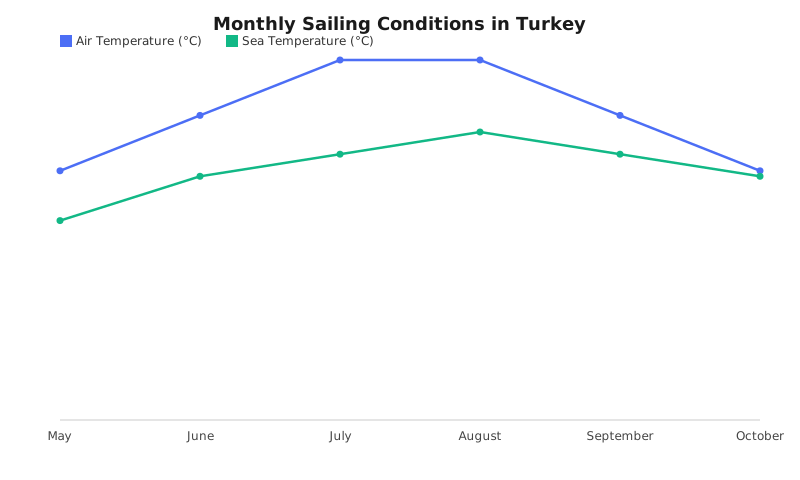
The best time to sail Turkey is from May through October, with June and September offering the most balanced conditions. These months deliver reliable wind, warm water, and manageable crowds at the main charter bases.
| Month | Conditions | Crowds & Prices | Notes |
|---|---|---|---|
| May | Mild, 20-25°C air, sea ~18°C | Low crowds, moderate prices | Early season; some tavernas still closed |
| June | Ideal: 25-30°C, Meltemi winds begin | Building crowds, higher prices | Best balance of comfort and breeze |
| July | Hot, 30-35°C, strong Meltemi | Peak crowds, peak prices | Expect busy anchorages; great wind |
| August | Hottest, calmest stretches | Peak crowds, peak prices | Book far ahead; midday heat is intense |
| September | Warm, 25-30°C, steady winds | Crowds ease, prices drop | Often considered the hidden sweet spot |
| October | Comfortable, 20-25°C, lighter wind | Low crowds, low prices | Late season; some services wind down |
Water temperature peaks at about 26°C in August and stays swimmable into October. The Meltemi, a northerly summer wind, builds through June and is strongest in July and August, giving reliable sailing in the Göcek-Fethiye region but occasionally gusting hard near headlands.
Events worth noting: the Marmaris International Yacht Festival in May and the Bodrum Cup in October attract extra boats and spectators. For a first charter in the Göcek-Fethiye area, June or September is the strongest choice.
Step 3: Yacht Charter Types Explained—Which Is Right for You?
| Charter Type | Experience Required | Privacy | Cost Level | Typical Group Size |
|---|---|---|---|---|
| Bareboat | High | High | Moderate | 2-10 |
| Skippered | Low | Moderate | Moderate-High | 2-10 |
| Crewed | None | Moderate | High | 2-12 |
| Flotilla | Moderate | Low | Moderate | Varies |
| Gulet | None | Moderate | Moderate-High | 8-16 |
The charter type you choose determines how much responsibility you carry and how much support you get. Turkey yacht charter planning starts with picking between bareboat, skippered, crewed, flotilla, and gulet options.
Bareboat charter
A bareboat charter gives you the boat with no crew. You are the captain, responsible for navigation, docking, and safety. This option is for experienced sailors who hold a recognized sailing license and can handle a 40-50 foot yacht with confidence.
The appeal is total independence. You set your own pace, choose your own anchorages, and pay less than any crewed option.
Skippered charter
A skippered charter provides a professional captain who handles the boat while you relax or learn. You get the freedom of a private yacht without the stress of piloting it. The skipper handles navigation and docking; you handle the itinerary, with their advice.
This is the most popular choice for first-time charterers and mixed-ability groups. It lets less experienced sailors enjoy remote bays that would be risky to approach without local knowledge. Most skippers also cook simple meals and know which restaurants are worth the mooring fee.
Crewed charter
A crewed charter adds a host or cook to the skipper, and often a deckhand. All meals, cleaning, and service are handled for you. The yacht runs like a small floating hotel.
This suits celebrations, honeymoons, and groups who want a full-service holiday rather than a sailing trip. It is the most expensive option per person, but the level of comfort is far higher than any bareboat.
Flotilla sailing
A flotilla is a group of 8 to 12 yachts that sail together with a lead boat crewed by experienced staff. You sail your own bareboat or skippered yacht during the day, then meet in the evening at a pre-arranged anchorage for socializing and guidance.
Flotilla sailing Turkey is the best middle ground for new bareboaters who lack confidence. The lead crew helps with mooring, offers daily route briefings, and sorts out problems quickly. It is also a social format, good for solo sailors and couples who want company at anchor.
Gulet cruise
A gulet is a traditional Turkish wooden yacht, usually 60 to 100 feet long, with a full crew and a separate cabin for every guest. You do no work at all.
This is the classic Turkish coast holiday. Gulets have large deck lounging areas, indoor saloons, and a dedicated cook who produces several meals a day. They are ideal for multi-generational family groups, large friend groups, and anyone who wants to see the coast without touching a winch.
Yacht types and amenities
The main sailing yacht choices in Turkey are monohulls and catamarans. Monohulls (30-55 feet) are the traditional choice. They sail closer to the wind, heel more, and fit into smaller anchorages. Catamarans offer more deck space, stability, and shallow draft, making them popular with families.
Step 4: Do You Need a Sailing License in Turkey?
Yes, you need a sailing license to charter a bareboat yacht in Turkey. Turkish authorities require a valid certificate that proves your competence, and charter companies will ask to see it before you leave the dock. The most widely accepted documents are the RYA Day Skipper or higher, the International Certificate of Competence (ICC), and the American Sailing Association (ASA) certifications.
The license must match the size of the yacht you plan to charter. Most Turkish charter companies require proof of at least one or two seasons of sailing experience in addition to the certificate itself. If your license is not in English, carry a certified translation, and always bring the physical document rather than relying on a photo.
How to charter without a license
If you do not have a recognized certificate, you can still sail Turkey by booking a skippered or crewed charter. With a skippered charter, a professional captain handles navigation, docking, and local regulations while you sail, relax, or learn. A crewed charter adds a host and often a deckhand, turning the trip into a full-service holiday with no sailing responsibilities at all.
Tips for first-timers
First-timers should carry their passport, sailing certificate, and a copy of their charter agreement at all times. Local rules require yachts to display the Turkish flag courtesy ensign, and you must check in and out at official ports rather than anchoring freely along the coast. Check your charter insurance policy for the deductible and confirm whether it covers the anchor, dinghy, and outboard motor, as these are the most commonly damaged items.
Step 5: Planning Your Route—Top Sailing Itineraries in Turkey
| Route | Daily Highlights | Approximate Distances (NM) |
|---|---|---|
| Bodrum–Gökova | Nightlife, Pine-clad coves | Varies |
| Marmaris–Fethiye | Datça Peninsula, Bozburun anchorages | Varies |
| Göcek Bays | Protected anchorages, Short hops | Lower |
| Lycian Coast (Fethiye–Kas–Kekova) | Dramatic scenery, Ancient ruins | Varies |
Turkey's sailing routes cluster around four main bases, each with a distinct character. The Bodrum–Gökova route mixes lively nightlife with the pine-clad coves of the Gulf of Gökova. The Marmaris–Fethiye passage takes you past the Datça Peninsula and the empty anchorages around Bozburun. The Göcek Bays offer short hops between protected anchorages, ideal for relaxed cruising. The Lycian coast, running east from Fethiye toward Kas and Kekova, delivers the most dramatic scenery and the richest concentration of ancient ruins.
Must-see stops
Across these routes, a handful of anchorages stand out. In Gökova, Cleopatra Island hides a beach of crushed shells that, according to legend, was laid for the queen herself. The bays around Göcek are best known for quiet swimming spots and the ruined village of Kayaköy near Fethiye. On the Lycian coast, Kekova's sunken city is visible through clear water from the deck, and the harbor at Kas makes a lively overnight stop. Farther west, the inlet at Bozburun offers a protected evening anchorage and a working boatyard where gulets are still built by hand.
Sample 7-day itineraries
For a bareboat charter from Bodrum, head south into Gökova. Day 1: overnight in Bodrum to provision. Day 2: sail to English Harbor. Day 3: Cleopatra Island and Sedir Island. Days 4-5: continue to Bozburun, then cross to Symi if time and wind allow. Days 6-7: return via the Datça Peninsula, with a final night at anchor before checking back in.
For a skippered charter from Göcek or Fethiye, the classic week runs east. Day 1: settle in aboard. Day 2: sail to Butterfly Valley. Day 3: cross to Kas. Day 4: explore Kekova and the sunken city. Day 5: head to Kalkan. Day 6: return west via Gemiler Island and its Byzantine ruins. Day 7: sail back for a final dinner in Göcek.
Whichever route you pick, the prevailing northerly Meltemi shapes your plan. In July and August it blows hardest in the afternoon, so schedule morning passages and anchor by early afternoon. In May and October, lighter winds mean you can cover more distance in a day without the afternoon gusts.
Step 6: Budgeting—How Much Does a Sailing Trip in Turkey Cost?
| Yacht Type | Season | Weekly Rate (EUR) | Daily Rate (EUR) | Extras (Weekly Est. EUR) |
|---|---|---|---|---|
| Bareboat Monohull (38-40 ft) | Shoulder (May, Jun, Sep, Oct) | 1,500 - 2,500 | N/A | Fuel: 200-400, Mooring: 210-560, Provisioning (2p): 200-350 |
| Peak (Jul, Aug) | 2,500 - 4,000 | N/A | Fuel: 200-400, Mooring: 210-560, Provisioning (2p): 200-350 | |
| Catamaran / Gulet | Shoulder (May, Jun, Sep, Oct) | 30-50% Higher | N/A | Varies by operator |
| Peak (Jul, Aug) | 30-50% Higher | N/A | Varies by operator | |
| Crewed (Skipper) | All | N/A | Skipper: 150-200 | Skipper food/drink |
| Crewed (Host/Cook) | All | N/A | Host/Cook: 100-150 | Host/Cook food/drink |
The cost of a Turkey yacht charter is determined by three factors: season, yacht type, and crew arrangements. A bareboat monohull in the shoulder season (May, June, September, October) starts around €1,500 to €2,500 per week for a 38-40 foot yacht. The same yacht in July or August runs €2,500 to €4,000. Catamarans and gulets command a premium, often 30-50% higher than monohulls of comparable length.
The base charter fee is rarely the full picture. Budget for fuel, mooring fees, provisioning, and crew costs. A week of fuel for a 40-foot monohull typically runs €200 to €400 depending on how much you motor. Marina berths cost €30 to €80 per night, though anchoring in a bay is free. Provisioning for two people runs €200 to €350 for the week if you shop at local markets rather than marina minimarkets.
Skipper fees add roughly €150 to €200 per day, plus you cover their food and drink. A host or cook adds another €100 to €150 per day. For a week with a skipper, expect total costs of €2,500 to €4,500 per couple, all in.
To keep the total down, book early for the best yacht selection, sail in the shoulder season, and share the boat. A group of six to eight people splits the skipper fee and provisioning across more heads, which can cut the per-person cost by nearly half compared to a couple.
Step 7: What to Pack and Prepare for Your Sailing Holiday in Turkey
Pack for layers and sun, not for a resort. Lightweight, quick-dry clothing, non-marking deck shoes, and a wide-brim hat are essential. Cotton holds sweat and stays damp; merino or synthetic fabrics dry fast and keep you comfortable through hot afternoons and cooler evenings on the water.
A soft-sided duffel beats a hard suitcase. It stows easily in a cabin locker and you will not need formal wear. For electronics, bring a power bank, a dry bag for your phone, and a 12V car charger adapter, since yacht outlets vary. Your travel documents are the one thing you cannot replace: passport, sailing certificate or license, charter agreement, and travel insurance. Keep photocopies in a waterproof pouch.
Sun protection is non-negotiable. Use reef-safe sunscreen with SPF 50, reapply often, and wear polarized sunglasses to cut glare off the water. For provisioning, buy fresh bread, olives, cheese, and local produce from market stalls. Carry a basic first-aid kit for cuts and seasickness.
Currency is cash in smaller ports. Many marinas and restaurants take cards, but village markets and some tavernas do not. Turkish lira works best for small purchases. Etiquette stays relaxed: greet locals with a friendly "Merhaba," and dress modestly when you go ashore in villages. For space efficiency, roll clothes and use compression cubes.
Sailing Safety and Practical Tips for Turkey's Waters
Turkey's waters are well-marked and generally forgiving, but safe sailing depends on preparation. The Turkish Coast Guard is the primary authority for maritime emergencies; dial 158 from any phone or VHF channel 16 if you are in distress. For non-emergency weather updates, check the official Turkish State Meteorological Service forecasts daily, as the Meltemi wind can build quickly in July and August.
Marina protocols are straightforward if you plan ahead. Call ahead on VHF channel 73 to confirm berth availability, and have your lines and fenders ready before you enter the harbor. Anchor in the soft mud or sand inside designated bays, and never anchor on the Posidonia oceanica seagrass beds, as this damages the ecosystem and is increasingly regulated.
Local navigation has a few quirks. Many bays dry out close to shore, so check your charts for depth and always use a bow lookout when anchoring. Health-wise, carry a basic first-aid kit with seasickness tablets, and ensure your travel insurance covers sailing activity, including a potential evacuation. For environmental care, take all rubbish ashore, use reef-safe sunscreen, and avoid single-use plastics.
Frequently Asked Questions
How many days do I need for a sailing trip in Turkey?
Most itineraries range from 4 to 7 days for a thorough experience of a single region like the Göcek-Fethiye loop. Longer trips of 10 to 14 days allow exploration of more remote anchorages and multiple regions, such as combining the Datça Peninsula with the Lycian coast.
Is it safe to sail in Turkey as a beginner?
Yes, Turkey's coast is well-charted with many sheltered bays and modern marinas. Beginners should consider skippered or flotilla charters for added safety and confidence. The Göcek-Fethiye region is the most forgiving starting point, with short passages and protected waters.
Can I join a sailing trip without booking an entire yacht?
Cabin charters and gulet cruises are available for solo travelers or small groups. These options are fully crewed and offer a social, hassle-free experience. You get a private cabin, all meals included, and no sailing responsibilities.
What are the best months for a sailing holiday in Turkey?
May, June, September, and October offer the best balance of pleasant weather and fewer crowds. July and August are the hottest and busiest, ideal for warm sea swimming but with peak prices and crowded anchorages. The last two weeks of September give summer water temperatures with autumn prices.
What local foods should I try on a sailing trip in Turkey?
Sample mezes, grilled seafood, Turkish breakfast, and dishes like gözleme and baklava. Many coastal towns have vibrant markets and seaside restaurants accessible by yacht. Provision simply from local market stalls with fresh bread, olives, and cheese for onboard meals.
The practical first step is deciding between the Göcek-Fethiye area and Bodrum or Marmaris, then matching that choice to your experience level and budget. For a first charter, book a skippered monohull out of Göcek in June or September, when winds are steady, crowds are thinner, and prices sit well below July peaks. Confirm your license or crew arrangement before you pay a deposit, and reserve early for July and August dates.
Once your week is booked, work backward: pick an itinerary with daily passages under 20 nautical miles, provision from a marina supermarket, and download wind and weather apps that cover the Turkish coast. The rest is anchoring, swimming, and letting the Meltemi do the work.
Explore next
Destination guide
Turkey
Turkey's Aegean and Turquoise Coast offer some of the best sailing in the Mediterranean. Here's where to base your charter and what to expect.