Hidden and additional yacht charter costs typically include VAT, Advance Provisioning Allowance (APA), fuel, port fees, provisioning, crew gratuity, insurance, and cleaning. These expenses can add 25–55% or more to the base price you see advertised. Understanding each fee is the difference between a smooth vacation and a budget surprise at the dock.
The advertised weekly rate on a sailing yacht charter almost never reflects what you will actually pay. That number covers the boat itself, and little else. Once you add taxes, operating expenses, and the crew or marina costs that vary by destination, the total climbs quickly.
This guide breaks down each cost layer, explains how they differ by boat type and region, and gives you a realistic budgeting framework before you sign a charter contract.
Understanding the True Cost of a Sailing Yacht Charter
| Cost Category | Bareboat Charter (Sailing Yacht) | Skippered Charter (Sailing Yacht) |
|---|---|---|
| Base Charter Fee | Included | Included |
| Security Deposit | Excluded | Excluded |
| Mandatory Extras | ||
| Transit Log | Excluded | Excluded |
| Cleaning Fee | Excluded | Excluded |
| End Cleaning Fee | Excluded | Excluded |
| Variable Costs | ||
| Provisions | Excluded | Excluded (often mandatory fee) |
| Diesel | Excluded | Excluded |
| Mooring Fees | Excluded | Excluded |
| Skipper's Wage | N/A | Included |
| Hostess Wage | N/A | Excluded |
| Regional Variations | ||
| Fuel/Water (Med) | Metered | Metered |
| Marina Fees (Caribbean) | Higher per-night | Higher per-night |
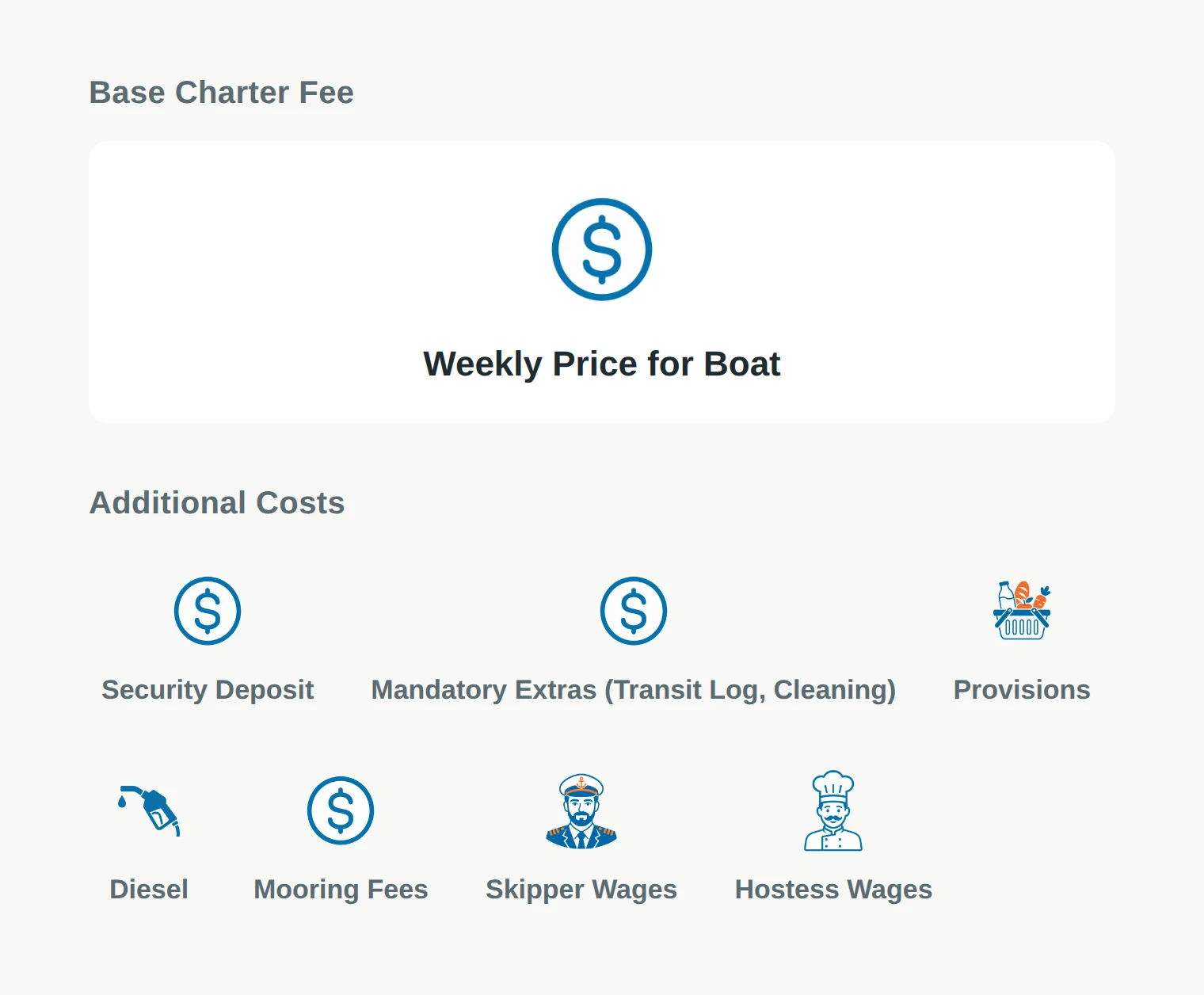
The base charter fee is the weekly price you pay to rent the boat itself. Every other expense, from the security deposit to provisioning, fuel, and port fees, sits on top of that number.
A typical sailing yacht charter cost structure breaks down into four layers: the charter fee, the refundable security deposit, the mandatory extras (transit log, cleaning, and end cleaning fees), and the variable costs you control (provisions, diesel, mooring fees, and skipper or hostess wages if crewed). Most operators quote the first layer and leave the rest to the booking contract.
Costs vary sharply by boat type. A catamaran's twin engines and wider beam push fuel burn and marina fees higher than a comparable monohull, though its shallow draft opens cheaper anchoring options. Bareboat charters shift all variable costs to you, while skippered charters bundle the skipper's daily wage but often add a mandatory provisioning fee. Geography drives the final variable: Greece and Turkey price fuel and water by the meter, while Caribbean marinas charge premium per-night rates.
What Are the Most Common Hidden and Additional Yacht Charter Costs?
| Cost Category | What it Covers | When/How Paid | Average Price Ranges |
|---|---|---|---|
| Taxes & Fees | |||
| VAT | Value Added Tax | Upfront (with base fee) | 8% - 24% of base rate |
| Customs Fees | Cross-border itineraries | Varies | Varies by region/route |
| Operational Expenses | |||
| Advance Provisioning Allowance (APA) | Fuel, port fees, food, drinks (crewed) | Before departure (prepaid account) | 25% - 35% of base charter fee |
| Fuel | Engine operation | Drawn from APA / Top-ups post-charter | Varies (Higher for motor yachts) |
| Port Fees / Mooring Charges | Dockage, marina services | Drawn from APA | Varies (Free to $300+ per night) |
| Provisioning | Groceries, food, drinks | Drawn from APA (crewed) / Self-purchased (bareboat) | Varies |
| Cleaning / End-Cleaning | Post-charter cleaning | Upfront (mandatory bareboat) | $150 - $400 |
| Delivery / Redelivery | Moving yacht to/from different base | Upfront | Varies by distance |
| Security Deposit | Damage, incidentals | Upfront (refundable) | Typically one week's fee |
| Optional Extras | |||
| Crew Gratuity | Service tip for crew | Post-charter (cash) | 10% - 20% of base fee |
| Shore Excursions | Activities off the yacht | Varies | Varies |
| Water Sports Equipment | Rental of additional gear | Varies | Varies |
| Communications Packages | Wi-Fi, satellite phone | Varies | Varies |
The most frequent additional yacht charter costs fall into three groups: taxes and fees, operational expenses, and optional extras. VAT is the biggest fixed surprise, often adding 8% to 24% to the base rate depending on the country. The Advance Provisioning Allowance (APA) is the second major line item, typically 25% to 35% of the base charter fee, covering fuel, port fees, food, and drinks.
Fuel is a variable cost that hits motor yachts far harder than sailing yachts. Port fees and mooring charges vary wildly by region, from free anchoring in Greece to $300-plus per night at Caribbean marinas.
The APA is the single most important number to understand, because it is a prepaid expense account. The captain draws from it during the charter and you settle the difference at the end, either refunding unused funds or paying the shortfall.
Provisioning is usually folded into the APA on crewed charters, but on bareboat charters you buy your own groceries. Crew gratuity is not mandatory but is customary at 10% to 20% of the base fee, paid in cash at the end. Insurance is often included in the base rate, but the refundable security deposit, typically one week's fee, is held upfront against damage.
Cleaning and end-cleaning fees are mandatory extras on most bareboat charters, ranging from $150 to $400. Delivery and redelivery costs apply if you pick up or drop off at a different port. Customs fees matter for cross-border itineraries, and shore excursions, water sports equipment, and communications packages are optional add-ons you control.
Payment timing splits into three phases: the deposit and base fee upfront, the APA and provisioning before departure, and gratuity, fuel top-ups, and any APA shortfall after the charter ends.
How Does the Advance Provisioning Allowance (APA) Work on Sailing Yacht Charters?
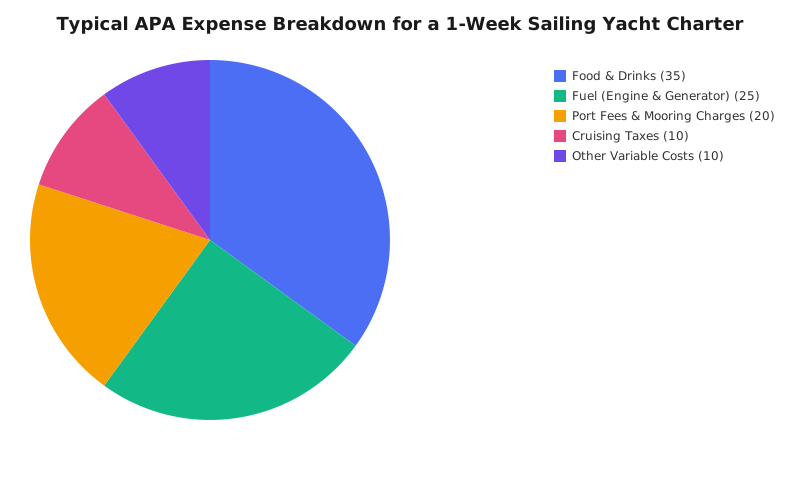
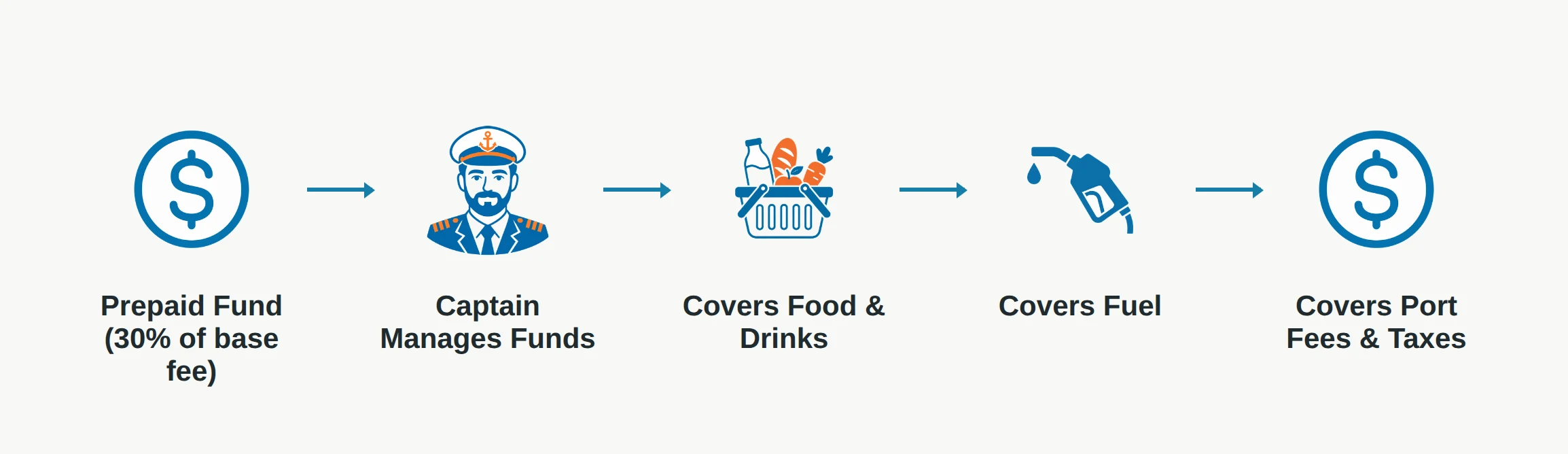
The Advance Provisioning Allowance (APA) is a prepaid fund the charter company collects before your trip, typically 30% of the base charter fee for sailing yachts. It covers all variable operating costs during your charter: food and drinks, fuel for the engine and generator, port fees, mooring charges, and cruising taxes. The APA exists so the captain can cover expenses as they arise without asking you for money mid-sail.
Your captain manages the APA like a dedicated bank account, logging every purchase and keeping receipts. You have the right to review the accounting at any time during the charter.
Reconciliation: refunds and shortfalls
At the end of the charter, the captain reconciles actual spending against the APA. If you spent less than the allowance, you get a refund. If you spent more, you owe the difference, usually payable by card or cash before you disembark.
The APA percentage differs by vessel type. Sailing yachts typically require 25% to 35% of the base fee, while motor yachts often ask for 35% to 45% because their fuel burn is dramatically higher. For a $10,000 weekly sailing charter, expect an APA of $2,500 to $3,500.
The unexpected yacht charter expenses that surprise most guests are tender fuel, water taxi fares, and the daily cruising tax some countries levy per person. Clarify with your broker exactly which line items the APA covers, since definitions vary between charter companies.
Taxes, VAT, and Local Fees: What Should You Budget For?
| Destination | VAT Rate | Typical Port Fees (per night) | Notes |
|---|---|---|---|
| Greece | 8% | Varies | |
| Croatia | 24% | Varies | |
| Italy | 24% | Varies | |
| British Virgin Islands | 4% | $300+ (premium marinas) | |
| US Virgin Islands | 10% | Varies | |
| Thailand | 7% | Varies | |
| Indonesia | 11% | Varies | |
| Bahamas | Varies | Varies | Flat cruising permit per boat |
| Mediterranean (General) | Varies | Varies | Environmental/tourist taxes common |
| Caribbean (General) | Lower overall | Varies | |
| Galápagos | Varies | Varies | Environmental/tourist taxes common |
VAT is the single largest tax line in a sailing charter budget, and it applies to the base charter fee, not just to onboard purchases. Rates differ sharply by region. In the Mediterranean, VAT runs from 8% in Greece up to 24% in Croatia and Italy. The Caribbean sits lower overall, with the British Virgin Islands at 4% and the US Virgin Islands at 10%. Southeast Asia spans the range too, with Thailand at 7% and Indonesia around 11%.
Port, customs, and environmental fees pile on top of VAT. Port fees can run from a few dollars for a basic anchorage to $300 or more per night in premium Caribbean marinas. Customs fees appear when your itinerary crosses national borders, and some countries, like the Bahamas, charge a flat cruising permit per boat. Environmental or "tourist" taxes are increasingly common, especially in the Mediterranean and the Galápagos.
Your APA usually covers port and cruising permit fees on a crewed charter, but tax treatment varies by company. Before you sign, confirm in writing whether the quoted rate is inclusive or exclusive of VAT.
Fuel, Provisioning, and Water Sports Equipment: What's Not Included?
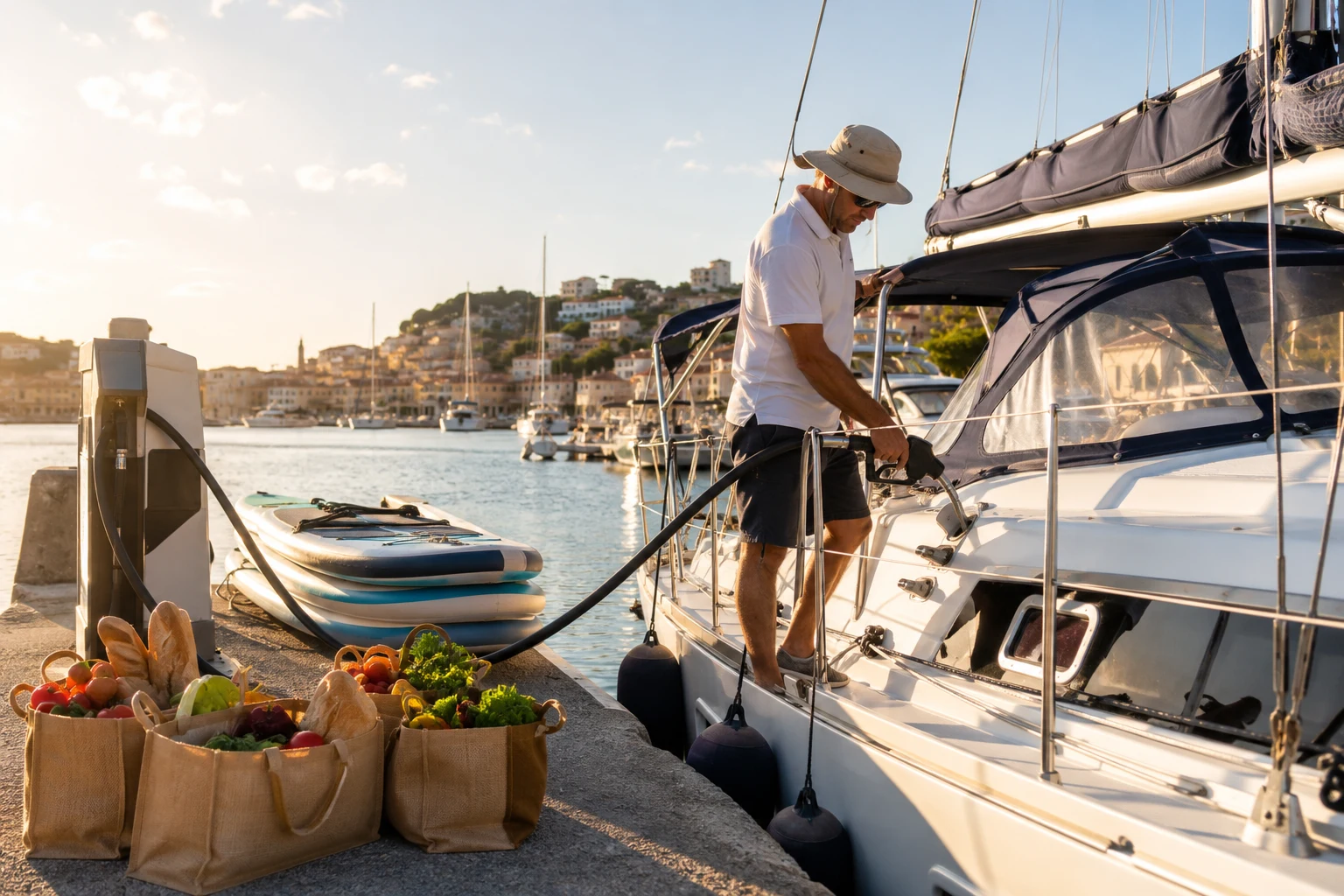
Fuel is the most variable line item on a sailing charter, and it is almost never included in the base rate. A typical bareboat monohull burns 5–10 liters per hour under engine, while a cruising catamaran with twin diesels can double that figure. For a week of motoring in light air, plan on $300–$700 for fuel, plus another $50–$100 for dinghy and generator use.
Provisioning is a separate cost you control directly. Charter companies offer pre-order packages, but you will pay retail markup plus a handling fee. Buying groceries locally at the port market is usually 20–30% cheaper. Budget $40–$60 per person per day for three meals, snacks, and drinks; add 10–15% if you want premium coffee, wine, or specialty dietary items.
Water sports gear is rarely included beyond basic snorkeling masks and fins. Kayaks, paddleboards, and fishing tackle rent for $100–$250 per week per item, and scuba gear or a dive guide adds $300–$800 depending on the destination.
The single best way to avoid surprises is to get every line item in writing before you sign. Ask specifically whether the quoted rate includes the transit log, final cleaning, and dinghy fuel.
Are Crew Gratuities, Insurance, and Cleaning Fees Included?
No, these three costs are almost never folded into the advertised base charter rate, and each is handled differently. Crew gratuity is customary but not legally required; insurance may be mandatory depending on the charter company and destination; cleaning fees are a fixed, non-refundable charge on most bareboat charters.
Crew gratuity
The industry standard for a yacht charter crew gratuity is 10-20% of the base charter fee, with 15% as the common midpoint. You typically give it in cash at the end of the charter, either directly to the captain or in an envelope for the crew to split. On crewed charters, the APA does not cover gratuity, so budget for it as a separate line item.
Insurance
Charter insurance is mandatory at most reputable companies, and the base rate never includes it. What it covers varies: most policies protect the security deposit against accidental damage, while liability and cancellation coverage are often optional add-ons. The charter contract will state the minimum required coverage, and you usually need to provide proof of insurance before boarding.
Cleaning fees
Cleaning fees apply mainly to bareboat charters, where you return the boat as you found it. Expect a mandatory final cleaning charge of $150-$400, which covers the professional deep clean between charters.
Other Potential Extra Charges: Delivery, Communications, and Shore Excursions
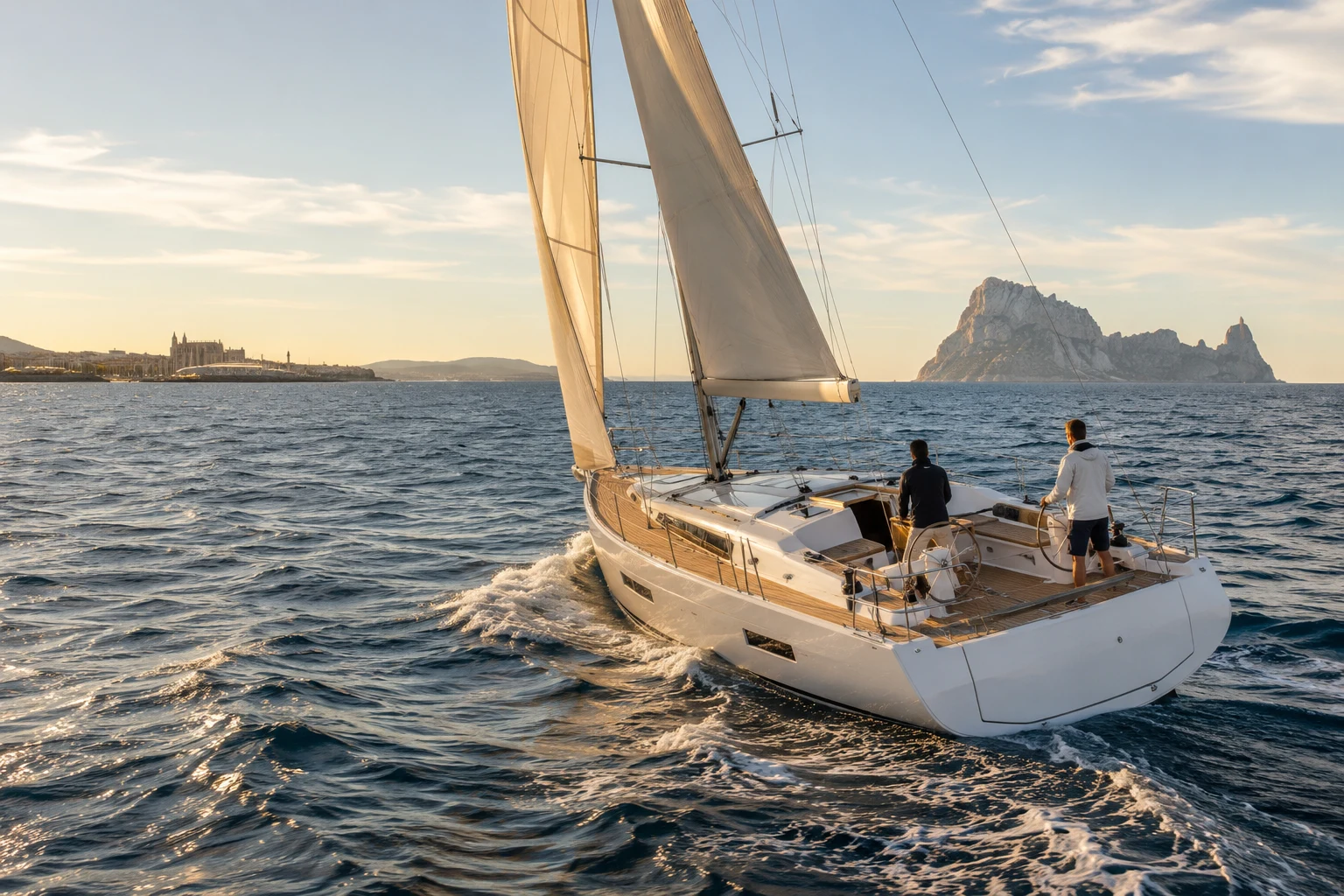
Yacht charter delivery fees apply when you pick up or drop off the boat at different locations. A one-way itinerary between distant ports can add $500 to $2,000 or more, depending on distance and whether the crew must sail the boat back.
Onboard communications are rarely included in the base rate. Basic Wi-Fi may cost $50 to $150 per week, while satellite phone or premium data packages run $200 to $500.
Shore excursions and third-party activities are separate from the charter fee. Diving trips, guided tours, and restaurant meals ashore are usually paid directly to the local provider. The captain can book these, but you pay the bill at cost.
How to Avoid or Minimize Unexpected Yacht Charter Expenses
The most effective way to avoid surprise costs is to demand a fully itemized written quote before you sign anything. A reputable charter company will gladly break down the base rate, APA, taxes, and mandatory fees like cleaning or transit log charges.
Ask pointed questions about the APA and fuel policy. Clarify exactly what the Advance Provisioning Allowance covers, since definitions vary widely by company and region. In Greece or Turkey, request a "sail-only" fuel plan so you pay only for what you burn under motor.
Confirm gratuity expectations and insurance terms in writing. Crewed charter gratuities typically run 10–20% of the base fee and are paid in cash at the end. Verify whether the security deposit is refundable in full and what damage scenarios trigger deductions.
Control variable costs through route planning. Anchor in free harbors instead of marinas, and provision strategically at local markets rather than premium chandlers. These choices can trim hundreds of dollars from your final invoice.
Real-World Charter Scenarios: What Will You Actually Pay?
| Scenario | Base Rate | APA / Provisions | Fees & Fuel | Gratuity | Estimated Total |
|---|---|---|---|---|---|
| Bareboat monohull, Med, 1 week | $3,500 | $800 | $500 | N/A | ~$4,800 |
| Skippered catamaran, Caribbean, 1 week | $9,000 | $2,700 | Varies | $1,350 | ~$13,050 |
| 'Below Deck'-style charter, 3 days | Higher | Higher | Higher | Expected | Varies by operator |
The true cost of yacht charter becomes clear only when you model a full trip. A week-long bareboat charter of a 40-foot monohull in Greece, quoted at $3,500, typically lands near $4,800 once you add the transit log, cleaning fee, fuel, mooring, and provisions for four people.
A skippered catamaran in the Caribbean tells a different story. A $9,000 weekly base rate plus a 30% APA ($2,700) and a 15% gratuity ($1,350) pushes the total past $13,000 before you step aboard. Group size drives this: splitting that cost across eight guests changes the per-person math dramatically compared to a couple on a monohull.
Duration matters as much as headcount. A two-week itinerary doubles the base fee but not the delivery charges or the one-time cleaning fee, so the per-day cost drops. Off-season bookings in the Mediterranean can cut base rates by 30-40%.
| Scenario | Base Rate | APA / Provisions | Fees & Fuel | Gratuity | Estimated Total |
|---|---|---|---|---|---|
| Bareboat monohull, Greece, 1 week, 4 guests | $3,500 | $800 | $500 | n/a | ~$4,800 |
| Skippered catamaran, Caribbean, 1 week, 8 guests | $9,000 | $2,700 | $400 | $1,350 | ~$13,450 |
| Bareboat catamaran, Croatia, 2 weeks, 6 guests | $7,000 | $1,600 | $900 | n/a | ~$9,500 |
The pattern is consistent: budget 30-40% above the advertised base rate for a bareboat, and 45-60% for a crewed charter. Yacht charter surcharges are not hidden if you ask for a line-item breakdown before signing.
Frequently Asked Questions
What are the hidden costs of chartering a sailing yacht?
The most common additional costs are VAT, the Advanced Provisioning Allowance (APA), fuel, port fees, provisioning, crew gratuity, insurance, and cleaning fees. Which ones apply depends on your region, the charter type (bareboat versus skippered), and the size of the yacht. Always ask for a complete list before signing.
How much does fuel typically cost for a sailing yacht charter?
Fuel costs for sailing yachts are usually far lower than for motor yachts, often €100–€400 per week with moderate sailing. Extended motoring in calm conditions, running generators, or using air conditioning will push that figure up quickly. Bareboat charters typically charge for fuel actually used on top of the base rate.
Are crew tips included in the price of a yacht charter?
Crew gratuity is almost always extra and never included in the base charter price. The industry standard is 10–20% of the charter fee, usually handed over in cash at the end of the trip. Check your contract to see if a tipping policy is specified before you sail.
What is the average VAT rate for yacht charters in the Mediterranean?
VAT rates range from 8% in Greece to 24% in Italy, with most Mediterranean countries charging between 12% and 20%. The rate applies to the charter fee and sometimes to the APA as well. Confirm in your contract whether VAT is included in the quoted price or added on top.
How can I avoid unexpected yacht charter expenses?
Request an all-inclusive quote that itemizes exactly what is included and excluded. Ask directly about the APA, taxes, gratuities, port fees, and any surcharges before you pay a deposit. Read the contract terms carefully, since most disputes come from charges that were disclosed but overlooked.
Are port fees included in sailing yacht charter contracts?
Port fees are rarely included in the base charter rate and are usually paid as you go or drawn from the APA. Marina charges vary widely by destination, with popular harbors in France and Italy costing significantly more than smaller Greek anchorages. Budget for them separately if you plan to dock every night.
What is the 12 person rule on a yacht?
International maritime law limits most charter yachts to 12 guests plus crew, no matter how large the vessel is. This rule comes from passenger vessel safety regulations. If your group exceeds 12 people, the yacht needs special certification or must be registered as a passenger vessel, which is rarely available for private charter.
Where is the least expensive place to charter a sailing yacht?
Greece, Croatia, and Thailand consistently offer the most competitive sailing yacht charter rates. Outside peak season, prices in most destinations drop substantially, often by 30–50% compared to July and August. Sailing in the shoulder season cuts costs and gives you lighter winds and fewer crowded anchorages.
The real cost of a sailing charter is the base rate plus 30-40% for a bareboat and 45-60% for a crewed boat. Before you sign, ask for an itemized quote that lists the APA percentage, fuel policy, cleaning fee, and VAT. Then build your own budget line by line: provisions at $40-60 per person per day, mooring and marina fees for your planned route, and gratuity if you are hiring a crew.
Anchor more than you dock, provision from local markets instead of pre-order packages, and confirm every policy in writing. A $3,500 week in Greece should cost you around $4,800. Plan for that number, not the advertised one, and the only surprise left will be a favorable one.