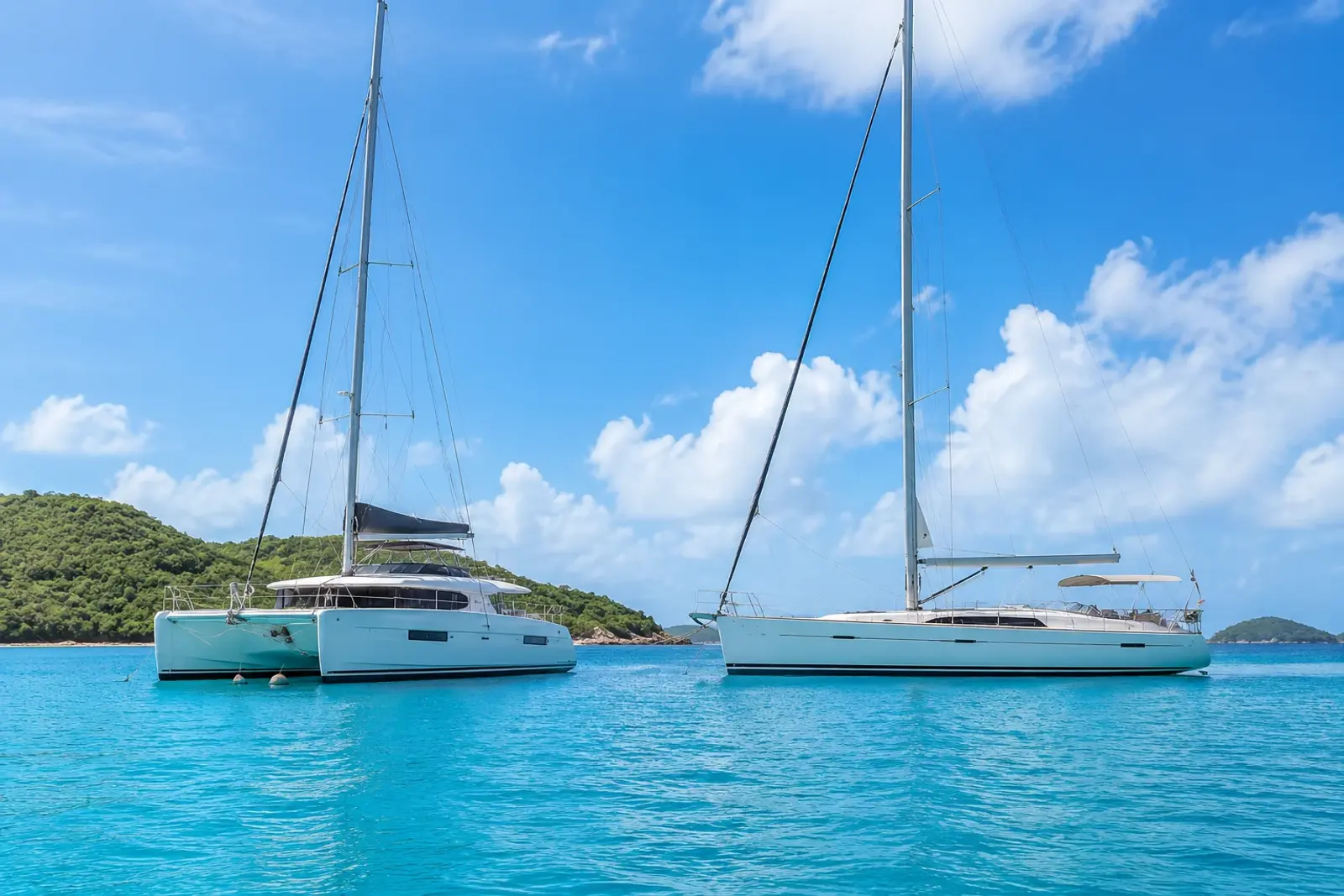
For commercial charter operations, catamarans typically offer higher guest capacity, greater comfort, and strong charter demand, while monohull sailing yachts may cost less to acquire and maintain. Catamarans generally deliver higher profitability for charter businesses, especially in popular destinations. That is the short answer to the commercial catamaran vs monohull question, but the longer answer depends on your operating model, target guests, and cruising ground.
The catamaran vs sailing yacht for charter decision is a financial and operational calculation that touches acquisition cost, annual operating expenses, achievable charter rates, occupancy, crew requirements, and resale value. A 40-foot catamaran costs roughly twice as much as a comparable monohull, yet it also commands higher weekly rates and attracts a broader bareboat market.
This guide breaks down each commercial factor so you can build a realistic financial model for your specific charter business.
Catamaran vs Sailing Yacht: Key Differences for Charter Businesses
| Feature | Catamaran | Monohull Sailing Yacht |
|---|---|---|
| Stability | High, less heel | Lower, more heel |
| Guest Capacity | Higher, more cabins | Lower, fewer cabins |
| Comfort (at sea) | Less motion, stable | More motion, can be exhilarating |
| Operating Costs | Higher (two engines, more systems) | Lower (one engine, simpler systems) |
| Draft | Shallow | Deep |
| Acquisition Cost | Higher | Lower |
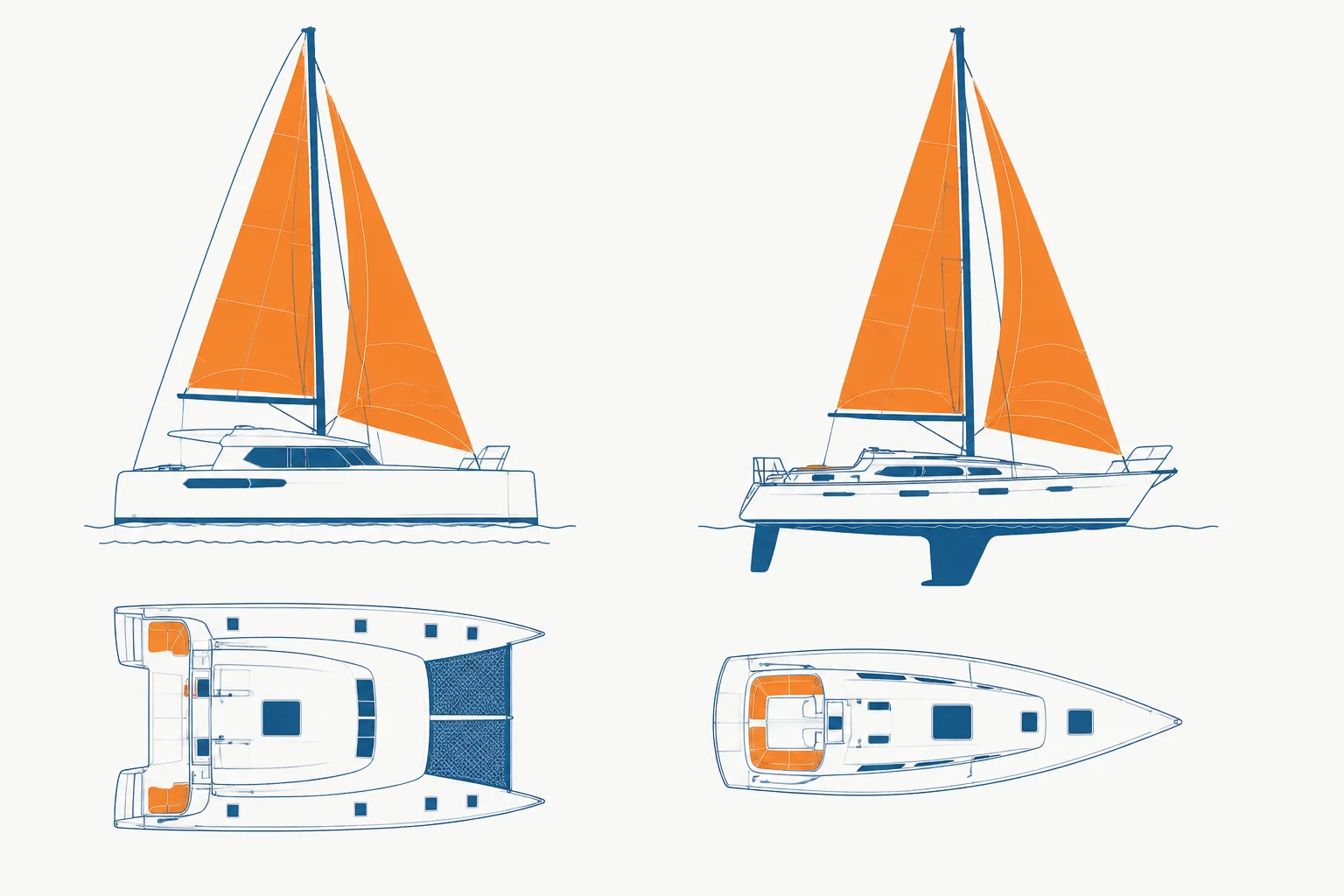
A catamaran is a twin-hull sailing vessel with two parallel hulls connected by a bridge deck, while a monohull sailing yacht has a single deep keel hull. That single structural difference drives nearly every commercial decision a charter operator makes, from purchase price to crew requirements to the guest experience on board.
The most immediate difference guests notice is stability. A catamaran's wide beam resists heeling, so it sails nearly flat, which virtually eliminates seasickness for most passengers. A monohull heels over when sailing upwind, offering a more dynamic feel that experienced sailors often prefer but some charter guests find uncomfortable.
Layout differences are equally stark. Catamarans spread living space across the bridge deck and both hulls, giving each cabin direct access to a private bathroom and generous salon space. Monohulls concentrate space in a single narrow hull, which typically means smaller cabins, fewer en-suite bathrooms, and a more intimate layout.
For commercial charters, these differences map directly onto market segments. Bareboat charters favor catamarans because their stability and space make them forgiving for less experienced skippers and appealing to families or groups. Skippered charters often work well on monohulls, where a professional crew handles the sailing and guests prioritize the classic sailing experience.
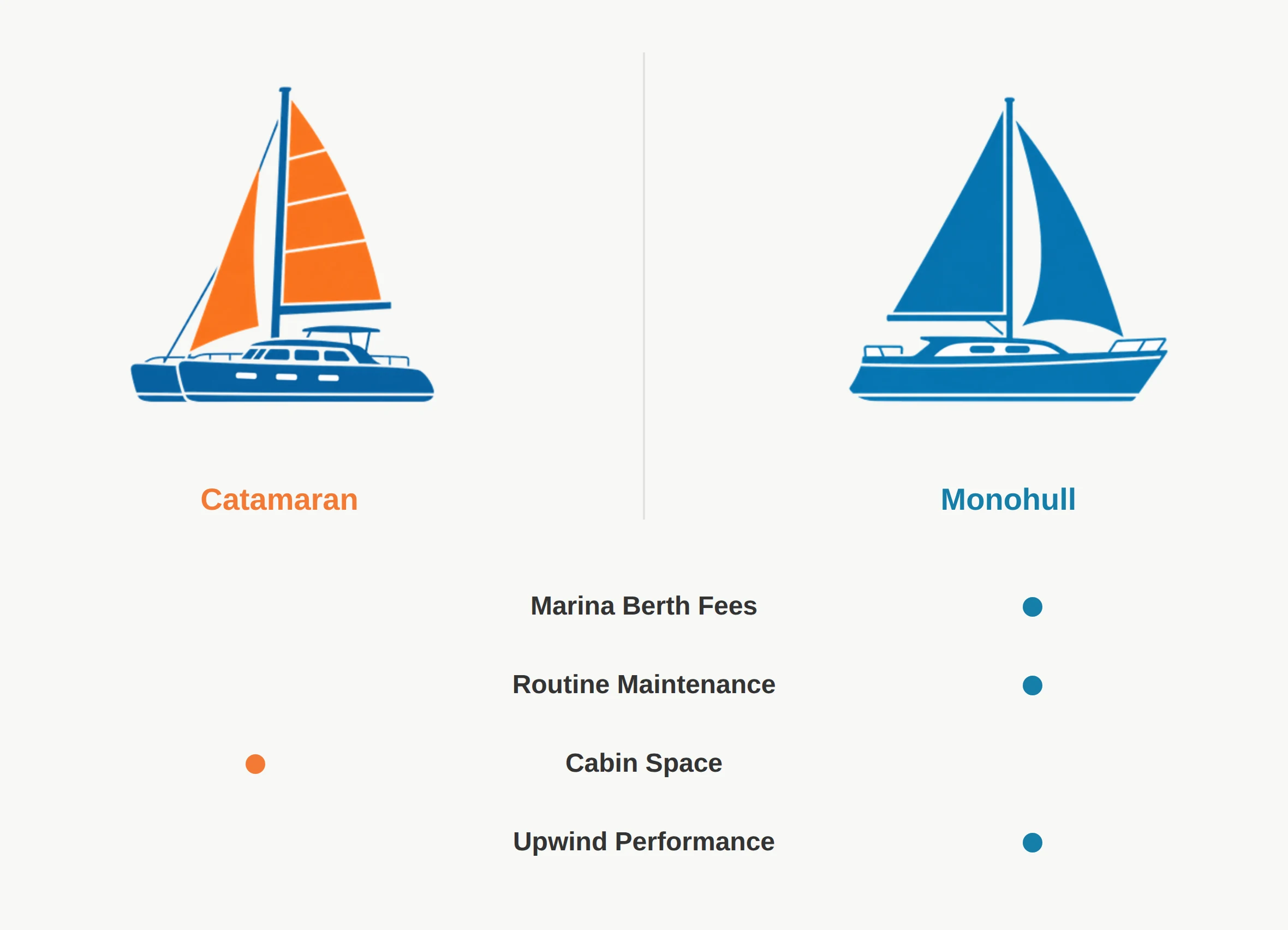
The commercial comparison comes down to revenue per booking versus operating cost. Catamarans command higher charter rates and attract a broader customer base, but they cost more to buy, maintain, and moor. Monohulls are cheaper to acquire and operate, with lower marina fees, but they appeal to a narrower, more sailing-focused clientele.
Profitability and Return on Investment: Which Yacht Type Wins?
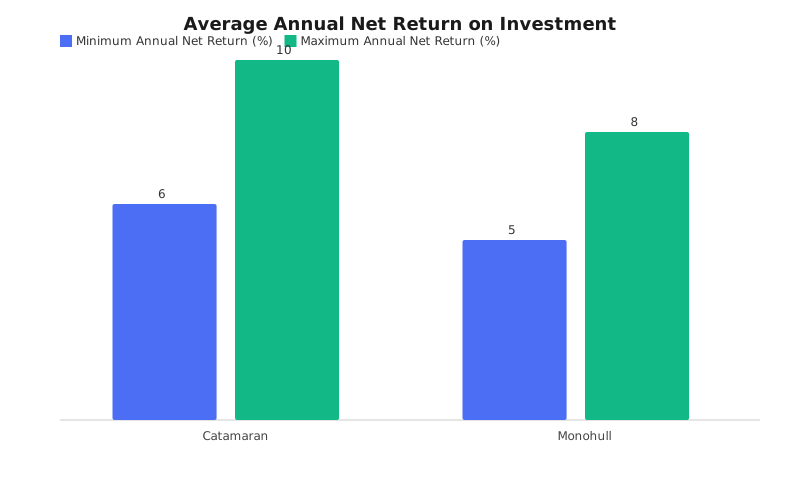
Catamarans generally win on gross charter revenue, but monohulls often win on return on investment because their lower acquisition and operating costs offset the income gap. The decisive metric is not the daily charter rate but the net yield after all running costs, which most owners calculate as a percentage of the purchase price.
The income gap is real. A 40-foot catamaran in the Caribbean can command $4,000 to $6,000 per week in high season, while a comparable monohull books at $2,500 to $4,000. Catamarans also hold higher occupancy rates, often 70 to 80 percent in peak regions, because their stability and space appeal to families and mixed-ability groups who book bareboat charters. Monohulls attract a narrower clientele, which can push occupancy down to 50 to 60 percent outside regatta weeks.
Expenses flip the picture. A new 40-foot catamaran costs roughly $400,000 to $600,000, while a similar monohull runs $200,000 to $350,000. Mooring fees, insurance, and maintenance scale with beam and length, so the catamaran's annual operating budget can run 30 to 50 percent higher. In a managed charter program, typical net returns land around 6 to 10 percent annually for a well-booked catamaran and 5 to 8 percent for a monohull.
Break-even timelines follow the same split. A monohull in a strong program can pay back in 8 to 12 years; a catamaran typically needs 10 to 15 years unless it books at premium rates in a high-demand region like the BVI or the Mediterranean in July and August. Seasonality is the lever owners control least: two months of peak charter rates can generate 40 percent of annual income, so a vessel that misses high season loses far more than its daily rate suggests.
For a commercial charter business, the "best" yacht depends on your market. If you can keep a catamaran booked in a premium destination, its gross revenue wins. If you want lower risk and a faster payback in a quieter market, the monohull's cheaper entry and operating costs make it the more profitable investment.
Operating Costs Breakdown: Catamaran vs Monohull
| Cost Category | Catamaran (45 ft) | Monohull (45 ft) |
|---|---|---|
| Fixed Costs | ||
| Marina Fees | $15,000 | $12,000 |
| Insurance | $8,000 | $6,000 |
| Loan Repayments | $25,000 | $20,000 |
| Management Fees | $10,000 | $8,000 |
| Licenses/Permits | $2,000 | $1,500 |
| Variable Costs | ||
| Fuel | $7,000 | $5,000 |
| Maintenance/Repairs | $12,000 | $9,000 |
| Haul Out/Antifoul | $4,000 | $3,000 |
| Provisions | $6,000 | $5,000 |
| Crew Salaries | $20,000 | $15,000 |
| Marketing/Booking | $5,000 | $4,000 |
| Total Annual Cost | $114,000 | $88,500 |
The largest single line item in a charter yacht's annual budget is maintenance, and catamarans carry the heavier load. Twin engines mean double the oil changes, impellers, filters, and servicing hours. A catamaran also has roughly 30% more wetted surface area than a comparable monohull, which accelerates bottom painting costs.
Haul-out costs compound the difference. A 40-foot catamaran has a beam of roughly 22 to 24 feet, which often requires a wider travel lift or a crane lift. Some yards cannot handle that beam at all, forcing operators to travel farther or pay premium rates. A monohull of the same length hauls out on a standard lift in most marinas.
Insurance is the second major divergence. Commercial yacht insurance premiums for catamarans typically run 20-40% higher than for an equivalent monohull, driven by higher hull value and greater windage in docking scenarios. Marina fees follow the same pattern, since most yards charge by length overall plus beam footprint, and a catamaran occupies more linear dock space than its LOA suggests.
Fuel efficiency favors the monohull under sail, but the gap narrows under power. A catamaran's twin engines burn roughly 15-25% more fuel at cruising speed than a single diesel on a monohull, though catamaran operators often motor less in port because their shallow draft allows closer anchoring.
Crew costs are comparable for skippered charters, since both platforms need the same captain and cook. Depreciation runs 4-6% annually on both, but the catamaran's higher purchase price means more absolute value lost each year.
Net profitability is the sum of these factors. A catamaran must clear roughly 30-50% more annual revenue than a monohull just to match its operating costs, so the occupancy advantage discussed earlier is not optional.
Guest Capacity, Comfort, and Experience: What Drives Charter Demand?
Guest capacity is the first commercial filter in the catamaran versus monohull decision. A typical 40-foot catamaran sleeps 8 to 10 guests across four or five double cabins, each with its own en-suite head. A comparable monohull carries 6 to 8 guests, usually with one or two shared bathrooms. That difference translates directly into revenue: more paying berths per charter week, and a layout that suits two families or a group of couples without forcing strangers to share facilities.
Comfort drives satisfaction, and satisfaction drives repeat bookings. A catamaran sails flat, with minimal heeling, which keeps seasickness down and makes movement around the boat safe for children and older guests. The bridge deck salon and cockpit create a single-level living space that feels like a floating apartment. Monohulls heel and move with the sea, which many experienced sailors enjoy but which narrows the market to guests who already know they like it.
The practical result is that catamarans dominate family charters, multi-generational trips, and event charters. Monohulls attract couples and seasoned sailors who prioritize performance over space. For a charter business, the catamaran advantages come from casting a wider net: the same boat can serve a family week, a corporate retreat, and a group of friends, keeping occupancy high across seasons.
Crew, Operations, and Maintenance: What to Expect as an Owner
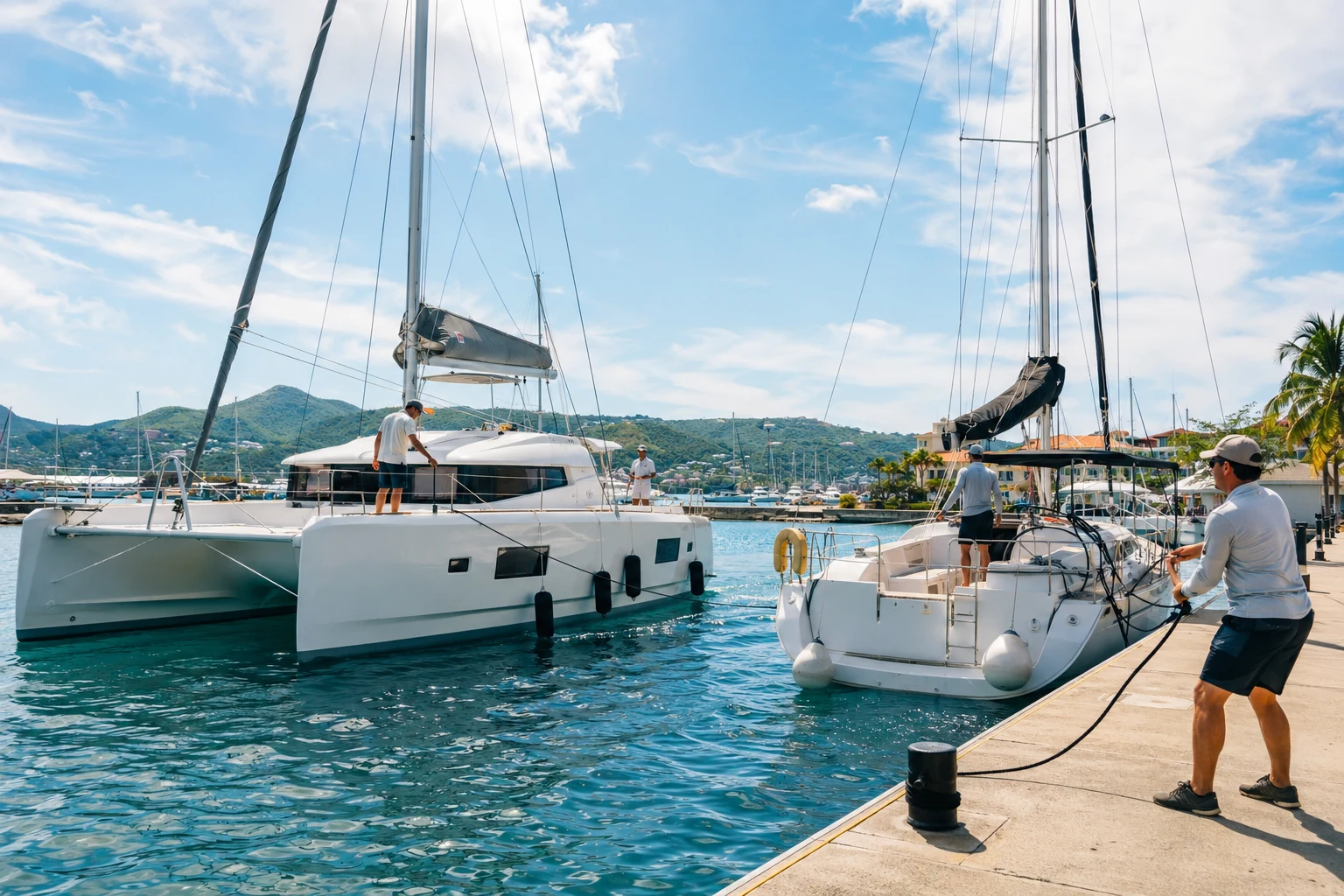
Crew requirements differ sharply between the two hull configurations. A catamaran needs a crew of two to handle the rig, docking, and guest services, though the twin engines make close-quarters maneuvering easier for a single competent skipper. A monohull of comparable size can be run by a couple, but the single-engine layout and deeper draft demand more precision when docking in tight marina berths.
Recruiting is easier for catamarans. The flat, stable platform appeals to a wider pool of charter crew, and the separate hulls give owner and guests genuine privacy. Monohull charters often require a skipper with stronger sailing credentials, which narrows the hiring pool and can push wages up.
Operational complexity favors the catamaran at the dock but penalizes it in the yard. Twin engines and bow thrusters make berthing forgiving, but the wide beam means finding a haul-out facility with an appropriately sized travel lift. Monohulls are simpler to haul, service, and store.
The yacht management company absorbs most day-to-day tasks for both types: booking, cleaning, crew payroll, and routine checks. Owners still carry the maintenance schedule, and on a catamaran that means servicing two engines, two saildrives, and roughly 30-50% more wetted surface.
Insurance, Licensing, and Tax: Navigating Commercial Charter Regulations
Commercial charter insurance costs more than private yacht insurance, and the gap is wider for catamarans. Insurers price catamarans 20-40% higher on premiums because of twin engines, greater beam, and higher replacement value. A commercial policy must cover paying passengers, which private coverage excludes; expect hull, liability, and loss-of-charter-income coverage bundled into the premium.
Licensing and registration requirements vary sharply by region. In the Mediterranean, a charter license (such as the French or Croatian commercial register) is mandatory, and the yacht must be flagged in the country where it operates. The US Virgin Islands and British Virgin Islands each have their own charter permit systems, with the BVI requiring a local operating license. Crew qualifications also differ: some jurisdictions accept an RYA Yachtmaster, others require a local commercial endorsement.
The single largest tax lever is the choice between private and commercial yacht registration. Commercial registration lets you depreciate the vessel and claim VAT, but it triggers stricter safety inspections and crewing rules. Private registration avoids those burdens but blocks charter income. In the EU, VAT treatment alone can shift your effective acquisition cost by 20% or more, so the registration decision should come before the purchase.
Depreciation is a straight-line write-down over the vessel's useful life, typically 10-20 years depending on the tax authority. Catamarans depreciate faster in absolute terms simply because they cost more; a $500,000 catamaran loses more annual value than a $300,000 monohull even at the same percentage rate. Working with a maritime accountant who knows charter-specific rules in your target region is worth the fee.
Resale Value and Long-Term Investment: Catamarans vs Monohulls
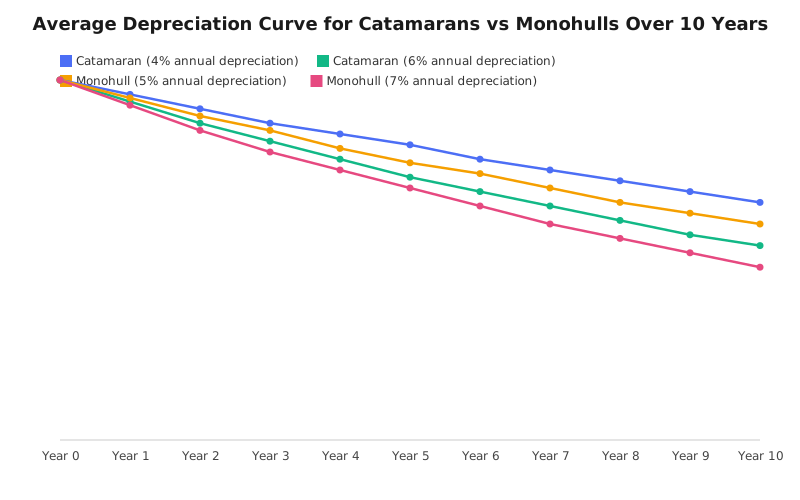
Catamarans hold their value better on a percentage basis, typically depreciating at 4-6% annually versus 5-7% for monohulls. The higher initial purchase price means a catamaran loses more absolute dollars each year, but the resale value reflects sustained demand from charter operators and private buyers alike.
Market demand favors catamarans for liquidity. A well-maintained charter catamaran sells faster because the same features that drive bookings—stability, space, and en-suite cabins—attract the widest pool of secondhand buyers. Monohulls have a narrower market, though performance cruisers and classic designs retain loyal followings.
Charter use accelerates depreciation for both hull types. High guest turnover, twin engine hours, and cosmetic wear from bareboat renters reduce resale value unless the owner keeps meticulous maintenance records. A charter yacht with documented service history and recent refits can command near-private pricing; one without records raises buyer skepticism.
For tax purposes, commercial registration lets owners claim depreciation as a business expense, which improves after-tax returns even when resale values soften. The real long-term investment question is whether the higher acquisition cost of a catamaran pays off through stronger occupancy and resale demand, or whether a monohull's lower entry point and faster break-even delivers better cash-on-cash returns.
Choosing the Right Yacht for Your Charter Business: Key Decision Factors
The decision between a catamaran and a monohull comes down to five factors: guest profile, destination, seasonality, budget, and operating model.
Guest profile is the starting point. If your target market is families, mixed-ability groups, or guests who want stability and private cabins, a catamaran is the best yacht for commercial charter in that niche. If you are marketing to experienced sailors who want a dynamic sailing experience, a monohull matches the product.
Destination and seasonality determine occupancy, which is the variable that decides profitability. A catamaran needs to hold over 65% occupancy to outperform a monohull's return on investment. In high-demand regions with long seasons, that is achievable. In quieter markets, the lower acquisition cost of a monohull makes it the safer commercial bet.
Budget covers more than the purchase price. Factor in financing terms, insurance, mooring, and maintenance. A 40ft monohull at $200k-$350k carries 30-50% lower operating costs than a comparable catamaran, which shortens the break-even timeline by several years.
Define your operating model before you buy. Bareboat fleets favor catamarans for their space and ease of handling. Skippered charters can work with either, but monohulls appeal to clients who prioritize the sailing experience over comfort.
Run a financial model on your specific cruising area before committing. Compare realistic occupancy, charter rates, and operating costs for both hull types at your destination. That model, not preference, should drive the purchase decision.
Frequently Asked Questions
Which is more profitable for commercial charter, a catamaran or a sailing yacht?
Catamarans generally command higher charter rates and carry more guests, increasing overall revenue potential. Monohulls may have lower acquisition and operating costs, but catamarans typically offer better ROI in high-demand charter areas. The higher daily rate multiplied by more guest berths often outweighs the lower cost structure of a monohull.
What are the main operational cost differences between a commercial catamaran and a monohull?
Catamarans often have higher maintenance, insurance, and marina fees due to their size and twin engines. Monohulls are usually less expensive to dock, maintain, and haul out but may earn less per charter. Twin engines mean twice the servicing, and a wider beam often means a premium for marina berths.
How does guest capacity impact the revenue of a charter catamaran versus a sailing yacht?
Catamarans accommodate more guests per charter, enabling higher per-trip income and better utilization for group bookings. A typical charter catamaran sleeps 8 to 12 guests, while a similar-length monohull sleeps 4 to 6. That higher guest capacity can offset increased operating costs and boost overall charter profitability.
What are the insurance implications for commercial catamarans compared to sailing yachts?
Commercial catamarans tend to have higher premiums due to higher asset values and passenger capacity. Insurers may require additional safety equipment and crew qualifications for catamarans, including more life rafts and specific stability documentation. Monohulls generally carry lower premiums, but the coverage scope still depends on operation area and crew experience.
Is it easier to find crew for a commercial catamaran or a sailing yacht?
Both require qualified crew, but catamarans may appeal to crew seeking more comfort and space. Crew demand is generally higher for catamarans in busy charter hubs, which can push up salaries. A monohull charter may be easier to crew with a single experienced skipper plus a host.
Are catamarans better in rough seas than monohulls?
Catamarans provide excellent stability in moderate seas but may struggle with large, steep waves compared to deep-keeled monohulls. A monohull's ballasted keel and narrower beam handle big swells with a more predictable motion. The best choice depends on typical operating conditions and intended itineraries.
How does the resale value of commercial catamarans compare to sailing yachts?
Catamarans currently hold their value better in popular charter markets due to strong demand. Monohulls may depreciate faster, but market conditions and maintenance quality are the key factors for both. A well-maintained monohull from a respected builder can still retain strong resale value.
What permits and licenses are required for commercial yacht charter operations?
Requirements vary by country and region, typically including commercial registration, safety inspections, and crew licensing. Catamarans and monohulls must both comply with local maritime law, but catamarans may face additional scrutiny for passenger capacity. Expect a commercial endorsement, a stability test, and a coded survey before operation.
Can a 40 foot catamaran cross the Atlantic?
Yes, many 40-foot catamarans are designed and equipped for transatlantic crossings with proper preparation. Charter-focused catamarans may need additional modifications for ocean passages, including extra fuel capacity, watermaker, and storm sails. The right hull design and experienced crew matter more than size alone.
The numbers do not point to a universal winner. A catamaran only beats a monohull on return when sustained occupancy clears roughly 65%, a threshold that depends entirely on your cruising ground, guest profile, and realistic charter rates. Before committing capital, build a five-year model with local marina fees, insurance quotes, and haul-out costs, not brochure numbers.
Run that model against 60%, 70%, and 80% occupancy scenarios for both hull types. If your destination reliably fills beds, the catamaran's higher gross revenue wins. If occupancy is uncertain, the monohull's lower break-even protects you. Let the spreadsheet, not the showroom, make the call.