Replace an anchor chain when corrosion, wear, cracks, deformation, or damaged galvanizing has reduced its strength or prevents it from running correctly through the windlass. There is no universal replacement age. Inspect the full chain regularly, measure questionable links, and replace it before a damaged section becomes a failure point.
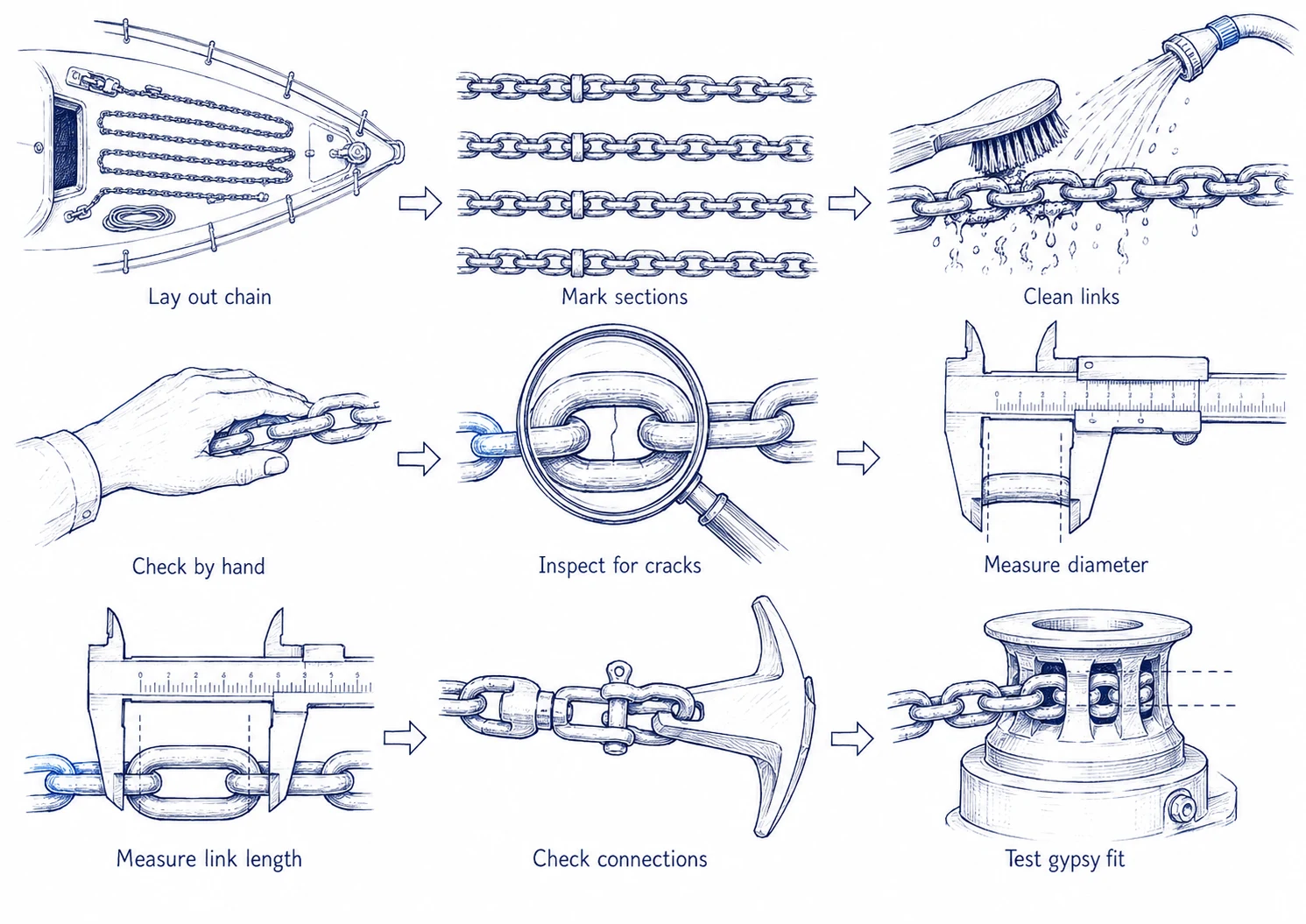
Signs Your Anchor Chain Needs Replacement
Deep corrosion and pitting
Light surface discoloration does not always mean a chain is unsafe. Deep corrosion is more serious. Flaking rust, scaling, and crater-like pits indicate that the protective zinc coating has failed and the underlying steel is deteriorating.
Pitting reduces the amount of sound metal in a link. It also creates stress concentrations where cracks can begin. Pay particular attention to the inside bends of links, where water and debris can collect and loads are concentrated.
Clean suspicious areas before making a decision. Salt deposits and dried mud can hide the true condition of the steel.
Worn or flattened links
Chain links wear where they rub against neighboring links, the bow roller, the windlass gypsy, and the seabed. Wear often appears as flat spots or grooves on the inside of a link.
Use calipers to compare the diameter of a worn area with an unworn section or the chain manufacturer's original specification. A reduction of about 10 percent is commonly treated as a serious warning, but the chain and windlass manufacturers' limits should take priority.
Wear is often concentrated near the anchor end because this section passes over the bow roller and gypsy during almost every anchoring cycle. Inspect at least the first 15 to 25 feet carefully, but do not assume the remaining chain is undamaged.
Bent, stretched, or twisted links
A link that is bent, twisted, or visibly elongated may have been overloaded. Damaged links can carry loads unevenly and may no longer fit the windlass gypsy correctly.
Compare questionable links with undamaged links from farther along the rode. Replace the affected section if the link shape has changed or the chain binds, jumps, or rides out of the gypsy.
Links that have fused together or show signs of heat damage require immediate replacement. Heat can change the properties of the steel even when the damage appears localized.
Cracks
Any visible crack is grounds for immediate replacement of the affected chain or section. Cracks commonly begin near the inside bend of a link, where stress is highest.
Inspect under strong light. A magnifying glass can help identify fine lines after the chain has been cleaned. Do not continue using a link that may be cracked while waiting to see whether the mark becomes larger.
Damaged galvanizing
Hot-dip galvanizing protects steel by placing a sacrificial zinc layer over it. The coating gradually wears away through abrasion and exposure to salt water.
A dull or uneven surface is not automatically unsafe. Replacement or regalvanizing should be considered when large areas of bare steel are exposed, corrosion continues after cleaning, or the chain has developed extensive pitting.
Poor windlass engagement
A chain that no longer seats fully inside the gypsy pockets may be worn, stretched, or incompatible with the gypsy. Warning signs include skipping, jumping, unusual vibration, and links climbing out of the pockets during retrieval.
Stop using the windlass under load until the cause is identified. The problem may be the chain, a worn gypsy, incorrect chain calibration, or a combination of these issues.
How to Inspect an Anchor Chain
Lay out the entire rode
Pull the full chain out of the locker at least once per season and after any severe loading event. Lay it out where every link can be reached and viewed from several angles.
Do not inspect only the anchor end. Sections stored deep inside the locker may suffer from trapped moisture, poor drainage, or hidden corrosion.
Use existing depth marks to divide the rode into manageable sections. Replace faded paint or damaged cable-tie markers during the inspection.
Clean before inspecting
Rinse the chain with fresh water and remove mud, salt, and loose corrosion. Use a wire brush carefully on suspicious areas so the steel surface becomes visible.
Avoid aggressive grinding that removes sound metal or makes a damaged link appear smoother than it is.
Inspect every link by sight and touch
View each section from several angles. Look for:
- Pitting, scaling, or flaking corrosion
- Flat spots and grooves
- Cracks near the inside bends
- Bent, twisted, or elongated links
- Damaged welds
- Areas of exposed steel
- Links that do not move freely
Run a gloved hand along the chain. Sharp edges, rough pits, and changes in link shape may be easier to feel than to see.
Measure worn sections
Use calipers to measure the wire diameter at the most worn point. Take a second measurement on an unworn part of the same link or on a sound link of the same chain.
Measure several links rather than relying on one reading. Record the smallest measurement and its position along the rode.
You can also measure the inside length and width of several links. Compare the results with the manufacturer's dimensions. A group of links that has become longer may indicate permanent stretching or wear at the contact points.
Inspect the anchor connection
Check every component between the chain and anchor, including:
- Swivel
- Shackle body
- Shackle pin
- Seizing wire or locking system
- Anchor shank connection point
- Terminal chain links
The swivel should rotate freely without excessive play. Shackle pins should be straight, secure, and protected against loosening. Replace components with bent pins, elongated holes, severe wear, cracks, or significant corrosion.
Make sure the selected shackle or connector is compatible with the chain size and has a suitable working load rating. A weak connector can reduce the strength of the complete anchoring system.
Test the chain in the windlass
After completing the visual inspection, run the chain slowly through the windlass without a heavy anchor load. Confirm that each link settles fully into the gypsy pockets and exits cleanly.
Watch for jumping, slipping, binding, or unusual noise. Test several sections, including the most frequently used part of the rode.
Never place fingers near the moving gypsy, chain, or wildcat. Use the windlass controls from a safe position and stop immediately if the chain jams.
Keep an inspection record
Record the inspection date, chain size, observed damage, measurements, and the position of each problem area. Photos taken from the same angle can help show whether corrosion or wear is progressing.
A written record is more useful than relying on the chain's age alone. It can reveal which sections wear fastest and whether inspection intervals should be shortened.
Choosing a Replacement Chain
Match the windlass gypsy
The replacement chain must match the exact size and link profile required by the windlass gypsy. Chains with the same nominal diameter can have different inside lengths, widths, and link shapes.
A gypsy made for one calibrated chain may not grip another chain correctly, even when both are labeled with the same diameter. Check the windlass manual or the markings on the gypsy before ordering.
When the original specification is unavailable, measure several unworn links and ask the windlass manufacturer or a marine supplier to confirm compatibility. A physical test sample is preferable to assuming that a nominal size will fit.
Select the correct chain grade
Chain grade describes the material strength and manufacturing standard. Common marine options include Grade 30 proof coil, Grade 40 high-test chain, Grade 43 chain, and short-link chains designed for specific windlasses.
Higher-grade chain can provide greater strength for the same diameter, but it is not automatically compatible with every gypsy. Choose a chain that meets all three requirements:
- Adequate working load for the boat and anchoring conditions
- Correct physical dimensions for the windlass
- Suitable corrosion protection for marine use
Do not choose chain grade by name alone. Standards and markings can differ between regions and manufacturers.
Choose an appropriate diameter
Chain diameter should be selected using the boat builder's guidance, anchor manufacturer's recommendation, windlass capacity, and expected anchoring conditions.
Undersized chain reduces the safety margin. Oversized chain adds weight in the bow and may not fit the windlass, bow roller, chain pipe, or locker.
The complete anchoring system should be considered together. The anchor, chain, rope, shackles, swivel, windlass, deck installation, and attachment point must all be suitable for the expected load.
Prefer certified calibrated chain
For a windlass installation, use calibrated chain made to a recognized standard and supplied with clear dimensional and strength information. Calibration means the links are manufactured within controlled dimensional tolerances so they engage correctly with a matching gypsy.
Ask the supplier for the chain standard, grade, working load limit, proof-test information, link dimensions, and coating type. Avoid unmarked chain with unknown strength or origin for a primary anchoring system.
Compare galvanized and stainless steel chain
Hot-dip galvanized steel is the standard choice for many cruising boats. It provides good strength, broad availability, and a replaceable sacrificial zinc coating. Its service life depends heavily on use, abrasion, water salinity, locker drainage, and coating quality.
Stainless steel offers a clean appearance and good corrosion resistance when the correct alloy and manufacturing quality are used. It is more expensive and is not immune to crevice corrosion, galling, or hidden damage in low-oxygen areas. Stainless chain should still be inspected regularly, especially inside the locker and at link contact points.
Do not mix metals without considering galvanic compatibility. Ask a qualified marine supplier about suitable connectors and isolation methods for the specific chain, anchor, and operating environment.
Confirm that the chain fits the boat
Before buying a full-length replacement, confirm that a sample passes through the complete chain system. Check its fit in:
- Windlass gypsy
- Bow roller
- Chain stopper
- Hawsepipe or deck opening
- Chain locker
- Anchor connector
The chain should enter the locker without piling up under the pipe. A new chain that forms a taller pile than the old one may require more locker depth or manual leveling.
Decide whether to replace a section or the full chain
A localized damaged section can sometimes be removed and replaced, but every new connection introduces another component that must be inspected and must fit through the windlass and bow hardware.
Replacing the complete chain is usually the simpler option when:
- Damage appears in several areas
- The remaining galvanizing is widely depleted
- The chain's grade or origin is unknown
- The chain no longer fits the gypsy consistently
- Multiple links are stretched or heavily worn
- Reliable connectors cannot pass through the windlass system
Consult the chain or windlass manufacturer before creating an in-line splice in an all-chain rode.
Care That Extends Chain Life
Rinse after saltwater use
Wash the chain with fresh water as it comes aboard. This removes salt, mud, sand, and organic material that retain moisture and accelerate corrosion.
A deck hose or washdown pump positioned near the bow makes regular rinsing easier. Continue rinsing until the water entering the locker is mostly clear.
Improve locker drainage and ventilation
The chain locker should drain freely and allow wet chain to dry. Clear blocked drains and check that water cannot remain trapped beneath the chain pile.
Ventilation can reduce condensation and drying time. Inspect locker surfaces and fittings for rust stains, leaks, and standing water.
Avoid leaving the chain packed with mud
Mud can remain wet for long periods and may create localized corrosion. If the chain comes aboard heavily coated, rinse it before it settles into the locker.
Periodically empty the locker and remove accumulated sand, rust flakes, cable-tie fragments, and other debris.
Reduce unnecessary shock loading
Use suitable anchoring technique and adequate scope so the system absorbs changing loads gradually. A properly selected nylon snubber can reduce shock loads on an all-chain rode, the windlass, and deck fittings.
The windlass should not be used as the primary load-bearing point while anchored. Transfer the load to a suitable chain stopper, cleat arrangement, or snubber system designed for the boat.
Protect the chain during storage
For seasonal storage, rinse and dry the chain before leaving it unused. A marine corrosion inhibitor may be suitable if it is compatible with the chain coating and windlass.
Avoid heavy coatings that collect abrasive dirt, make inspection difficult, or interfere with gypsy engagement. Follow the product and windlass manufacturers' instructions.
FAQ
How long does an anchor chain last?
There is no fixed replacement interval. Chain life depends on frequency of use, bottom conditions, water salinity, galvanizing quality, locker drainage, windlass alignment, and maintenance.
A lightly used chain stored dry may remain serviceable for many years. A newer chain exposed to frequent anchoring, abrasive seabeds, poor drainage, or heavy loading may wear out much sooner. Base replacement decisions on inspection and measurement rather than age alone.
Can a rusty anchor chain still be safe?
Light surface rust may be cosmetic, especially where the zinc coating has been scratched. Deep pitting, flaking scale, reduced link diameter, and corrosion inside link bends are more serious.
Clean and measure rusty areas. Replace the affected section when corrosion has removed a significant amount of metal, created deep pits, or made the link's condition difficult to judge with confidence.
Is 10 percent chain wear an automatic replacement limit?
A 10 percent reduction in diameter is a commonly used warning threshold, but it is not a universal rule for every chain. Follow the limits supplied by the chain, windlass, boat, or classification authority when available.
Replace the chain earlier when wear is uneven, pits are deep, cracks are present, links are deformed, or the chain no longer engages the gypsy correctly.
Which part of an anchor chain wears fastest?
The anchor-end section often wears fastest because it repeatedly passes over the bow roller and windlass and may drag across the seabed. The section near the normal anchoring depth can also receive repeated wear.
The chain stored at the bottom of a wet locker may corrode faster even when it is rarely deployed. Inspect the entire rode rather than only the first few feet.
Can anchor chain be regalvanized?
Some structurally sound chains can be cleaned and hot-dip galvanized again. The chain should be inspected before treatment because a new zinc coating can hide existing pits, cracks, or excessive wear.
Ask the galvanizing company whether it handles marine chain and how the process may affect chain markings, dimensions, and windlass compatibility. Severely worn, stretched, cracked, or deeply pitted chain should be replaced rather than recoated.
Can I replace only the first section of chain?
It may be possible when damage is clearly localized and the remaining chain is in good condition. The connection between old and new chain must have adequate strength, resist loosening, and pass safely through the boat's hardware if required.
In-line connectors may not fit a windlass gypsy. Check with the windlass and chain manufacturers before joining sections.
How do I know which chain fits my windlass?
Check the windlass manual, gypsy markings, or manufacturer specifications for the required chain standard and dimensions. Nominal diameter alone is not enough.
Confirm the wire diameter, inside link length, inside width, and chain standard. Test a sample in the gypsy before buying the complete rode whenever possible.
Should I replace the windlass gypsy with the chain?
Not automatically. Inspect the gypsy pockets for rounding, grooves, cracks, and uneven wear. A worn gypsy may slip even with new chain and can quickly damage it.
Replace the gypsy when it is outside the manufacturer's wear limits or when the correct new chain does not seat securely. Changing chain size or profile usually requires a matching gypsy.
Is stainless steel anchor chain better than galvanized chain?
Stainless steel is not automatically better for every boat. It offers good corrosion resistance and a clean appearance, but it costs more and can develop crevice corrosion or galling under certain conditions.
Hot-dip galvanized chain is widely used because it provides a practical balance of strength, cost, and corrosion protection. The better choice depends on the windlass, budget, inspection routine, and operating environment.
Should an anchor swivel be replaced with the chain?
Inspect the swivel separately. Replace it if it has cracks, bent parts, excessive play, seized movement, severe corrosion, elongated holes, or an inadequate load rating.
A serviceable swivel does not always need replacement with the chain, but its dimensions and strength must remain compatible with the new chain and anchor connection.
What should I do after the chain experiences a severe shock load?
Lay out and inspect the entire chain as soon as practical. Look for stretched links, bent links, cracks, damaged connectors, and changes in gypsy engagement.
Also inspect the anchor, swivel, shackles, bow roller, windlass mounting, chain stopper, snubber, cleats, and attachment points. Replace any component with uncertain structural condition.
Can I determine chain strength from its appearance?
No. Chains of similar size can have different grades, standards, and working load limits. Surface appearance does not confirm material strength or manufacturing quality.
Use chain markings, purchase records, manufacturer documentation, or supplier certification. Replace unmarked chain of unknown origin when its strength cannot be verified for the intended anchoring system.
How often should I inspect an anchor chain?
Perform a basic visual check whenever the chain is retrieved. Complete a full inspection at least once per season and before a long passage or extended cruise.
Inspect it sooner after grounding the chain on rock, experiencing severe weather at anchor, overloading the windlass, or noticing slipping, jumping, or unusual noise during retrieval.