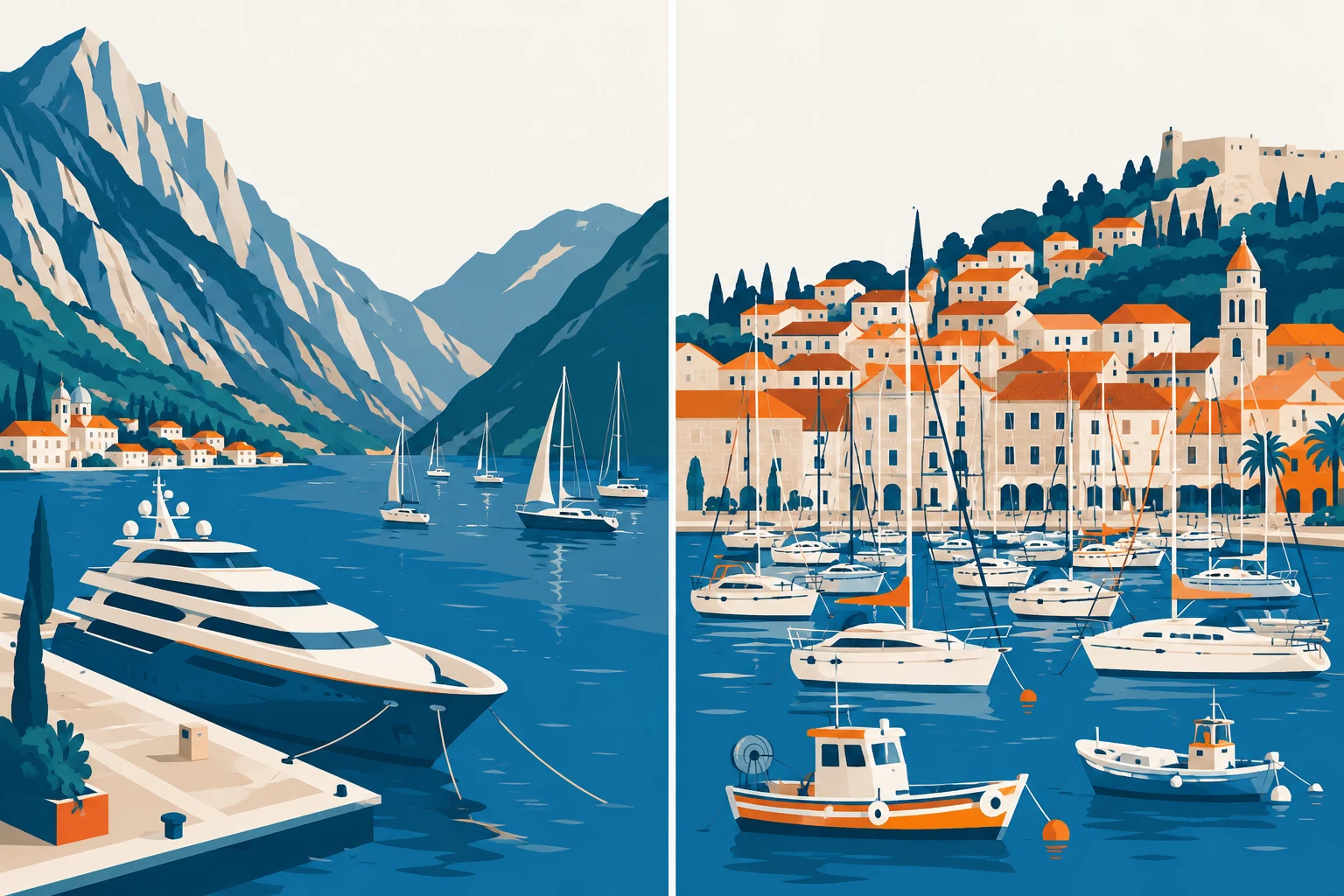
Choosing between a Montenegro vs Croatia yacht charter depends on your sailing style: Croatia offers extensive island-hopping and vibrant towns, while Montenegro delivers dramatic fjord-like scenery and luxury marinas in a compact cruising area. Both offer excellent sailing, but experiences, costs, and regulations differ.
The Croatia vs Montenegro yachting decision comes down to how you want to spend your time on the water. Croatia spreads its attractions across a thousand islands, rewarding sailors who enjoy covering miles between destinations. Montenegro concentrates its highlights into a tight loop around Boka Bay and the coast, where short passages leave more time for anchoring, swimming, and exploring.
Your budget matters too. Montenegro generally undercuts Croatia on charter prices, marina fees, and provisioning. Croatia counters with a far larger charter fleet and more base options.
Montenegro vs Croatia Yacht Charter: At a Glance
| Feature | Montenegro | Croatia |
|---|---|---|
| Coast Length | Smaller area | Larger scale |
| Number of Islands | Fewer (focused on Boka Bay, Budva Riviera) | Over a thousand |
| Marina Density | Smaller fleet, newer, higher standard | Far larger fleet, more bases |
| Typical Routes | Concentrated scenery, Boka Bay, Budva | Endless island-hopping, Dalmatian Coast |
| Charter Types | Bareboat, Crewed (smaller fleet) | Bareboat, Crewed (more options) |
| Cost (General) | Generally cheaper | Higher in July/August |
Croatia wins on sheer scale and variety, Montenegro wins on drama and value. Both sail the same Adriatic Sea, but they deliver different experiences.
Croatia offers over a thousand islands along the Dalmatian Coast, with a new anchorage, town, or cove around every headland. Montenegro compresses that magic into a smaller area, anchored by the fjord-like Boka Bay and the open water around the Budva Riviera.
Croatia's charter fleet is far larger, with more bases, more boat options, and more supply of bareboat yachts in peak season. Montenegro's fleet is smaller but newer, and its marinas, especially Porto Montenegro, are built to a higher standard. Montenegro generally comes in cheaper on berthing, provisioning, and boat prices, while Croatia's popularity pushes costs up in July and August.
Both destinations share the same sailing conditions. The Adriatic offers reliable summer thermal winds, predictable sea states, and manageable distances between ports. Neither is technically difficult, but each rewards different priorities: Croatia for endless island-hopping, Montenegro for concentrated scenery and lower costs.
Sailing Experiences: What Sets Each Destination Apart?
In Montenegro, the passages are short and the scenery is immediate. You can sail from the historic walls of Kotor to the open Adriatic in a morning, with the mountains of the Boka Bay yacht charter route rising straight from the water.
Croatia is built on distance and discovery. The Dalmatian coast yachting experience lets you set a course for a different island every day for two weeks and still not cover the full arch of the 1,000-plus islands. The routes between the Kornati, Hvar, and Korčula are long, which rewards planning and a willingness to let the wind do the work.
Croatia's anchorages are busy, social, and full of variety, with a different island bar or historic town around every headland. Montenegro's scene is more concentrated, split between the glamour of Porto Montenegro and the raw beauty of the Bay of Kotor's bends.
Best Sailing Routes and Itineraries
A classic Dubrovnik yacht charter round-trip runs south to the Elafiti Islands and Mljet, then back through the Pelješac Channel. For a longer voyage, a one-way itinerary from Split to Dubrovnik covers Hvar, Vis, and Korčula, though you will pay a one-way repositioning fee.
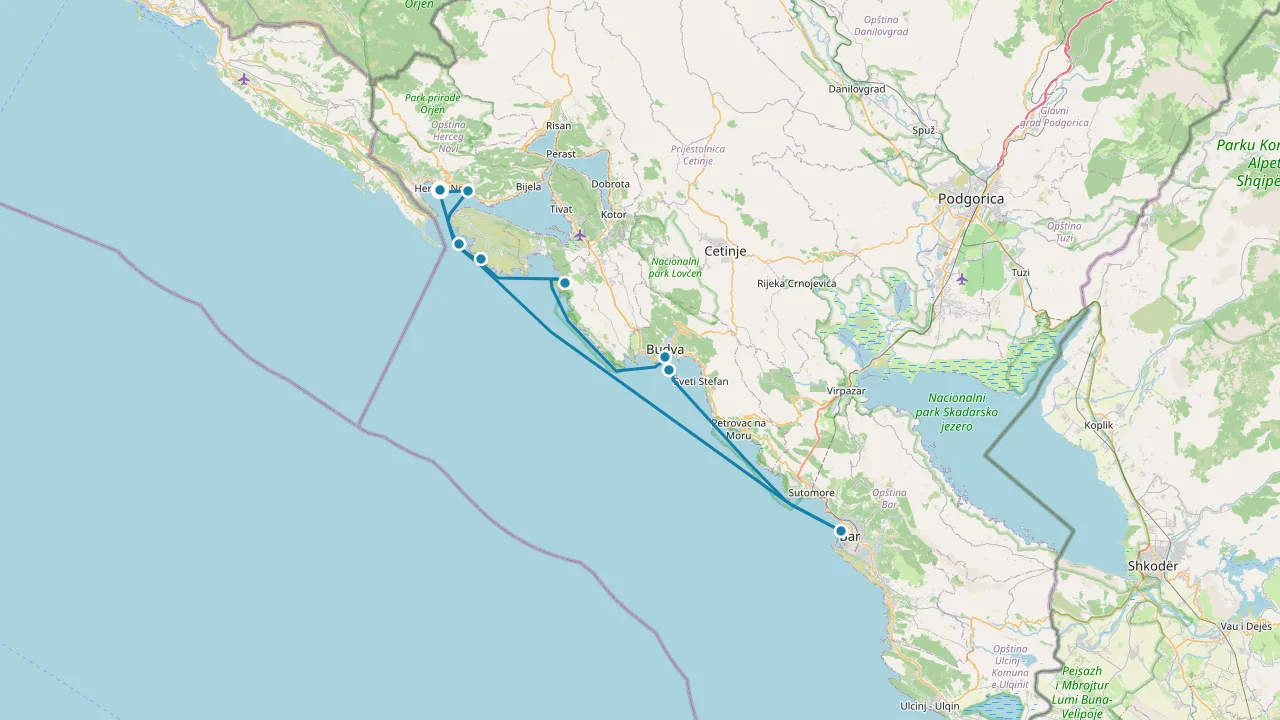
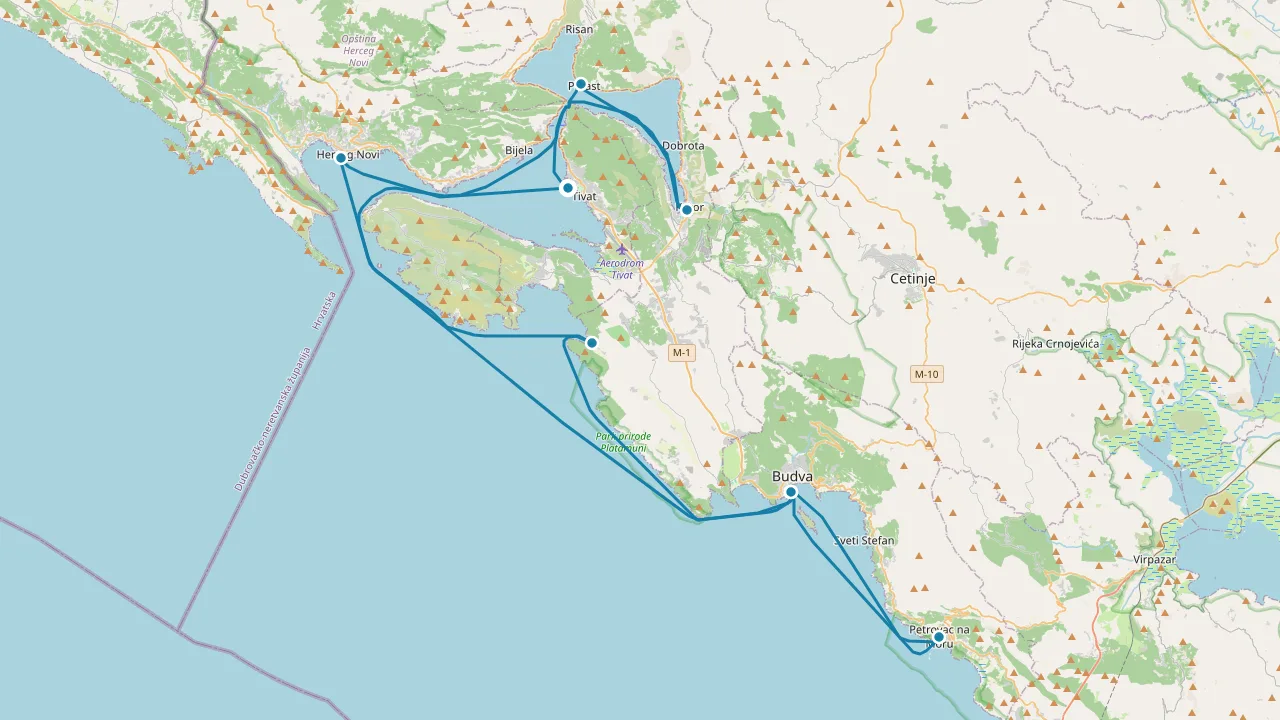
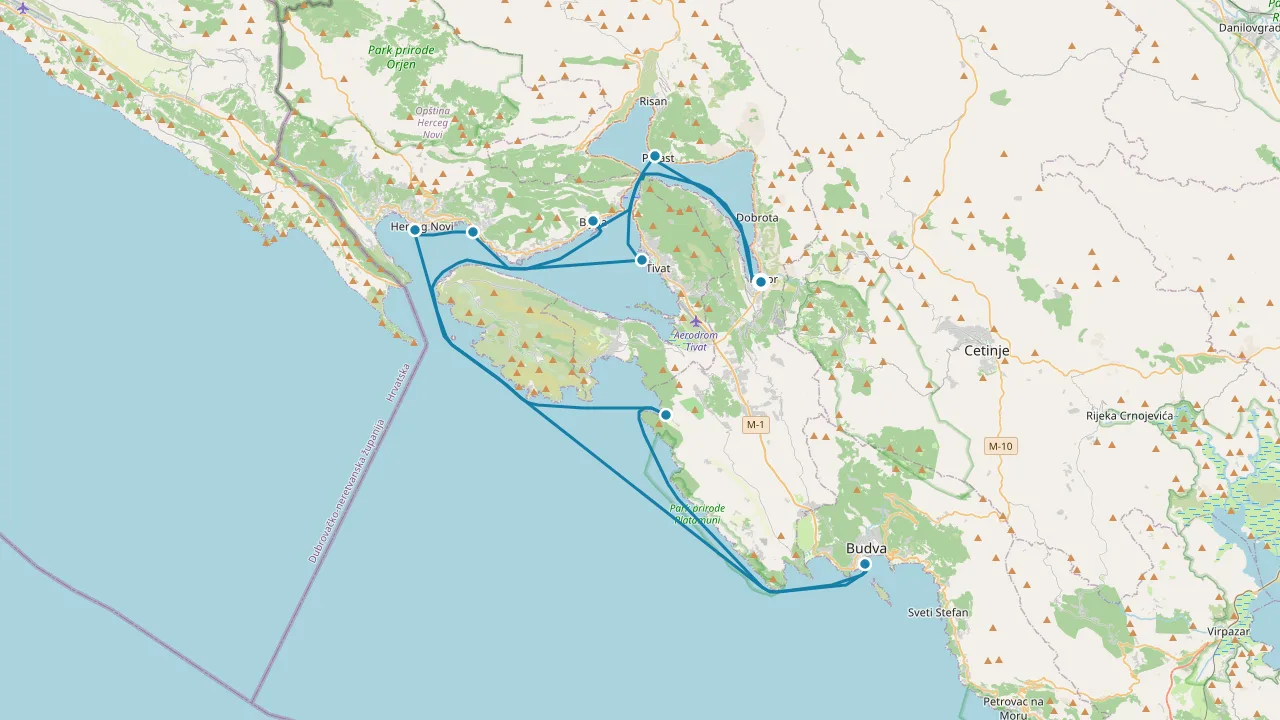
A Kotor yacht charter often starts with a Boka Bay loop, sailing from Kotor to Perast, then out to the open sea for a day at Herceg Novi before returning. A round-trip from Tivat reaches Budva, Sveti Stefan, and Bar in a single relaxed week.
Montenegro's highlights sit close together, so you can anchor for lunch and still make port by evening. Croatia rewards a longer itinerary with more islands, but demands longer passages between them.
Cost Comparison: Charter Prices, Fees, and Value
| Feature | Montenegro | Croatia |
|---|---|---|
| Bareboat Charter (40ft Monohull, July) | 2,200-3,000 EUR/week | 2,500-3,500 EUR/week |
| Skippered Charter (Skipper Fee) | 150-200 EUR/day (boat rate cheaper) | 150-200 EUR/day (boat rate higher) |
| VAT on Charter Fees | 7% | 13% |
| Marina Fees (40ft, Summer) | 40-60 EUR (e.g., Porto Montenegro, Kotor) | 60-100 EUR (e.g., Split, Hvar) |
| High Season Pricing | Shorter peak, shallower discounts | Steeper swings, July/August inflated |
| Shoulder Season Discount | Shallower | Deeper (e.g., 3,000 EUR to 1,600 EUR) |
| Mandatory Extras (Typical) | More bundled into advertised rate | Often 200-400 EUR additional |
| Yacht Age/Quality | Skews newer (2-3 years old common) | Older (5-6 years old common) |
| Fleet Size/Choice | Smaller, newer operators | Larger, more choice |
| Overall Value | Higher, especially for bareboat | Good choice, but less value per euro |
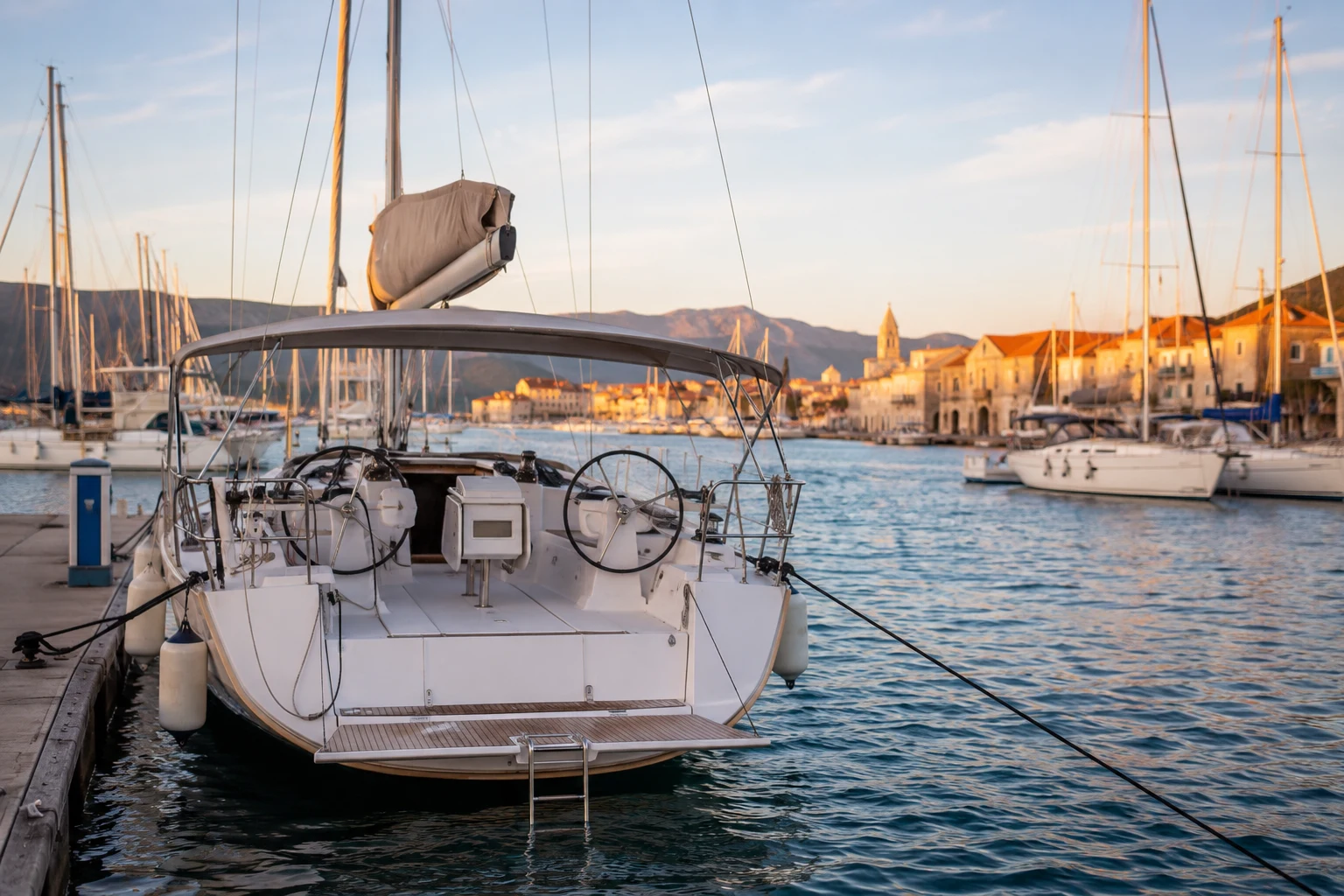
Bareboat charter costs in Montenegro run roughly 10-15% lower than equivalent boats in Croatia. For a standard 40-foot monohull in July, expect to pay around 2,500-3,500 EUR per week from a Croatian base like Split or Dubrovnik, versus 2,200-3,000 EUR from Tivat or Kotor in Montenegro. Skippered charters follow the same pattern, with skipper fees of 150-200 EUR per day in both countries, but the base boat rate stays cheaper in Montenegro.
VAT is the main structural difference. Montenegro applies a 7% VAT on charter fees, while Croatia charges 13%. Marina fees also favor Montenegro: a 40-foot boat berthing overnight in Porto Montenegro or Kotor costs roughly 40-60 EUR, compared to 60-100 EUR in a popular Croatian marina like Split or Hvar during summer.
Seasonal price swings are steeper in Croatia. A boat that costs 3,000 EUR in August can drop to 1,600 EUR in May or October, whereas Montenegro's high season runs shorter and its shoulder-season discounts are shallower.
Yacht quality skews newer in Montenegro because its charter industry expanded recently, so you often get a 2-3 year old boat for less than a 5-6 year old equivalent in Croatia. Croatia's larger fleet means more choice in boat type and base location, but the value per euro sits with Montenegro.
Marinas, Facilities, and Sailing Infrastructure
Montenegro's flagship, Porto Montenegro in Tivat, is a superyacht-standard marina with excellent shore power, fuel, chandlery, and modern washrooms. Kotor's old-town quay and the smaller marinas around Boka Bay offer charm but fewer services. In Croatia, Split, Hvar, and Dubrovnik marinas are numerous and well-equipped, yet many operate at high occupancy during July and August, making berth availability tight without a reservation.
Croatia wins on sheer choice: dozens of marinas spread across its islands mean you are rarely far from a fuel dock or a repair yard. Montenegro concentrates its facilities in a smaller radius, which shortens logistics but limits options if you need specialized parts or services. The key difference is booking flexibility: Croatia's demand pushes many marinas to require advance reservations in peak season, while Montenegro's lower occupancy allows more spontaneous berthing.
Montenegro's newer infrastructure often feels more polished. The practical takeaway: Croatia offers breadth and availability across a wider cruising ground, while Montenegro delivers higher-end facilities at a lower price, particularly at Porto Montenegro.
Yacht Charter Regulations and Entry Requirements
| Feature | Croatia | Montenegro |
|---|---|---|
| Skipper License | ICC or National License | ICC or National License (more flexible) |
| Crew Requirement | At least 2 for most monohulls/catamarans | At least 2 for most monohulls/catamarans |
| Passport Validity | 3 months beyond stay (non-EU) | 3 months beyond stay (non-EU) |
| EU Citizen Entry | ID Card | ID Card |
| Visa Rules | Schengen 90/180-day rule | 90 days visa-free (most nationalities) |
| Cross-Border Out | Clear out at Croatian port | Clear out at Montenegrin port |
| Cross-Border In | Charter contract, VHF, Croatian VAT proof | Clear in at Montenegrin port (e.g., Zelenika) |
| Transit Log Deposit | €1,000–€2,000 (typical) | €1,000–€2,000 (typical) |
| Tourist Tax | Daily, per person (usually included) | Daily, per person (lower rates) |
| Insurance | Third-party liability | Third-party liability, Hull insurance |
Both Croatia and Montenegro require a valid passport and proof of boat insurance for any yacht charter. EU citizens can enter either country with just an ID card, while non-EU nationals need a passport valid for at least three months beyond their stay.
Bareboat charter licenses are mandatory in both countries. Croatia accepts the ICC (International Certificate of Competence) or a national license, and you need at least two crew members for most monohulls and catamarans. Montenegro applies the same rules, but authorities there are slightly more flexible with recognized national licenses.
Visa rules differ significantly. Croatia, as an EU member, follows the Schengen 90/180-day rule. Montenegro, though not EU, grants most visitors 90 days visa-free, and entering Montenegro does not count against your Schengen days.
Cross-border charter procedures are the main paperwork difference. Sailing from Croatia to Montenegro requires clearing out at a Croatian port, then clearing in at a Montenegrin port like Zelenika or Bar. This adds roughly half a day of formalities each way. The reverse trip into Croatia is stricter: you must have your charter contract, VHF license, and proof of paid Croatian VAT.
Transit logs and fees apply in both countries. Croatia charges a daily tourist tax per person, usually included in your charter price. Montenegro uses a similar system but with lower daily rates. A required deposit, typically €1,000–€2,000, covers the transit log and potential damage.
Insurance requirements are non-negotiable. Both countries mandate third-party liability coverage, and Montenegro requires proof of hull insurance before issuing a transit log. Most charter companies include this, but verify your policy covers cross-border sailing if you plan to island-hop between the two.
When to Charter: Sailing Seasons and Weather
The peak sailing season in the Adriatic runs from May through September, with July and August delivering the hottest, calmest, and most crowded conditions in both countries. Shoulder months offer a better balance of pleasant weather and fewer crowds.
In summer, the reliable Meltemi, or "Maestral" as it's known locally, blows from the northwest, providing steady afternoon winds of 15-25 knots. While generally consistent, summer storms, known as "neveras," can build quickly, especially in July and August.
Croatia's popularity means its anchorages and marinas are packed in July and August, requiring advance bookings. Montenegro experiences the same summer weather but with less congestion. The shoulder months of May, June, and September are ideal for those seeking a balance, with fewer crowds, pleasant temperatures, and more reasonable prices.
Luxury, Comfort, and Charter Types: What to Expect
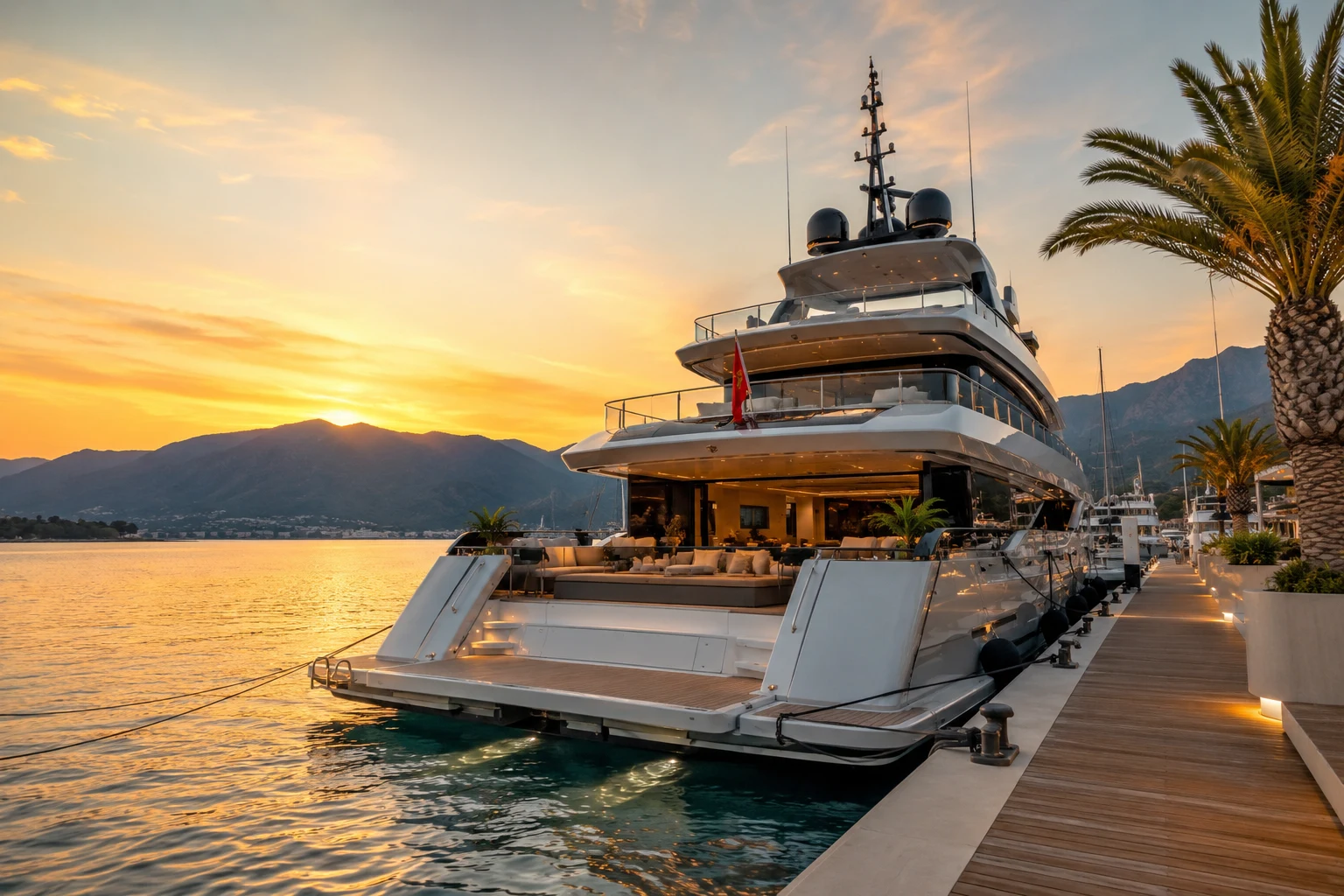
Montenegro's charter fleet is noticeably newer, and its marinas, particularly Porto Montenegro, set a higher standard for onshore luxury. Croatia compensates with sheer variety: more bases, more boats, and more choices across every price bracket.
Both destinations offer bareboat, skippered, and fully crewed charters. A bareboat charter suits experienced sailors who want independence; skippered charters add local knowledge for navigating Boka Bay's tight corners or Croatia's crowded anchorages. Crewed charters, with a skipper and host or chef, are the most comfortable option in both, though Montenegro's smaller fleet means crewed boats book out early in peak season.
The onboard experience differs mainly in age and condition. Montenegro's newer catamarans and monohulls often include modern amenities like generator-backed air conditioning, electric winches, and upgraded galleys as standard. Croatian boats vary more, so check the inventory year and what extras the base charges for before booking.
Service culture also differs. Croatian charter companies are seasoned and efficient, but mandatory extras like final cleaning, dinghy hire, and outboard engines commonly add 200-400 EUR to the advertised price. Montenegro's operators tend to bundle more into the quote, which makes their published rates look closer to the final cost.
Hidden Gems and Unique Attractions for Sailors
Montenegro's hidden gems sit close together. The Blue Cave near Herceg Novi rewards an early-morning visit before the tour boats arrive, and the shallow-draft anchorages of the Luštica Peninsula offer quiet swimming spots that the main routes skip entirely. Croatia's off-the-beaten-path treasures, like the uninhabited island of Biševo with its Blue Grotto or the remote coves of Lastovo, demand longer passages but repay the effort with near-empty anchorages.
Local food distinguishes the two. Montenegro's konobas around Boka Bay serve fresh mussels from the bay itself and cured pršut from Njeguši, a village in the mountains above Kotor. Croatian islands each carry their own culinary identity, from Vis's famous Pogi bread to the lamb and olive oil of Šolta. In both countries, the best meals come from small family taverns away from the main harbors.
For nature, Montenegro's Boka Bay delivers drama that Croatia cannot match: the bay's fjord-like walls rise steeply from the water, and a morning sail out of Kotor feels like leaving a mountain amphitheater. Croatia's nature is more diffuse, with national parks like Kornati and Mljet offering protected cruising grounds where the sailing itself is the attraction.
In Montenegro, a spontaneous detour to a hidden cove costs an hour. In Croatia, the distances between gems are longer, so route planning matters more.
Can You Combine Montenegro and Croatia in One Charter?
Yes, you can combine both countries in a single sailing itinerary, though it requires planning around customs formalities. A cross-border yacht charter means clearing customs in each country, which adds roughly half a day of paperwork per crossing. You will need a transit log, valid passports, boat insurance, and a bareboat charter license (ICC or national equivalent).
The practical route runs from Dubrovnik south to the Bay of Kotor, or vice versa. A common Montenegro Croatia sailing itinerary spans 10 to 14 days: start in Tivat or Kotor, explore Boka Bay, then cross to Dubrovnik and work your way up the Dalmatian coast to Korčula and Hvar before returning.
Pros of combining: you get Montenegro's dramatic fjord-like scenery and Croatia's island density in one trip. Cons: customs fees, extra paperwork, and the risk of weather delays at border crossings. Most charter companies allow one-way trips between bases, but confirm this before booking, as repositioning fees can run 200-500 EUR.
Frequently Asked Questions
Where is cheaper for yacht charter, Montenegro or Croatia?
Montenegro generally offers lower VAT (7% versus Croatia's 13%) and cheaper marina fees, which makes it the better value for luxury charters. Croatia has a wider range of budget sailing yachts, particularly older boats in shoulder season, which can reduce total costs for some travelers. Compare the all-in price, not just the headline rate.
Which country offers better sailing conditions for yachts?
Croatia's Adriatic coast has more steady summer breezes and a wide variety of sailing routes across its island archipelago. Montenegro's Boka Bay is sheltered and ideal for relaxed, scenic cruising, while its open sea conditions match Croatia's but cover a smaller area. Neither is technically difficult; the choice depends on whether you want long passages or short, dramatic hops.
What are the main attractions for yachting in Montenegro compared to Croatia?
Montenegro features dramatic mountain backdrops, the UNESCO-listed Bay of Kotor, and modern luxury marinas like Porto Montenegro. Croatia offers historic cities, extensive islands, and vibrant nightlife in places like Hvar and Split. Montenegro delivers concentrated scenery; Croatia delivers variety and scale across a thousand-plus islands.
Are there any visa requirements for yacht charter in Montenegro or Croatia?
EU and US citizens can enter both countries visa-free for short stays. Croatia follows the Schengen 90/180-day rule, while Montenegro grants most visitors 90 days without counting against Schengen days. Crossing the maritime border requires customs clearance in both directions and proper yacht documentation, including a transit log and insurance.
Can I charter a yacht in Croatia and sail to Montenegro?
Yes, but you must follow international check-in and check-out procedures at ports in both countries, which adds roughly half a day of formalities per crossing. Ensure your charter company allows cross-border trips and that your insurance covers it. Some itineraries start in Dubrovnik and end in Tivat or Kotor, or vice versa, often with a one-way repositioning fee.
Why are there so many yachts in Montenegro?
Montenegro's favorable tax regime, new luxury marinas, and strategic location attract both private and charter yachts. Porto Montenegro in Tivat is a superyacht-standard facility that draws vessels from across the Mediterranean. The country also serves as a gateway to the Adriatic and is less crowded than Croatia's hotspots, making it an appealing base for a sailing week.
The right choice comes down to how you want to spend your time on the water. Pick Croatia if you want a long, varied island-hopping itinerary with a huge choice of boats and bases, and you do not mind covering miles between anchorages. Pick Montenegro if you want shorter passages, newer yachts, lower costs, and a more dramatic, concentrated cruising ground centered on Boka Bay.
For a first charter, Montenegro is the easier, more forgiving introduction. For an experienced crew, Croatia's scale and variety reward the extra miles. Either way, book May, June, or September to avoid the July and August crowds, and confirm whether your charter includes the mandatory extras before you compare prices.
Explore next
Destination guide
Montenegro
Sail Montenegro's Adriatic coast, where deep fjord-like bays meet open sea. Base yourself at Porto Montenegro or Marina Budva and explore the Bay of Kotor's fortified towns.